


LONDON: Disbelief. That was the reaction of Saudi general Prince Khalid bin Sultan when he answered the telephone at his home near Riyadh in the early hours of Aug. 2, 1990, and learnt that Iraq had invaded Kuwait.
The general had been entertaining friends at a barbecue, and they were still sipping coffee when the phone rang.
“War was the farthest thing from my mind,” Prince Khalid recalled in an article he wrote in 1993. “Arabs may disagree, but they don’t usually invade each other.”
The prince’s disbelief was shared by the rest of the world.

Now, 35 years on, the avalanche of consequences triggered by Iraq’s unprovoked invasion of its tiny southern neighbor continues to reverberate — in Kuwait and the entire region.
In a surprise pre-dawn attack, hundreds of Iraqi tanks and tens of thousands of troops, backed by helicopters and fighter aircraft, began pouring over the border.
As a postwar report by the US Pentagon would later put it, “despite individual acts of bravery,” the heavily outnumbered Kuwaiti forces “were hopelessly outmatched.”
By 4 a.m., Iraqi troops were at the gates of Dasman Palace in the heart of Kuwait City. Emir Jaber Al-Ahmad Al-Sabah and most of his family were evacuated just in time, seeking sanctuary in Saudi Arabia, but his younger brother, Sheikh Fahad, was among those who died in defense of the palace.

General Khalid bin Sultan bin Abdul Aziz, chief of the Saudi Armed Forces in the Desert Storm and Desert Shield campaigns during Iraq's invasion of Kuwait in 1990, speaks during a press conference in Riyadh on Feb. 25, 1991. (AFP)
Isolated units of the Kuwaiti army fought a series of running battles before withdrawing to regroup over the Saudi border. Hundreds were killed.
Pilots of the small Kuwaiti air force downed at least 20 helicopters ferrying Iraqi troops over the border before their bases were overrun.
Many Kuwaitis fled the country, most seeking sanctuary in neighboring Saudi Arabia. Those who were unable to escape faced an ordeal of looting, arrests and executions during an occupation that would last seven months.

Picture taken on August 9, 1990 in Egypian port of Nuweiba showing Egyptian workers arriving after leaving Kuwait amid an invasion by the Iraqi army. (AFP)
A cable to Washington from US diplomats in Saudi Arabia on Nov. 22, 1990, reported that the invasion “and subsequent Iraqi brutalities in Kuwait literally drove Kuwait into Saudi Arabia.
“Thousands of refugees and the bulk of Kuwait’s government arrived on the scene in need of support and sustenance. The Saudis were and remain generous with both.”
Kuwait was liberated on Feb. 27, 1991, by the forces of a multinational US-led coalition which had been assembled in Saudi Arabia. Iraq, previously an ally, had massed tanks on the border and fired Scud missiles at targets in the Kingdom. Just two days before the Iraqis were routed from Kuwait, one of these missiles killed 28 US personnel at a base in Dharan.

US and Saudi soldiers pass under road signs showing the way towards Kuwait city on February 26, 1991, as allied forces moved towards the liberation of the capital. (AFP/ file photo)
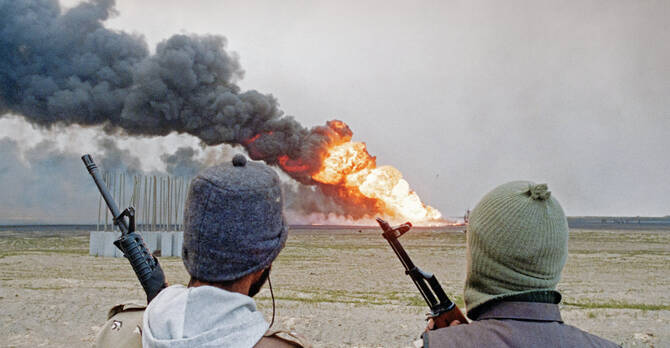
As they retreated, Iraqi forces set fire to hundreds of Kuwait’s oil wells. Thousands of Saddam Hussein’s soldiers died as they fled back to Iraq, their vehicles repeatedly attacked by coalition aircraft on Highway 80.
“Iraq’s invasion of Kuwait, while garnering a historically united response from the international community, ironically also marked the beginning of regional disunity, distrust, and fragmentation,” said Caroline Rose, a defense and security director at the New Lines Institute for Strategy and Policy in Washington.

An oil refinery, set alight by Iraqi troops, continues to burn and plunges area into pitch black darkness in the south of Kuwait city on March 1, 1991. (AFP)
“The invasion incited new levels of wariness between Gulf states and their regional neighbors as Kuwait’s location and rich oil reserves had become a vulnerability, rather than a strength, that had motivated Iraq to invade.
“This promoted a ‘this could happen to us’ mentality among Gulf states, marking moves to increase defense ties with security guarantors such as the US.”
READ MORE:
• Analysis: How Iran reaped the rewards of Saddam’s 1990 Kuwait invasion
• Thirty years ago, Iraq invaded Kuwait
• Saddam Hussein ‘acted like Hitler’ during Kuwait invasion, former UK PM Thatcher said
The invasion of Kuwait, and the resulting international intervention, she said, “also marked a sharp downward trend in political, economic and social stability in Iraq, later opening up the country for Iranian influence and campaigns to widen the sectarian divide in both Iraq and the Levant at large.”
Sir John Jenkins, former British ambassador to Saudi Arabia, Iraq and Syria, agreed that the invasion and its aftermath “certainly encouraged Iran, and helped Tehran build on its successes in the 1980s in creating out of dissident exiled Iraqi Shiites the nucleus of a militia — the Badr Brigade — which ultimately helped to secure the victory of the Shiite Islamist bloc after 2003.”
There were other geopolitical upheavals. When Kuwait was liberated, “the expulsion of most Palestinians resident there, in retaliation for PLO chairman Yasser Arafat’s major error in supporting Saddam, resulted in an influx into Jordan, which raised Amman property prices and also made Jordanian Palestinians more radical.”

Picture taken on August 27, 1990 at Ruwaished, at Iraqi-Jordan border, showing a traffic jam due to thousands of people fleeing Kuwait and Iraq twenty-five days after the invasion of Kuwait by the Iraqi army. (AFP)
Perhaps most importantly, in the aftermath of the invasion “the passing at the UN in New York of a set of punitive resolutions imposing on Iraq requirements for compensation and redress and intrusive inspections of its weapons programs led to a breakdown of consensus within the UN Security Council, the food-for-oil scandal, and ultimately the discrediting of the UN as the last resort on issues of international peace and security.”
That, said Sir John, “is one reason US President George W. Bush thought he should go it alone in 2003.”
The fact that coalition forces stopped 240 kilometers short of Baghdad in 1991, choosing to leave Saddam Hussein in power, has remained controversial.

Photo taken March 5, 1991 of a convoy of US Army tanks driving down the road from Kuwait towards Dhahran in the Saudi desert as US troops begin their withdrawal from Kuwait. (AFP)
But in 2003, in the wake of the Sept. 11, 2001, attacks on the US, and under the pretext of searching for weapons of mass destruction, a US-led coalition returned to Iraq to finish the job, costing 300,000 Iraqi and US lives in the course of an invasion, occupation and subsequent insurgency that would last for years.
There were other far-reaching consequences of Iraq’s attack on Kuwait. In leading ultimately to the demise of Saddam Hussein, “it destroyed the last real champion of pan-Arabism, creating more space for radical Islamists,” said Sir John.

A reproduction of a picture displayed at the Nasr or Victory Museum in Baghdad shows Iraqi President Saddam Hussein (L) visiting Iraqi troops at a military camp in occupied territory in Kuwait after the August 2, 1990 invasion of the Gulf emirate. (AFP)
But it is for Kuwaitis that the echoes of invasion are loudest.
“To be a formerly occupied country is to be in quite a unique position,” said Bader Mousa Al-Saif, an assistant professor of history at Kuwait University and an associate fellow on the Middle East and North Africa program at UK policy institute Chatham House.
“It has left Kuwait trapped in a combination of denial and survival mode, preventing a return to normalcy.
“We haven’t really sat down as a people to talk through what we went through — the traumas, the losses, and how we can move on.”
This failure to find national closure “has led to a lot of displaced energy in other spaces, such as rising crime and drug taking,” while an understandable focus on security has stalled Kuwait’s momentum.
“Our geography hasn’t changed,” said Al-Saif, who served as deputy chief of staff to a former prime minister of Kuwait.

Saudi Arabian soldiers stand guard in front of Iraqi prisoners on February 25, 1991 in Kuwait as Allied forces claim to have taken nearly 20,000 prisoners. (AFP)
“We’re still a small country surrounded by larger neighbors and keeping that all in check has, in a way, halted our own development.
“If your mind is focused on survival, you’re not going to be able to push forward, in the way that the other Gulf states have pushed themselves forward.”
For many Kuwaitis, the largest unhealed wound is the fate of its “martyrs,” — the 308 people who, after 35 years, remain missing, presumed dead.
“Kuwait continues to fly the flag for these people — not only Kuwaiti nationals but also those from other countries who disappeared,” said Al-Saif.
After the war, the fate of more than 600 people, mainly civilians, was unknown. Some remains, found in mass graves in Iraq and identified by their DNA, have been returned, “but we cannot claim this chapter is fully closed until we can bring some relief to those 308 families that are still seeking answers and want to honor and safeguard their loved ones by burying them properly.”

Kuwaitis watch as the coffins of nineteen Kuwaiti prisoners of war (POWs) whose remains were recently found in a mass grave in Iraq and identified following DNA tests, are carried by honor guards during a funeral procession at a cemetaery in Kuwait City on November 21, 2021. (AFP)
The Iraqi government, said Al-Saif, “has been working to support this, which is why we have recovered the remains of some people, but this work needs to continue. And while Kuwait does not doubt the sincerity, due diligence and hard efforts of Iraq, it is pushing for more speed and agility in this matter.”
There is also the issue of Kuwait’s national archives, stolen during the invasion, the fate of which remains even less clear.
“The archive remains missing, and we haven’t received any information about it. A few things have been returned, but much of the fabric of the country’s heritage and memories remains lost, and this also needs to be resolved,” said Al-Saif.

Kuwaiti former prisoners of war (RtoL) Nasser Salmeen, Abdulwahad al-Nafah and Abdullah al-Awadhi shows theirs faces on a picture taken during their captivity in an Iraqi prison on August 2, 2015 in Kuwait City at the Kuwait House for National Works Museum. (AFP)
For the past 35 years, he added, “Kuwait has been striving for normalcy,” a quest frustrated in part by the ongoing uncertainty over its maritime borders.
“As an aspiring responsible nation which abides by the rules-based international order, having fixed borders is the least that you can demand, and we haven’t been able to settle the maritime boundary between Iraq and Kuwait for the past 20 years,” he said.
Ever since 2005, when the first government of Iraq was elected in the wake of the US occupation, Kuwait has been working to resolve this unsettling issue.

Kuwaitis visit the Martyr's Museum at the Martyr's Office headquarters in Kuwait City on August 2, 2022, on the 32nd anniversary of the 1990 Iraqi invasion of Kuwait. (AFP)
“But we’re at a standstill,” said Al-Saif. “Committees have come and gone but there hasn’t been any closure on this, which isn’t good for either country.”
The issue centers on the Khor Abdullah, the narrow waterway shared between the two countries for about 50 kilometers before it enters the Arabian Gulf.
There has been a long-running dispute over the precise location of the maritime boundary beyond the mouth of the waterway, an issue which — as highlighted by an analysis by the International Crisis Group, co-authored by Al-Saif and published last month — has been exploited by Iraqi politicians “seemingly hoping to boost their own electoral fortunes.”

Such rabble rousing seems to be working. A meeting in Kuwait City on July 17 of the Joint Kuwaiti-Iraqi Technical and Legal Committee provoked outcry in Iraq, with politicians claiming that access to Iraq’s new Grand Faw Port was under threat, along with Iraqi sovereignty.
Meanwhile, said Al-Saif, the uncertainty would undermine the confidence of investors and industry over the viability of both the Grand Faw Port in Iraq and Kuwait’s Mubarak Al-Kabeer Port, both currently under construction barely miles apart on opposite banks near the mouth of the Khor Abdullah.
He concluded: “This needs to be sorted out for the sake of all concerned. Unfortunately, the Kuwait card is being played in Iraq to draw attention away from domestic issues there.”


