

Israel ‘using thirst as a weapon to kill Palestinians’ in Gaza, UN experts say

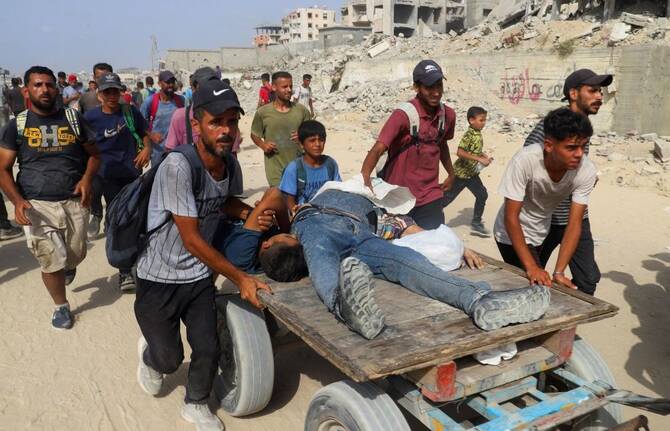
Palestinians wounded by Israeli fire are transported on a cart, as others carry aid supplies, Beit Lahia, northern Gaza Strip, July 29, 2025. (Reuters)
Short Url
Updated 29 July 2025
Follow

Israel ‘using thirst as a weapon to kill Palestinians’ in Gaza, UN experts say

  • ‘Cutting off water and food is a silent but lethal bomb that kills mostly children and babies,’ they warn
  • As summer temperatures soar and hygiene conditions deteriorate rapidly, fatalities from dehydration are increasing and outbreaks of waterborne diseases are spreading

NEW YORK CITY: A group of UN human rights experts on Monday accused Israeli authorities of deliberately depriving Palestinians in Gaza of access to clean drinking water. They described this alleged action as a grave violation of international law and a potential crime against humanity.

“Israel is using thirst as a weapon to kill Palestinians,” the experts said. “Cutting off water and food is a silent but lethal bomb that kills mostly children and babies.”

The independent experts, who are appointed by the UN Human Rights Council, said that water and sanitation systems in Gaza have been systematically targeted throughout the Israel’s ongoing military campaign.

Since the conflict began in October 2023, Israeli forces have destroyed or severely damaged wells, pipelines, desalination plants and sewage networks. According to the UN, nearly 90 percent of the territory’s water infrastructure is no longer functional, leaving more than 90 percent of the population without reliable access to safe water supplies.

As summer temperatures soar and hygiene conditions deteriorate rapidly, fatalities from dehydration are increasing and outbreaks of waterborne disease are spreading. Most of the 2 million residents of Gaza have been displaced, with many of them forced to drink contaminated water and live without even basic sanitation.

“This catastrophe was not only predictable, it was predicted,” the UN experts said. “The deliberate denial of water and essential supplies is part of a pattern of collective punishment and may amount to extermination under international law.”

The experts referred to an advisory opinion issued by the International Court of Justice in July 2024, which reaffirmed Israel’s obligations as an occupying power to ensure civilians are able to access adequate supplies of food and water.

Instead, the experts noted, Israeli authorities have further reduced the already limited flow of emergency water deliveries, and continue to block essential shipments of fuel required to power desalination and sanitation systems.

The UN Relief and Works Agency, the main humanitarian agency in Gaza, has warned that it will be forced to close several of its remaining wells entirely unless immediate authorization is granted for fuel deliveries to the territory. These sources currently provide hundreds of thousands of liters of water to people each day for drinking and hygiene purposes.

“With fuel supplies nearly exhausted, humanitarian organizations are scaling back life-saving work, including the distribution of water,” the UN experts said.

Describing the situation as “barbaric,” they added that the actions of the Israeli government meet the legal definition of genocide. They cited the Rome Statute, which established the International Criminal Court and defines genocide as “deliberate infliction of conditions of life calculated to bring about the destruction of a population.”

They urged the international community to act decisively, calling for the immediate deployment of naval humanitarian missions from Mediterranean ports to deliver fuel, water and aid workers to Gaza. They also called for urgent action to restore water and sanitation systems in Gaza, and an end to restrictions on humanitarian access.

“The international community must act now to end this inhumane and unlawful deprivation,” the experts said. “This is a test of global conscience — and failure is not an option.”

The statement was issued by seven of UN’s special rapporteurs and experts responsible for issues related to human rights, water and sanitation, food, health, displaced persons, and the occupied Palestinian territories. They operate independently, are not members of UN staff, work on a voluntary basis and do not speak on behalf of the organization.


Syrian government and SDF agree to de-escalate after Aleppo violence

Updated 23 December 2025
Follow

Syrian government and SDF agree to de-escalate after Aleppo violence

  • Turkiye views the US-backed SDF, which controls swathes of northeastern Syria, as a ⁠terrorist organization and has warned of military action if the group does not honor the agreement

DAMASCUS: Syrian government forces and the Kurdish-led Syrian Democratic Forces agreed to de-escalate on Monday evening in the northern city of Aleppo, after a wave of attacks that both sides blamed on each other left at least two civilians dead and several wounded.
Syria’s state news agency SANA, citing the defense ministry, said the army’s general command issued an order to stop targeting the SDF’s fire sources. The SDF said in a statement later that it had issued instructions to stop responding ‌to attacks ‌by Syrian government forces following de-escalation contacts.

HIGHLIGHTS

• SDF and Syrian government forces blame each other for Aleppo violence

• Turkiye threatens military action if SDF fails integration deadline

• Aleppo schools and offices closed on Tuesday following the violence

The Syrian health ministry ‌said ⁠two ​people ‌were killed and several were wounded in shelling by the SDF on residential neighborhoods in the city. The injuries included two children and two civil defense workers. The violence erupted hours after Turkish Foreign Minister Hakan Fidan said during a visit to Damascus that the SDF appeared to have no intention of honoring a commitment to integrate into the state’s armed forces by an agreed year-end deadline.
Turkiye views the US-backed SDF, which controls swathes of northeastern Syria, as a ⁠terrorist organization and has warned of military action if the group does not honor the agreement.
Integrating the SDF would ‌mend Syria’s deepest remaining fracture, but failing to do ‍so risks an armed clash that ‍could derail the country’s emergence from 14 years of war and potentially draw in Turkiye, ‍which has threatened an incursion against Kurdish fighters it views as terrorists.
Both sides have accused the other of stalling and acting in bad faith. The SDF is reluctant to give up autonomy it won as the main US ally during the war, which left it with control of Daesh prisons and rich oil resources.
SANA, citing the defense ministry, reported earlier that the SDF had launched a sudden attack on security forces ⁠and the army in the Sheikh Maqsoud and Ashrafiyah neighborhoods of Aleppo, resulting in injuries.
The SDF denied this and said the attack was carried out by factions affiliated with the Syrian government. It said those factions were using tanks and artillery against residential neighborhoods in the city.
The defense ministry denied the SDF’s statements, saying the army was responding to sources of fire from Kurdish forces. “We’re hearing the sounds of artillery and mortar shells, and there is a heavy army presence in most areas of Aleppo,” an eyewitness in Aleppo told Reuters earlier on Monday. Another eyewitness said the sound of strikes had been very strong and described the situation as “terrifying.”
Aleppo’s governor announced a temporary suspension of attendance in all public and private schools ‌and universities on Tuesday, as well as government offices within the city center.