

Colombian ex-president to learn fate in witness tampering case

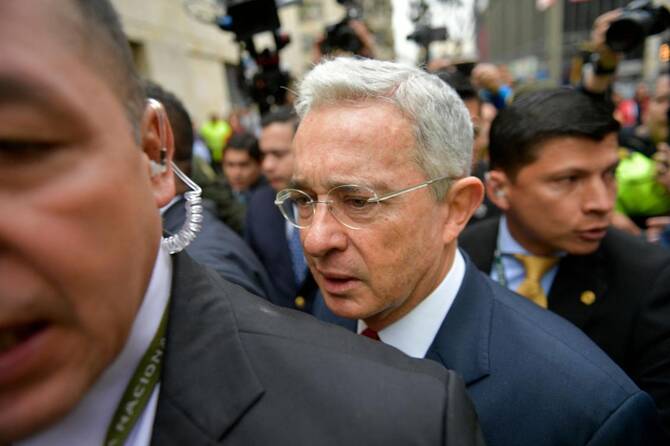
Former Colombian president Alvaro Uribe risks a 12-year prison sentence in the highly politicized case. (AFP)
Short Url
Updated 28 July 2025
Follow

Colombian ex-president to learn fate in witness tampering case

  • Alvaro Uribe, who was president from 2002 to 2010, is charged with ‘bribery of witnesses’ in a separate investigation against him
  • Uribe on Sunday gave an hourlong speech in his native Medellin in which he criticized the left-leaning Petro administration

BOGOTA: Colombian ex-president Alvaro Uribe will learn his fate Monday in a witness tampering case that saw him become the South American country’s first-ever former head of state to be put on trial.

The 73-year-old, who was president from 2002 to 2010, is charged with “bribery of witnesses” in a separate investigation against him, and risks a 12-year prison sentence in the highly politicized case.

The matter dates to 2012, when Uribe accused leftist senator Ivan Cepeda before the Supreme Court of hatching a plot to falsely link him to right-wing paramilitary groups involved in Colombia’s long-standing armed conflict.

The court decided against prosecuting Cepeda and turned its sights on his claims against Uribe instead.

Paramilitary groups emerged in the 1980s in Colombia to fight Marxist guerrillas that had taken up arms against the state two decades earlier with the stated goal of combating poverty and political marginalization, especially in rural areas.

The plethora of armed groups adopted cocaine as their main source of income, the genesis of a rivalry for resources and trafficking that continues to pit them against each other and the state.

Uribe was a politician on the right of the political spectrum – like all Colombian presidents before current leader Gustavo Petro, who unseated Uribe’s Centro Democratico party in 2022 elections.

Uribe on Sunday gave an hourlong speech in his native Medellin in which he criticized the left-leaning Petro administration.

“We need an enormous victory in the coming year,” Uribe said, in reference to presidential elections that will be held in 2026.

During his tenure, Uribe led a relentless military campaign against drug cartels and the FARC guerrilla army that signed a peace deal with his successor Juan Manuel Santos in 2016.

After Cepeda accused him of having had ties to paramilitary groups responsible for human rights violations, Uribe is alleged to have contacted jailed ex-fighters to lie for him.

He claims he only wanted to convince them to tell the truth.

In 2019, thousands protested in Bogota and Medellin when Uribe – who remains a prominent voice on the right – was indicted in the case.

More than 90 witnesses testified in his trial, which opened in May 2024.

The investigation against Uribe began in 2018 and has had numerous twists and turns, with several attorneys general seeking to close the case.

It gained new impetus under Attorney General Luz Camargo, picked by Petro – himself a former guerrilla and a political arch-foe of Uribe.

Prosecutors claim to have evidence from at least one paramilitary ex-fighter who claims to have been contacted by Uribe to change his story.

The former president is also under investigation in other matters.

He has testified before prosecutors in a preliminary probe into a 1997 paramilitary massacre of small-scale farmers when he was governor of the western Antioquia department.

A complaint has also been filed against him in Argentina, where universal jurisdiction allows for the prosecution of crimes committed anywhere in the world.

That complaint stems from Uribe’s alleged involvement in the more than 6,000 executions and forced disappearances of civilians by the military when he was president.

Uribe insists his trial is a product of “political vengeance.”


Blacklisted naphtha tanker from Russia enters Venezuelan waters while another diverts, ship data shows

Updated 20 December 2025
Follow

Blacklisted naphtha tanker from Russia enters Venezuelan waters while another diverts, ship data shows

  • Under U.S. sanctions related to Russia, the ship has a different sanctions profile than Skipper, the tanker that was seized by the U.S. on December 10

HOUSTON: A tanker subject to U.S. sanctions carrying some 300,000 barrels of naphtha from Russia entered Venezuelan waters late ​on Thursday, while another began redirecting course in the Atlantic Ocean, ship tracking data showed, a reflection of diverging last-minute decisions by ship owners after President Donald Trump ordered a "blockade" of oil tankers under sanctions bound for the OPEC country earlier this week.
The move ramped up pressure on Venezuelan president Nicolas Maduro by targeting the country's main source of income and followed the seizure by the U.S. of an oil tanker off the coast of Venezuela earlier in December.
Vessels that were not subject to sanctions began setting sail on Wednesday from Venezuelan waters after a week's pause, helping drain the country's mounting crude stocks.

HIGHLIGHTS

• Trump's 'blockade' aims to halt sanctioned oil tankers to Venezuela

• Hyperion's sanctions profile differs from seized Skipper tanker

• Venezuela condemns US actions as violating international law

Gambia-flagged medium tanker Hyperion docked on Friday at Amuay ‌Bay on Venezuela's ‌western coast, according to LSEG ship tracking data. It loaded near ‌Murmansk ⁠in ​Russia in ‌late November.
Under U.S. sanctions related to Russia, the ship has a different sanctions profile than Skipper, the tanker that was seized by the U.S. on December 10.
The U.S. can only seize vessels outside of its jurisdiction, or vessels that aren't heading to or from the country, if Washington has placed them under sanctions for links to groups it designates as terrorist, said David Tannenbaum, a director at consulting firm Blackstone Compliance Services that specializes in sanctions and anti-money laundering compliance.
Skipper, formerly called the Adisa, was under sanctions for what the U.S. says was involvement in Iranian oil trading that generated ⁠revenue for Iranian groups it has designated as foreign terrorist organizations.
With the Hyperion, though, sanctions were imposed to reduce Russian revenues from energy because of ‌its war with Ukraine.
"The Hyperion doesn't have known ties to ‍terrorism, and therefore unless they can prove it's subject ‍to the jurisdiction of the U.S., Washington can't grab it extraterritorially," said Tannenbaum, who previously worked with the ‍U.S. Treasury's Office of Foreign Assets Control that administers and enforces economic and trade sanctions.

REDIRECTS AND U-TURNS
The Angola-flagged Agate, another medium tanker under sanctions that loaded in Russia and had been sailing toward the Caribbean, was seen redirecting on Friday, according to LSEG ship tracking. The vessel was pointing towards Africa, but had not yet signaled a new destination.
Oman-flagged Garnet, also under sanctions ​and loaded in Russia, continued on its track, signaling the Caribbean as its destination on Friday.
Benin-flagged tanker Boltaris, under sanctions and carrying some 300,000 barrels of Russian naphtha bound for Venezuela, made ⁠a U-turn earlier this month and was heading for Europe without having discharged, according to LSEG vessel monitoring data.
Two very large crude carriers not subject to sanctions set sail for China on Thursday from Venezuela, according to sources familiar with Venezuela's oil export operations, marking only the second and third tankers unrelated to Chevron to depart the country since the U.S. seized Skipper.
The American oil major, which has continued to ship Venezuelan crude under a U.S. authorization, exported a crude cargo on Thursday bound for the U.S., LSEG data showed.
Secretary of State Marco Rubio on Friday said the U.S. was not concerned about the four vessels that sailed from Venezuela on Thursday, as those were not ships under sanctions.
"Sanctioned boats, we have the capabilities necessary to enforce our laws. We'll have a judicial order, we'll execute on those orders and there's nothing that will impede us from being able to do that," Rubio said.
Venezuela's government ‌called Trump's blockade a "grotesque threat" in a statement on Tuesday, saying it violates international law, free commerce and the right of free navigation.