

Who is Colombian Sen. Miguel Uribe Turbay who was shot during a campaign rally in Bogota?

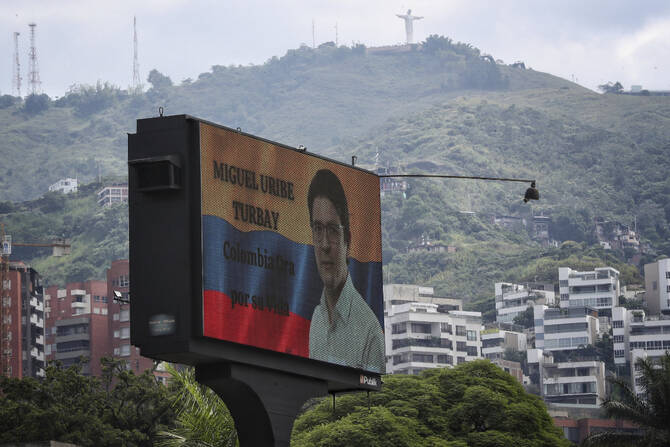
A billboard that reads in Spanish, "Miguel Uribe Turbay, Colombia prays for your life" is seen in Cali, Colombia, okn June 8, 2025, after the senator was shot at a political rally. (AP Photo)
Short Url
Updated 09 June 2025
Follow

Who is Colombian Sen. Miguel Uribe Turbay who was shot during a campaign rally in Bogota?

  • Uribe Turbay, 39, who has announced he intends to run for president next year, was in serious condition following surgery, a day after the shooting
  • He launched his presidential bid in March and has become a prominent opposition voice against the government of President Gustavo Petro

Conservative Colombian Sen. Miguel Uribe Turbay was shot and seriously injured during a campaign rally in the capital, Bogota. The brazen attack captured on video shook a nation that decades ago regularly saw kidnappings and killings of politicians and high profile people.
Uribe Turbay, 39, who has announced he intends to run for president next year, was in serious condition following surgery Sunday, a day after the shooting, and doctors said he was going through “critical hours.”
Here’s what to know about the conservative politician:
Presidential contender
A member of the right-wing Democratic Center party, Uribe Turbay has become a prominent opposition voice against the government of President Gustavo Petro, the first leftist politician to become the leader of Colombia. Petro cannot seek reelection in 2026.
Uribe Turbay, whose family had also suffered political violence, launched his presidential bid in March. In October last year, he had posted a video on social media announcing his intention to run, choosing the mountains of Copacabana in the department of Antioquia as a backdrop.


The country will hold a presidential election on May 31, 2026.
“A place with deep meaning for me,” he said in the video. “It was here that my mother was kidnapped by Pablo Escobar and was killed when I was about to turn five.”
His mother, journalist Diana Turbay, was abducted by the Medellin Cartel and killed in 1991, one of Colombia’s most violent periods.
The attack on Uribe Turbay on Saturday shocked the nation and revived memories of an era when political violence affected Colombian public life.
Prominent political family
Uribe Turbay entered politics early, being elected to Bogota’s City Council at age 25 in 2012. In 2016, he was appointed the city’s secretary of government by then-Mayor Enrique Peñalosa.
In 2022, he became senator after being invited to run by former President Álvaro Uribe Vélez, no relation.
Uribe Turbay was born into a prominent political family. He is the grandson of former President Julio César Turbay Ayala, who served from 1978 to 1982, and the paternal grandson of Rodrigo Uribe Echavarría, a former director of the Liberal Party.
He was not considered a front-runner in next year’s race, according to recent polls, and was still facing competition within his political coalition. In his pre-campaign messaging, Uribe Turbay focused heavily on security, seeking to inspire investments and promote economic stability.


‘Reserved prognosis’
The senator is going through what authorities have described as “critical hours” after undergoing surgery at a private clinic in Bogotá.
“He survived the procedure; these are critical moments and hours for his survival,” said Bogotá Mayor Carlos Galán early Sunday after receiving information from the medical staff at the Fundación Santa Fe clinic.
“His condition is extremely serious and the prognosis is reserved,” the clinic added hours later in a new medical report.
Police arrested a 15-year-old boy for the shooting, whom they considered the perpetrator. Authorities have not disclosed a motive.
Colombia’s Ombudsman’s Office condemned the attack, saying the country “cannot allow a return to dark times when violence sought to silence ideas, candidacies or political leadership.”


Fourth Palestine Action activist ends hunger strike in UK prison

Protesters take part in a demonstration in support of "Defend Our Juries" and their campaign against the ban on Palestine Action
Updated 5 sec ago
Follow

Fourth Palestine Action activist ends hunger strike in UK prison

  • Amy Gardiner-Gibson began eating again after 49 days of protest
  • Govt rejects claims it ignored prison safety protocols

LONDON: A fourth Palestine Action activist imprisoned in the UK has ended her hunger strike.

Amy Gardiner-Gibson, who also uses the name Amu Gib, began eating again after 49 days of fasting, the campaign group Prisoners for Palestine said.

Qesser Zuhrah, another activist, ended her hunger strike last week after 48 days but said she might resume it next year, Sky News reported.

Four Palestine Action activists have now ended their hunger strikes while in prison, while four others are continuing to fast.

All of them are in prison on remand, awaiting trial for a series of high-profile alleged break-ins and criminal damage.

Palestine Action was proscribed as a terrorist organization and banned earlier this year.

On Tuesday, Swedish climate activist Greta Thunberg was arrested in central London at a rally in support of the hunger strikers.

The protesters are demanding that weapons factories in Britain with ties to Israel be shut down, as well as the removal of Palestine Action’s proscription.

They are also calling for immediate bail to be given to imprisoned pro-Palestine activists and an end to the alleged mistreatment of prisoners in custody.

Seven imprisoned members of Palestine Action have been transferred to hospital over the course of the hunger strike campaign. Doctors have highlighted concerns about the long-term impact of fasting on the activists.

Lawyers representing the group on Monday initiated legal action against the government over its alleged failure to follow prison safety regulations.

The government, however, has rejected this accusation, Sky News reported.

A Ministry of Justice spokesperson said: “Ministers do not intervene in individual cases. Where individuals are on remand, doing so would risk prejudicing ongoing legal proceedings and undermine the independence of the justice system.

“Concerns about welfare and process can be raised through established legal and administrative channels, including prison governors and ultimately the prison and probation ombudsman.

“Healthcare decisions are taken independently by qualified NHS professionals and appropriate care and oversight frameworks remain in place.”

The activists still on hunger strike include Heba Muraisi and Teuta Hoxha. Hoxha has been on remand for 13 months and her family told Sky News they feared she would die in prison.

Another of the activists, Kamran Ahmad, is believed to have been on hunger strike for 45 days and hospitalized three times.

Lewie Chiaramello, who has Type 1 diabetes, is on day 31 of his strike and taking part by fasting every other day.