

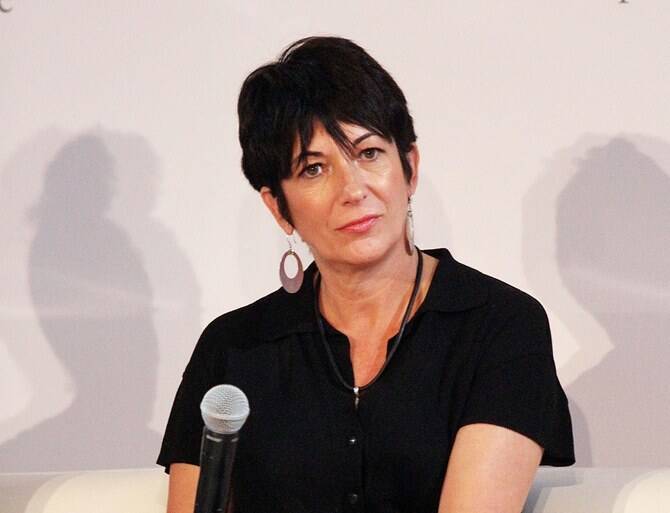
Epstein ex-girlfriend Ghislaine Maxwell finishes interviews with Justice Department officials

Ghislaine Maxwell, the imprisoned former girlfriend of convicted sex offender Jeffrey Epstein, finished 1 1/2 days of interviews with Justice Department officials on Friday, answering questions “about 100 different people,” her attorney said. (AFP/File)
Short Url
Updated 25 July 2025
Follow

Epstein ex-girlfriend Ghislaine Maxwell finishes interviews with Justice Department officials

  • Officials have said Epstein killed himself in his New York jail cell while awaiting trial in 2019
  • Blanche said Maxwell would be interviewed because of President Trump’s directive to gather and release any credible evidence

FLORIDA: Ghislaine Maxwell, the imprisoned former girlfriend of convicted sex offender Jeffrey Epstein, finished 1 1/2 days of interviews with Justice Department officials on Friday, answering questions “about 100 different people,” her attorney said.

“She answered those questions honestly, truthfully, to the best of her ability,” David Oscar Markus told reporters outside the federal courthouse in Tallahassee, Florida, where Maxwell met with Deputy Attorney General Todd Blanche.

“She never invoked a privilege. She never refused to answer a question, so we’re very proud of her,” Markus said.

Maxwell is serving a 20-year sentence and is housed at a low-security federal prison in Tallahassee. She was sentenced three years ago after being convicted of helping Epstein, a wealthy, well-connected financier, sexually abuse underage girls.

Officials have said Epstein killed himself in his New York jail cell while awaiting trial in 2019, but his case has generated endless attention and conspiracy theories because of his and Maxwell’s links to famous people, such as royals, presidents and billionaires, including Donald Trump.

In a social media post this week, Blanche said Maxwell would be interviewed because of President Trump’s directive to gather and release any credible evidence about others who may have committed crimes.

Trump has denied prior knowledge of Epstein’s crimes and claimed he cut off their relationship long ago. But he faces ongoing questions about the Epstein case, overshadowing his administration’s achievements. On Friday, reporters pressed the Republican president about pardoning Maxwell, but he deflected, emphasizing his administration’s successes.

Markus said Maxwell “was asked maybe about 100 different people.”

“The deputy attorney general is seeking the truth,” Markus said. “He asked every possible question, and he was doing an amazing job.”

Markus said he didn’t ask for anything for Maxwell in return, though he acknowledged that Trump could pardon her.

“Listen, the president this morning said he had the power to do so. We hope he exercises that power in the right and just way,” Markus said.

Earlier this month, the Justice Department said it would not release more files related to the Epstein investigation, despite promises that claimed otherwise from Attorney General Pam Bondi. The department also said an Epstein client list does not exist.

Maxwell is appealing her conviction, based on the government’s pledge years ago that any potential Epstein co-conspirators would not be charged, Markus said. Epstein struck a deal with federal prosecutors in 2008 that shifted his case to Florida state court, where he pleaded guilty to soliciting and procuring a minor for prostitution.

Epstein in 2019 and Maxwell in 2020 were charged in federal court in New York.


Report highlights role of British Muslim charitable giving in supporting UK public services

Updated 05 December 2025
Follow

Report highlights role of British Muslim charitable giving in supporting UK public services

  • The study, “Building Britain: British Muslims Giving Back,” finds that donations from British Muslims are helping to bolster overstretched service

LONDON: British Muslim charitable giving is playing an increasingly significant role in supporting frontline public services across the UK, according to a new report by policy and research organization Equi.

The study, “Building Britain: British Muslims Giving Back,” finds that donations from British Muslims are helping to bolster overstretched services, including local councils, the NHS and welfare systems, at a time of growing financial pressure.

The report estimates that Muslim donors contribute around £2.2 billion ($2.9 billion) annually, making them the UK’s most generous community.

This figure is around four times the national giving average and rises to almost 10 times the average among higher earners.

According to the findings, Muslim-led charities are providing a wide range of support, including housing assistance, emergency cash grants, food provision and mental health services, easing demand on statutory services.

Equi points to evidence from 2023 showing that housing support delivered by the National Zakat Foundation helped prevent evictions that would have cost councils an estimated £28.8 million, with every £1 of charitable spending generating £73 in public sector savings.

The report also highlights a generational shift, with younger British Muslims increasingly directing their donations toward domestic causes such as homelessness, child poverty and mental health challenges.

Despite their growing impact, Muslim charities face a number of barriers, including de-banking, restrictive funding rules, securitization measures and what the report describes as limited recognition from government. Equi argues that these challenges are constraining the sector’s ability to maximize its contribution.

“British Muslim giving is not just generosity but a lifeline for public services that needs recognizing,” said Equi Managing Director Prof. Javed Khan.

“From preventing evictions to supporting mental health, these donations are saving millions for the taxpayer and strengthening communities across Britain. The evidence is clear that Muslim-led action is delivering frontline support where the state is struggling,” he added.

Equi is calling on policymakers to engage more closely with Muslim-led charities and to move beyond what it describes as symbolic recognition.

The report recommends measures such as UK-based match-funding schemes and greater faith literacy within policymaking, which it says could unlock billions of pounds in additional domestic spending while maintaining the UK’s global humanitarian commitments.

The study concluded that with greater collaboration between government and Muslim charities, charitable giving could play an even more transformative role in strengthening public services and social cohesion across the country.