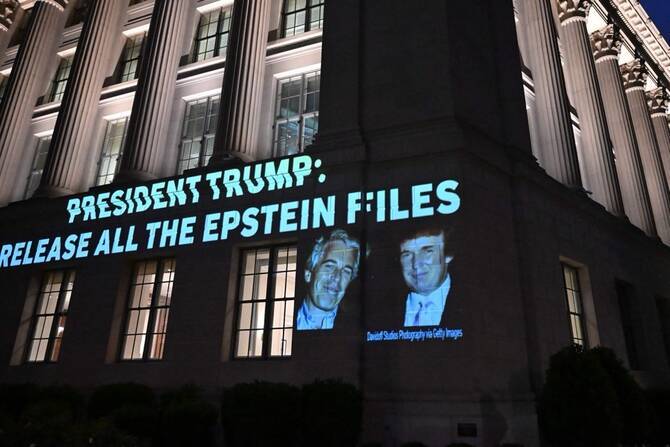
Justice Department wants to interview Jeffrey Epstein’s former girlfriend Ghislaine Maxwell

The Department of Justice wants to interview Jeffrey Epstein’s former girlfriend, who was convicted of helping the financier sexually abuse underage girls and is now serving a lengthy prison sentence, a senior official said Tuesday. (AFP/File)
Short Url
Updated 22 July 2025
Follow

Justice Department wants to interview Jeffrey Epstein’s former girlfriend Ghislaine Maxwell

  • If Ghislaine Maxwell “has information about anyone who has committed crimes against victims, the FBI and the DOJ will hear what she has to say,” Blanche said
  • A lawyer for Maxwell confirmed there were discussions with the government

WASHINGTON : The Department of Justice wants to interview Jeffrey Epstein’s former girlfriend, who was convicted of helping the financier sexually abuse underage girls and is now serving a lengthy prison sentence, a senior official said Tuesday.

If Ghislaine Maxwell “has information about anyone who has committed crimes against victims, the FBI and the DOJ will hear what she has to say,” Deputy Attorney General Todd Blanche said in a post on X, adding that President Donald Trump ”has told us to release all credible evidence.”

A lawyer for Maxwell confirmed there were discussions with the government.

The overture to attorneys for Maxwell, who in 2022 was sentenced to 20 years in prison, is part of an ongoing Justice Department effort to cast itself as transparent following fierce backlash from parts of Trump’s base over an earlier refusal to release additional records in the Epstein investigation.

As part of that effort, the Justice Department, acting at the direction of the Republican president, last week asked a judge to unseal grand jury transcripts from the case. That decision is ultimately up to the judge.

Epstein, who killed himself in his New York jail cell in 2019 while awaiting trial, sexually abused children hundreds of times over more than a decade, exploiting vulnerable girls as young as 14, authorities say. He couldn’t have done so without the help of Maxwell, his longtime companion, prosecutors say.

The Justice Department had said in a two-page memo this month that it had not uncovered evidence to charge anyone else in connection with Epstein’s abuse. But Blanche said in his social media post that the Justice Department “does not shy away from uncomfortable truths, nor from the responsibility to pursue justice wherever the facts may lead.”

He said in his post that, at the direction of Attorney General Pam Bondi, he has “communicated with counsel for Ms. Maxwell to determine whether she would be willing to speak with prosecutors from the Department.” He said he anticipated meeting with Maxwell in the coming days.

A lawyer for Maxwell, David Oscar Markus, said Tuesday in a statement: “I can confirm that we are in discussions with the government and that Ghislaine will always testify truthfully. We are grateful to President Trump for his commitment to uncovering the truth in this case.”


Geoeconomic confrontation tops global risks in 2026: WEF report

Updated 4 sec ago
Follow

Geoeconomic confrontation tops global risks in 2026: WEF report

  • Also armed conflict, extreme climate, public polarization, AI
  • None ‘a foregone conclusion,’ says WEF’s MD Saadia Zahidi

DUBAI: Geoeconomic confrontation has emerged as the top global risk this year, followed by state-based armed conflict, according to a new World Economic Forum report.

The Global Risks Report 2026, released on Wednesday, found that both risks climbed eight places year-on-year, underscoring a sharp deterioration in the global outlook amid increased international competition.

The top five risks are geoeconomic confrontation (18 percent of respondents), state-based armed conflict (14 percent), extreme weather events (8 percent), societal polarization (7 percent) and misinformation and disinformation (7 percent).

The WEF’s Managing Director Saadia Zahidi said the report “offers an early warning system as the age of competition compounds global risks — from geoeconomic confrontation to unchecked technology to rising debt — and changes our collective capacity to address them.

“But none of these risks are a foregone conclusion.”

The report assesses risks across three timeframes: immediate (2026); short-to-medium term (next two years); and long term (next 10 years).

Economic risks show the largest overall increase in the two-year outlook, with both economic downturn and inflation jumping eight positions.

Misinformation and disinformation rank fifth this year but rise to second place in the two-year outlook and fourth over the 10-year horizon.

The report suggests this reflects growing anxiety around the rapid adoption of artificial intelligence, with adverse outcomes linked to AI surging from 30th place in the two-year timeframe to fifth in the 10-year outlook.

Uncertainty dominates the global risk outlook, according to the report.

Surveyed leaders and experts view both the short- and long-term outlook negatively, with 50 percent expecting a turbulent or stormy global environment over the next two years, rising to 57 percent over the next decade.

A further 40 percent and 32 percent, respectively, describe the outlook as unsettled across the two- and 10-year timeframes, while just 1 percent anticipate a calm global outlook in either period.

Environmental risks ease slightly in the short-term rankings. Extreme weather fell from second to fourth place and pollution from sixth to ninth. Meanwhile, critical changes to Earth systems and biodiversity loss dropped seven and five positions, respectively.

However, over the next decade, environmental threats re-emerge as the most severe, with extreme weather, biodiversity loss, and critical changes to Earth systems topping the global risk rankings.

Looking ahead over the next decade, around 75 percent of respondents anticipate a turbulent or stormy environmental outlook, making it the most pessimistic assessment across all risk categories.

Zahidi said that “the challenges highlighted in the report underscore both the scale of the potential perils we face and our shared responsibility to shape what comes next.”

Despite the gloomy outlook, Zahidi signaled a positive shift in global cooperation.

 “It is also clear that new forms of global cooperation are already unfolding even amid competition, and the global economy is demonstrating resilience in the face of uncertainty.”

Now in its 21st year, the Global Risks Report highlights a core message: global risks cannot be managed without cooperation.

As competition intensifies, rebuilding trust and new forms of collaboration will be critical, with the report stressing that today’s decisions will shape future outcomes.

The report was released ahead of WEF’s annual meeting, which will be held in Davos from Jan. 19 to 23.