



LONDON: Israel mounted a bombing campaign across Syria last week with the stated objective of protecting the Druze community of Sweida from attack by Bedouin fighters amid a recent upsurge in sectarian violence.
Yet, this purported humanitarian intervention on behalf of a vulnerable religious minority has drawn attention to the disparity in Israel’s treatment of its own Druze citizens, prompting accusations of double standards.
For centuries, the Druze — an enigmatic religious community whose origins in the Levant date back to the 11th century — have guarded their beliefs and customs behind a veil of secrecy.
Today, amid mounting regional upheaval and intensifying sectarian conflict, the fate of this small group — whose numbers are dwarfed by those of their neighbors — has become a critical test case for questions of loyalty, identity, and equal citizenship within modern nation states.

Israeli troops on July 16 sought to control crowds and prevent Druze from crossing the border with Syria, after deadly violence in the country's south that prompted Damascus to send in government forces. (AFP)
Nowhere are these tensions more apparent than in Israel, where the Druze have forged a uniquely complex relationship with the Jewish majority, one marked by military partnership and shared sacrifice, yet also by persistent inequality and simmering frustration.
As a result of their opposition to conversion and discouragement of intermarriage, the Druze community remained small in number and vulnerable, constantly maneuvering politically for their own survival among more powerful forces.
Still, when push comes to shove, they can prove to be fearless warriors.
The special relationship between the Jewish and Druze communities already existed in Mandatory Palestine. This relationship grew closer and stronger after Israel declared its independence, although it remains rather complex.
One of the tenets of Druze philosophy — some might call it a survival mechanism — is loyalty to the state where they reside. In this sense, Israel is no exception.

Syrian Druze people cross back into Syria as they walk at the Israeli-Syrian border, in the Israeli-controlled Golan Heights town of Majdal Shams, on July 17, 2025. (AP)
In 1956, at the request of the Druze community’s leaders, Druze men became subject to the military draft upon turning 18, just like their Jewish compatriots.
This created a covenant written in blood between the Jewish and Druze communities, with more than 430 having lost their lives serving in the Israeli security forces — a substantial number for a small community of 143,000, which is less than 1.6 percent of Israel’s population.
But despite this sacrifice and the generally positive perception of the Druze among Jewish Israelis — unlike attitudes toward other Arab communities — they are not spared discrimination. Consequently, there are forces among their youth who oppose continued military service.
The recent wave of deadly sectarian clashes that rocked southern Syria exposed the country’s fragility, as the new government proved either incapable or unwilling to impose law and order, leading to a failure to protect the Druze.
The response by the Druze in Israel highlighted another strong tenet in the community’s philosophy: mutual responsibility. In a Pew Research Center survey, nine in 10 said that they had a strong sense of belonging to the Druze community and were proud to be part of it.
Roughly two-thirds expressed that they feel a special responsibility to care for Druze in need around the world.
Over the last week, this manifested in community leaders exerting pressure on the Israeli government to intervene on behalf of the Druze in their clashes with Bedouin militias.
Translating intentions into action, around 1,000 community members — including two members of the Knesset, Afef Abed and Hamad Amar from the right-wing parties Likud and Yisrael Beytenu, respectively — crossed the border from the Israeli-occupied side of the Golan Heights to support their brethren on the other side, expressing outrage over what they described as the massacre of their relatives in Suwaida.

Members of the Druze community pass through a hole in the barbed-wire border fence in the Israeli-annexed Golan Heights near Majdal Shams on July 16, 2025, amid deadly violence in the in Syria's Sweida province. (AFP)
Israeli Prime Minister Benjamin Netanyahu addressed the Druze community in Israel and the Golan Heights in a video statement, urging them to show restraint and avoid crossing into Syria amid the ongoing clashes.
Instead, Israel took the extreme measure of striking the Syrian Defense Ministry in Damascus and government forces in southern Syria, with Netanyahu announcing that Israel was “working to save our Druze brothers.”
Israel’s immediate reaction to the fall of the Bashar Assad regime in December of last year was to “temporarily” take over additional territory on the Syrian side of the Golan Heights — a move that increasingly looks permanent — and to carry out hundreds of airstrikes on military targets across Syria.
With this in mind, Israel’s use of force again last week raises questions about whether the strikes were solely in defense of the Druze or intended to send a broader message to the government of Ahmed Al-Sharaa about the power balance between the two countries.
Another factor raises suspicion over Israel’s purported commitment to the Druze in Syria. Despite the total loyalty of the Druze to the state of Israel, it does not appear that the Jewish state is equally loyal to them.
For all their years of sacrifice and devotion, the Druze still do not enjoy the same equal rights as the Jewish population. Although attitudes toward the Druze in Israel may be more favorable than toward Palestinian citizens, they are still far from being treated as equals.

This photo taken on July 13, 2006 shows members of the Druze community attending the funeral of 25-year-old First Sergeant Wasim Salah Nazal, a Druze member of the Israeli military, at the Druze village of Yanuh in northern Israel. Despite the sacrifice and devotion shown they have shown to Israel, the Druze still do not enjoy the same equal rights as the Jewish population. (AFP/File)
Some researchers of the Druze community in Israel suggest that they represent something of an in-between group, comprising “individuals who simultaneously belong to social categories that are often seen as mutually exclusive, while maintaining their distinct group identity.”
The Druze are ethnically Arab and share that Arab identity with the Arab-Palestinian minority in Israel, but, at the same time, identify with the Jewish Israeli state.
In recent years, there has been an awakening among young Druze that, despite their sacrifices, they are institutionally and socially discriminated against as individuals and as a community.
In a protest last year, community leaders stated: “The covenants of blood and life have become superficial and false slogans.” They demanded that budgets allocated to their towns and villages be equal to those of their Jewish neighbors.
This discrimination is visible not only in the underinvestment in their communities, but also in the confiscation of their land for the Judaization of the Galilee and in house demolitions — not to mention having to contend with poor electricity networks, sewage systems, and roads.
Many residents in the 16 Druze towns and villages of Israel find it almost impossible to obtain planning permission, leaving them under constant threat of demolition orders or hefty fines.
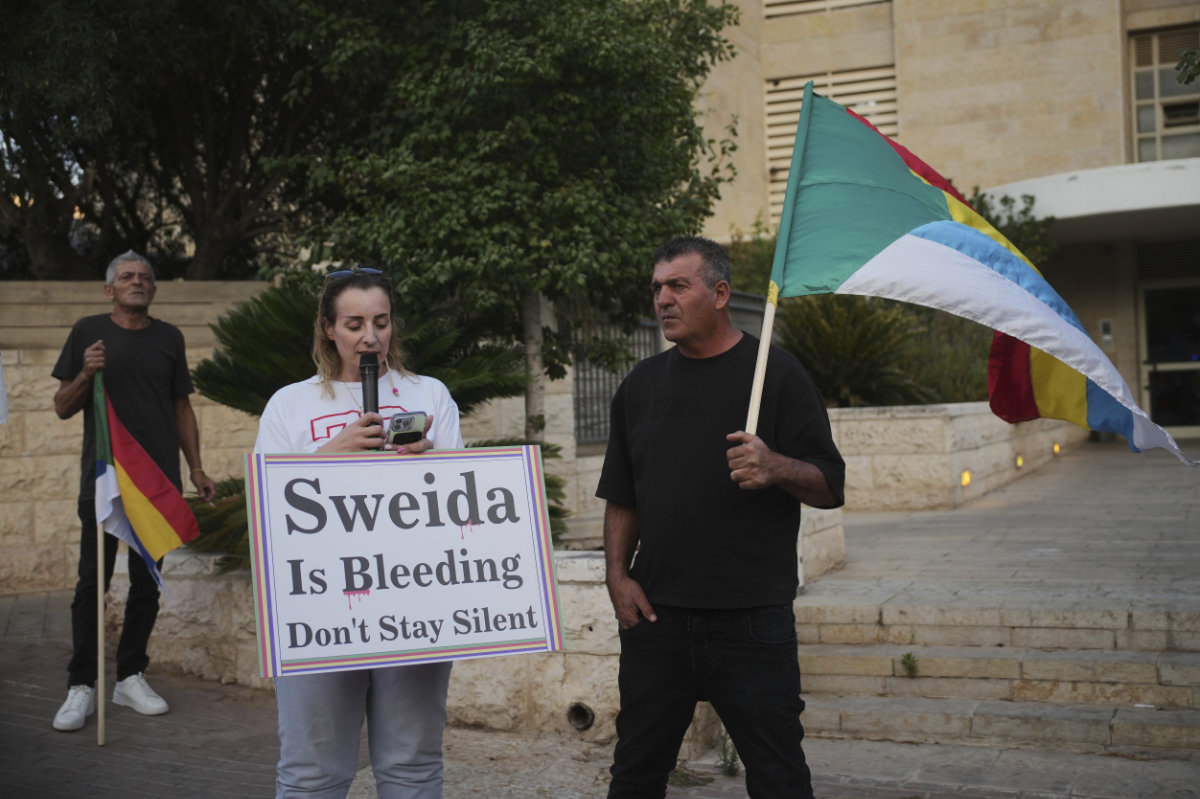
Members of the Druze minority and their supporters protest outside the US Embassy in Jerusalem on July 16, 2025, amid clashes between Syrian government forces and Druze armed groups in the southern Syrian city of Sweida. (AP)
A piece of legislation dating back to 2017, the Kaminitz Law, gives authorities the power to issue penalties — such as demolition and stop-work orders, the confiscation of building equipment and vehicles, and arrests — all without referring these cases to the judicial system.
Generally, the law is seen as targeting Arab communities, where building permits are almost impossible to secure, resulting in illegal construction followed by fines and threats of demolition by the government, despite a growing population and need for additional accommodation.
A request to put in place a 5-year plan to support local authorities of Druze communities has not been approved despite protests by community leaders.
The final straw for many Druze in Israel was likely the 2018 Nation State Law, which made many feel that despite their loyalty and sacrifice for the country, they are not rewarded in kind.
The law explicitly states that Jews have a unique right to national self-determination in Israel, and it relegated Arabic from being one of the two official languages, alongside Hebrew, to one with “special status.”
Describing Israel as “the national home of the Jewish people” was effectively a way of defining everyone else as unequal in their political, human, and civil rights.
Despite repeated promises from the Israeli government to promote a Basic Law for the Druze community, which aims to anchor the important status of the Druze community in Israel, this still has not happened.
This has instilled among the community an oft-quoted sentiment: “Druze enter the army as an Israeli and leave as an Arab.”
For the Druze, there is a sense that the community has the rawest of deals — one in which they are loyal and prepared to sacrifice their lives for the country but are still treated as second-class citizens.

Caption


