

Israel strikes Syrian city, vows to protect Druze from government forces

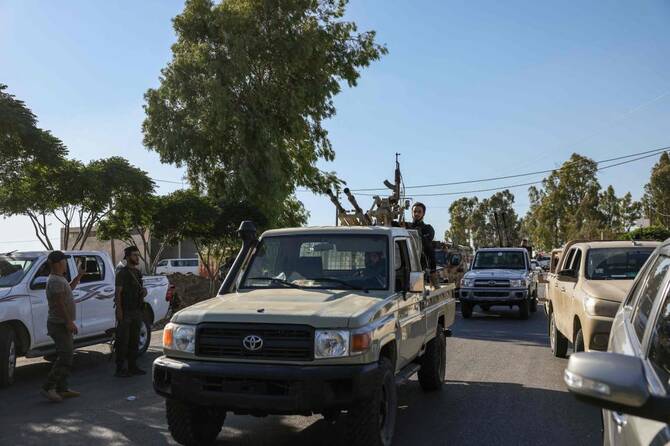
Members of Syria's security forces patrol an area between Mazraa and Walga near the predominantly Druze city of Sweida on July 14, 2025, following clashes between Bedouin tribes and Druze fighters. (AFP)
Short Url
Updated 16 July 2025
Follow

Israel strikes Syrian city, vows to protect Druze from government forces

  • Bursts of gunfire were heard and three bodies were seen on the ground
  • Dozens of people have been killed in fighting in the region since Sunday

SWEIDA, Syria: Israel carried out strikes against Syrian Arab Republic government forces in southwestern Syria for a second day on Tuesday, vowing to keep the area demilitarized and to protect the Druze minority as deadly clashes continued in the region at the Israeli frontier.

A Reuters reporter heard at least four strikes as drones could be heard over the predominantly Druze city of Sweida and saw a damaged tank being towed away. Bursts of gunfire were heard and three bodies were seen on the ground. Dozens of people have been killed in fighting in the region since Sunday.

The upsurge in violence underlines the challenges facing interim President Ahmed Al-Sharaa who has struggled to assert control over the area near the Israeli border since toppling Bashar Assad in December.

While Sharaa has been buoyed by rapidly improving ties with US President Donald Trump’s administration, the violence has highlighted lingering sectarian tensions and distrust among minority groups toward his Islamist-led government — distrust that was deepened by mass killings of Alawites in March.

Israel, which has struck Syria several times in the name of protecting the Druze, carried out its latest attacks after influential Druze Sheikh Hikmat Al-Hajjri issued a statement accusing government troops of breaching a ceasefire and urging fighters to confront what he described as a barbaric attack.

After Al-Hajjiri appeared in a recorded statement, Syrian Defense Minister Murhaf Abu Qasra issued a statement declaring that a complete ceasefire was in place, and saying government forces would only open fire if fired upon.

Abu Qasra also said that military police had been ordered to deploy in Sweida to “control military behavior and hold violators accountable,” the state news agency SANA reported.

The Reuters reporter saw men in fatigues burning and looting homes and shops, and setting fire to a store that sold alcohol.

The Druze are a minority group whose faith is an offshoot of Islam and has followers in Israel, Syria and Lebanon.

’Deep brotherhood’
Israeli Prime Minister Benjamin Netanyahu and Defense Minister Israel Katz said they had ordered Israel’s military to strike “regime forces” and weaponry brought to Sweida to be used against the Druze.

In a statement, they said the deployment of government forces was in violation of a demilitarization policy that had called on Damascus to refrain from bringing forces and weapons into southern Syria that pose a threat to Israel.

“Israel is committed to preventing harm to the Druze in Syria due to the deep brotherhood alliance with our Druze citizens in Israel,” they said. “We are acting to prevent the Syrian regime from harming them and to ensure the demilitarization of the area adjacent to our border with Syria.

Reuters reported in May that Israel and the Syrian authorities had held direct talks focused on security.

The latest violence began on Sunday with fighting between armed Druze groups and Bedouin fighters in Sweida province, which displaced thousands of people.

The Druze spiritual leadership said in a written statement on Tuesday morning that it would allow Syrian forces to enter Sweida city to stop the bloodshed, calling on armed groups to surrender their weapons and cooperate with incoming troops.

But hours later, Al-Hajjri, a vocal opponent of the new Syrian leadership, said the statement had been “imposed” on them by Damascus and that Syrian troops had breached the arrangement by continuing to fire on residents.

“We are being subject to a total war of extermination,” he said in a recorded video statement, calling on all Druze “to confront this barbaric campaign with all means available.”

Convoys of Syrian army tanks, trucks and motorcycles entered parts of Sweida city by mid-morning and were continuing to fire on neighborhoods there, the Reuters reporter in Sweida said.

On Monday, Israel’s military said it had carried out several strikes on tanks approaching Sweida “to prevent their arrival to the area” because they could pose a threat to Israel.


Lebanon PM publishes long-awaited banking law draft

Updated 19 December 2025
Follow

Lebanon PM publishes long-awaited banking law draft

  • The law stipulates that each of the state, the central bank, commercial banks and depositors will share the losses accrued as a result of the financial crisis.
  • Depositors with a limit of $100,000, over the course of four years

BEIRUT: Lebanese Prime Minister Nawaf Salam published on Friday a long-awaited banking draft bill, which distributes losses from the 2019 economic crisis between banks and the state.
The draft law is a key demand from the international community, which has conditioned economic aid to Lebanon on financial reforms.
In a televised speech, Salam said “this draft law constitutes a roadmap to getting out of the crisis” that still grips Lebanon.
The draft will be discussed by the Lebanese cabinet on Monday before being sent to parliament, where it could be blocked.
The law stipulates that each of the state, the central bank, commercial banks and depositors will share the losses accrued as a result of the financial crisis.
Depositors, who lost access to their funds after the crisis, will be able to retrieve their money, with a limit of $100,000, over the course of four years.
Salam said that 85 percent of depositors had less than $100,000 in their accounts.
The wealthiest depositors will see the remainder of their money compensated by asset-backed securities.
“I know that many of you are listening today with hearts full of anger, anger at a state that abandoned you,” Salam said.
“This bill may not be perfect... but it is a realistic and fair step toward restoring rights, halting the collapse.”

- ‘Banks are angry’ -

The International Monetary Fund, which closely monitored the drafting of the bill, had previously insisted on the need to “restore the viability of the banking sector consistent with international standards” and protect small depositors.
The Associations of Banks in Lebanon criticized the draft law on Monday, saying in a statement that it contains “serious shortcomings” and harms commercial banks.
“Banks are angry because the law opens the door to them sharing any part of the losses,” said Sami Zougheib, researcher at The Policy Initiative, a Beirut-based think tank.
He told AFP that banks would have preferred that the state bear full responsibility.
The text provides for the recapitalization of failing banks, while the government’s debt to the Central Bank will be converted into bonds.
Salam said that the bill aims to “revive the banking sector” which had collapsed, giving free rein to a parallel economy based on cash transactions, which facilitate money laundering and illicit trade.
According to government estimates, the losses resulting from the financial crisis amounted to about $70 billion, a figure that is expected to have increased over the six years that the crisis was left unaddressed.
Since assuming power, Salam and President Joseph Aoun have pledged to implement the necessary reforms and legislation.
In April, Lebanon’s parliament adopted a bank restructuring law, as the previous legislation was believed to have allowed a flight of capital at the outbreak of the 2019 crisis.
The new bill stipulates that politically exposed persons and major shareholders who transferred significant capital outside the country from 2019 onwards — while ordinary depositors were deprived of their savings — must return them within three months or face fines.
The draft law could still be blocked by parliament even if the cabinet approves it.
“Many lawmakers are directly exposed as large depositors or bank shareholders, politically allied with bank owners, and unwilling to pass a law that either angers banks or angers depositors,” Zougheib said.
Politicians and banking officials have repeatedly obstructed the reforms required by the international community for Lebanon to receive financial support.