

Pakistan says fuel stocks sufficient to last a month as Iran conflict disrupts Hormuz supplies

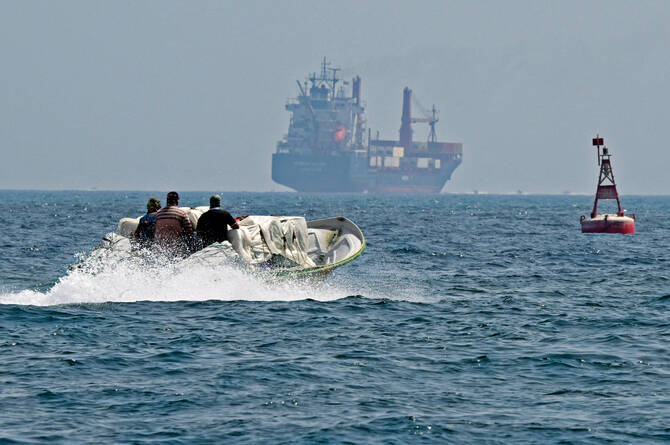
A small boat loaded with merchandise sails a container ship in the waters of the Strait of Hormuz off the coast of Khasab in Oman’ on June 25, 2025. In 2024, Saudi Arabia alone moved 5.5 million barrels of oil per day through the waterway. (AFP)
Short Url
Updated 02 March 2026
Follow

Pakistan says fuel stocks sufficient to last a month as Iran conflict disrupts Hormuz supplies

  • Tehran on Saturday closed the vital shipping lane, following US-Israeli attacks on Iran
  • Analysts say prolonged disruption of Hormuz may spike global oil prices, shipping costs

ISLAMABAD: Pakistan's government and industry officials on Sunday said the country has enough fuel stockpiles to last at least a month, amid regional tensions in the Middle East that have disrupted oil supply through the Strait of Hormuz.

Pakistan relies heavily on energy imports, with majority of its crude oil and petroleum imports from the Middle East passing through the Strait of Hormuz. On Saturday, Tehran closed the shipping lane, warning that it was dangerous due to US and Israeli attacks on Iran.

The Strait of Hormuz is a narrow waterway between Iran and Oman, connecting the Gulf to the Arabian Sea. On a typical day, tankers carrying around 20 percent ‌of global oil consumption pass through it with cargoes from Saudi Arabia, ​Iraq, Iran, UAE, Kuwait and Qatar.

Pakistan's Petroleum Division has been directed to submit daily stock reports, while the country's Oil and Gas Regulatory Authority (OGRA) has been tasked with maintaining strict market oversight, according to officials.

“Fuel inventories remain robust, with 28 days’ supply of both petrol and diesel currently available in stock,” OGRA spokesman Imran Ghaznavi told Arab News. "This level is comfortably above the mandatory reserve requirement, indicating a stable and well-managed supply position."

The statement came after three ships were attacked in the Strait of Hormuz, maritime security agencies said on Sunday, as Iran pressed a second day of strikes in response to ongoing US-Israeli air raids.

An official at the Pakistani energy ministry, who spoke on condition of anonymity, said finished petroleum stocks were sufficient to last for “over one month.”

The state-owned Pakistan State Oil (PSO) company said it held “healthy stock of all petroleum products.”

"However, the situation is being monitored and we will act accordingly in line with Ministry of Energy’s directives," it said in a statement.

While energy companies and regulators have taken steps to ensure fuel availability in the event of further regional disruptions, analysts warn that the country’s heavy reliance on imported crude could leave it vulnerable if the instability persisted.

“If the Strait of Hormuz is impacted [for long], this may create a shortage of oil supply in region and world as material amount of oil passes through this track,” said Shankar Terleja, head of research at Topline Securities Ltd.

“This may cause spike in petroleum prices globally.”

Ahsan Mehanti, chief executive officer of Arif Habib Commodities, said the Strait of Hormuz is "highly critical" to Pakistan for its petroleum supplies and its prolonged closure could impact "security and industrial activity."

The alternatives could include Russian and Venezuelan oil, according to Mehanti.

The Federation of Pakistan Chambers of Commerce and Industry (FPCCI) has voiced concern over the potential impact of the Middle East conflict on Pakistan's economy.  “The instability in the region will disrupt trade routes and lead to a massive increase in shipping costs,” FPCCI President Atif Ikram Sheikh said, urging the government to “make full efforts to achieve a ceasefire through mediation and negotiations between the United States and Iran.”

He also requested the government to “immediately formulate a policy to ensure supply chain continuity, particularly for petroleum products.”


Peace can only prevail if Afghanistan renounces support for ‘terrorism’— Pakistan defense chief

Updated 04 March 2026
Follow

Peace can only prevail if Afghanistan renounces support for ‘terrorism’— Pakistan defense chief

  • Pakistan’s chief of defense forces visits South Waziristan district bordering Afghanistan
  • Pakistan says has killed 481 Afghan Taliban operatives since clashes began last Thursday

ISLAMABAD: Pakistan’s Chief of Defense Forces Field Marshal Syed Asim Munir said on Wednesday that peace with Afghanistan can only prevail if Kabul renounces support for “terrorism” and “terrorist” organizations, the military’s media wing said as the two countries remain locked in conflict. 

Fighting between the two neighbors, the worst in decades, broke out last Thursday night after Afghan forces attacked Pakistan’s military installations along their shared border. Afghanistan said its attacks were in response to earlier airstrikes by Pakistan against alleged militant hideouts in its country. 

Pakistan accuses Afghanistan of sheltering militant outfits such as the Tehreek-e-Taliban Pakistan (TTP) on its soil who have launched attacks against Pakistani civilians and security forces in recent years. Kabul denies the allegations. 

Munir visited Wana town in Pakistan’s South Waziristan district to review the security situation and troops’ operational preparedness at the Afghan border, the Pakistani military’s media wing said in a statement. 

“The Field Marshal reiterated that peace could only prevail between both sides if the Afghan Taliban renounced their support for terrorism and terrorist organizations,” the Inter-Services Public Relations (ISPR) said. 

The military chief said the use of Afghan soil by militant outfits to launch attacks against Pakistan was unacceptable, vowing that “all necessary measures” would be taken to neutralize cross-border threats. 

During the visit, Munir was briefed by military commanders about ongoing intelligence-based operations and measures being taken by the military to manage the border with Afghanistan.

He was also briefed about “Operation Ghazab Lil Haq” or “Wrath for the Truth,” the name Pakistan has given to its military operation against Afghan forces, the ISPR said. 

The Pakistani military chief spoke to troops deployed in the area, praising their vigilance, professional conduct and high morale, the ISPR said. 

Pakistan’s Information Minister Attaullah Tarar said on Wednesday that the military has killed 481 Taliban operatives, injured more than 690 and destroyed 226 Afghan checkposts since clashes began. 

Arab News has been unable to verify claims by both sides about the damages they claim to have inflicted on each other.

Afghanistan has signaled it is open for dialogue but Pakistan rejected the offer, saying it would continue its military operations till its objectives were achieved. 

Since the conflict began, diplomatic efforts have intensified with several countries, including global bodies such as the European Union and United Nations, urging restraint and calling for talks.

Turkish President Recep Tayyip Erdogan told Pakistani Prime Minister Shehbaz Sharif that ⁠Ankara would help ⁠reinstate a ceasefire, the Turkish Presidency said on Tuesday, as other countries that had offered to mediate have since been hit by the conflict in the Gulf.