

UK sanctions senior Russian GRU officers over cyberattacks

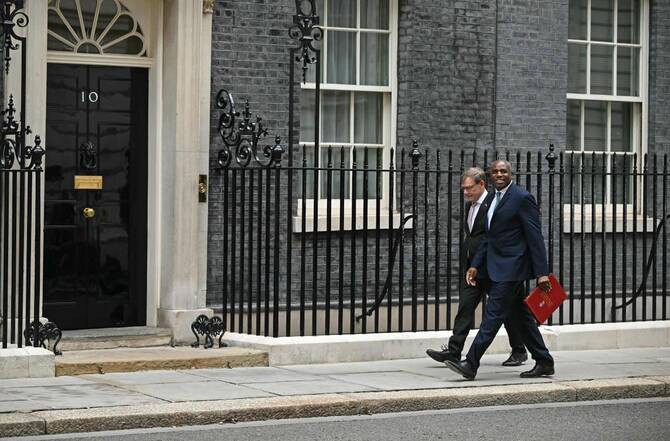
Britain’s Foreign Secretary David Lammy walks with Germany’s Foeign Minister Johann Wadephul to 10 Downing Street in London on July 17, 2025. (AFP)
Short Url
Updated 18 July 2025
Follow

UK sanctions senior Russian GRU officers over cyberattacks

  • “GRU spies are running a campaign to destabilize Europe, undermine Ukraine’s sovereignty and threaten the safety of British citizens,” Lammy said
  • British authorities have repeatedly accused Moscow of orchestrating malign activity

LONDON: Britain said on Friday it had sanctioned more than 20 Russian spies, hackers and agencies over what it called a “sustained campaign of malicious cyber activity” involving attacks on governments and institutions across Europe.

The foreign ministry said it was sanctioning three units of the Russian military intelligence GRU agency and 18 of its officers, including those it said were involved in targeting strikes against Mariupol during the war in Ukraine, and spying on former Russian double agent Sergei Skripal and his daughter Yulia before they were targeted in a Novichok poisoning in 2018.

“GRU spies are running a campaign to destabilize Europe, undermine Ukraine’s sovereignty and threaten the safety of British citizens,” Foreign Secretary David Lammy said in a statement.

British authorities have repeatedly accused Moscow of orchestrating malign activity, ranging from traditional espionage and actions to undermine democracy, to sabotage and assassinations.

Earlier this month, three men were convicted over an arson attack on a Ukrainian-linked business in London which police said was carried out at the behest of the Wagner mercenary group.

Moscow has rejected such accusations, saying they were politically motivated and that it posed no threat to Britain. The Russian embassy in London did not immediately respond to a request for comment.

The European Union and NATO issued statements on Friday condemning what they described as Russia’s destabilising hybrid activities.

In its latest announcement, Britain said three Russian GRU units — 29155, 26165 and 74455 — had targeted media outlets, telecoms providers, political and democratic institutions, and energy infrastructure in the UK and across Europe.

Among these incidents were an Estonian government hack in 2020, a cyber-attack on the German Bundestag in 2015, the hacking in 2016 of the US Democratic National Committee and Democratic Congressional Campaign Committee, and cyberattacks on the Paris Olympics last year, Britain said.

The British foreign ministry also said Unit 26165 had conducted reconnaissance on the Mariupol Theatre in March 2022 ahead of air strikes which local officials said killed about 300 people and which Russia has denied deliberately targeting.

In addition to the GRU-focused sanctions, the ministry said it was sanctioning three leaders of “African Initiative,” which it said was a Russian-funded social media content mill conducting information operations in West Africa.

Britain has recently ramped up its military spending to help change its approach to defense, partly to address threats from Russia, nuclear risks and cyberattacks.


Trump targets non-white immigrants in renewed xenophobic rants

Updated 43 min 38 sec ago
Follow

Trump targets non-white immigrants in renewed xenophobic rants

  • During a rally in Pennsylvania on Wednesday,  Trump doubled down on his tirade against Somali migrants
  • "Why is it we only take people from shithole countries,’ right? Trump told his cheering audience

WASHINGTON: Back in 2018, President Donald Trump disputed having used the epithet “shithole” to describe some countries whose citizens emigrated to the United States.
Nowadays, he embraces it and pushes his anti-immigrant and xenophobic tirades even further.
Case in point: during a rally in the northeastern state of Pennsylvania on Wednesday that was supposed to focus on his economic policy, the 79-year-old Republican openly ranted and reused the phrase that had sparked an outcry during his first term.
“We had a meeting and I said, ‘Why is it we only take people from shithole countries,’ right? ‘Why can’t we have some people from Norway, Sweden?’” Trump told his cheering audience.
“But we always take people from Somalia,” he continued. “Places that are a disaster. Filthy, dirty, disgusting, ridden with crime.”
Recently, he called Somali immigrants “trash.”
These comments are “more proof of his racist, anti-immigrant agenda,” Massachusetts Senator Ed Markey responded on X.

The Trump megaphone

Florida Republican lawmaker Randy Fine, on the other hand, defended Trump.
“Not all cultures are equal and not all countries are equal,” he said on CNN, adding “the president speaks in language that Americans understand, he is blunt.”
University of Albany history professor Carl Bon Tempo told AFP this type of anti-immigrant rhetoric has long thrived on the far-right.
“The difference is now it’s coming directly out of the White House,” he said, adding “there’s no bigger megaphone” in American politics.
On the campaign trail in 2023, Trump told a rally in New Hampshire that immigrants were “poisoning the blood of our country” — a remark that drew comparisons to Nazi dictator Adolf Hitler.
Now back in power, Trump’s administration has launched a sweeping and brutal deportation campaign and suspended immigration applications from nationals of 19 of the poorest countries on the planet.
Simultaneously, the president ordered white South African farmers to be admitted to the US, claiming their persecution.

No filter left

“Any filter he might have had is gone,” Terri Givens, a professor at the University of British Columbia in Canada and immigration policy expert, told AFP.
For Trump, it doesn’t matter whether an immigrant obeys the law, or owns a business, or has been here for decades, according to Syracuse University political science professor Mark Brockway.
“They are caught in the middle of Trump’s fight against an invented evil enemy,” Brockway told AFP.
By describing some immigrants as “killers, leeches, and entitlement junkies” — as Secretary of Homeland Security Kristi Noem did earlier this month — the White House is designating a target other than itself for American economic ire at a time when the cost of living has gone up and fears are growing over job security and loss of federal benefits.
But, Bon Tempo noted, “when immigration spikes as an issue, it spikes because of economics sometimes, but it also spikes because of these larger sort of foundational questions about what it means to be an American.”
On November 28, after an Afghan national attacked two National Guard soldiers in Washington, Trump took to his Truth Social network to call for “REVERSE MIGRATION.”
This notion, developed by European far-right theorists such as French writer Renaud Camus, refers to the mass expulsion of foreigners deemed incapable of assimilation.
Digging into the “Make America Great Again” belief system, many experts have noted echoes of the “nativist” current of politics from the 1920s in the US, which held that white, Anglo-Saxon, Protestant culture was the true American identity.
That stance led to immigration policies favoring Northern and Western Europe.
As White House senior adviser Stephen Miller recently wrote on X: “This is the great lie of mass migration. You are not just importing individuals. You are importing societies...At scale, migrants and their descendants recreate the conditions, and terrors, of their broken homelands.”