

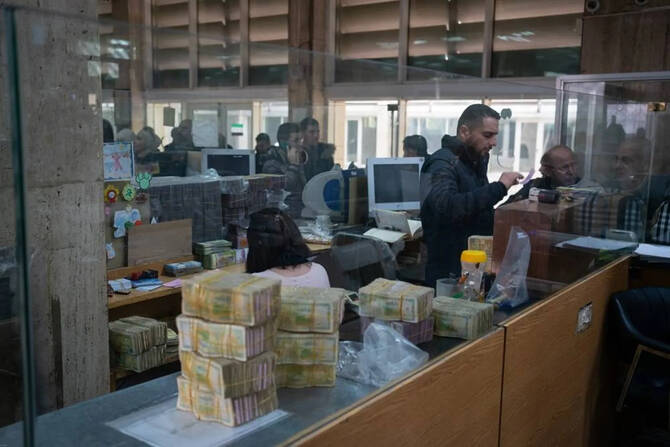
Syria announces sweeping tax reforms to boost transparency, investment

The reforms are designed to ease the burden on taxpayers, promote fairness, and stimulate economic activity through clearer and more equitable rules. File
Short Url
Updated 17 July 2025
Follow

Syria announces sweeping tax reforms to boost transparency, investment

RIYADH: Syria’s Finance Ministry has announced a major overhaul of the country’s tax system, set to take effect in early 2026, as part of broader efforts to modernize fiscal policy, enhance transparency, and attract investment.

According to a statement carried by the state-run SANA news agency, the draft law for the new income tax system is currently open for public consultation until July 30. The reforms are designed to ease the burden on taxpayers, promote fairness, and stimulate economic activity through clearer and more equitable rules.

Under the proposed system, individuals earning less than $12,000 annually will be fully exempt from income tax, in a move aimed at supporting low-income earners.

Corporate tax rates will be tailored by sector, replacing the current “flat income committees” with a more transparent and structured mechanism.

The reforms will also unify multiple charges into a single tax fee to eliminate double taxation, while offering deductions for taxpayers who make verified social contributions.

Enhanced digital systems—including mandatory electronic invoicing and QR code integration—will be introduced to curb tax evasion and strengthen compliance.

To improve trust and streamline the resolution of tax disputes, the ministry plans to implement simplified procedures, with complex cases referred to a specialized tax court. Notably, the burden of proving income sources will shift from the taxpayer to the tax authority—a significant change from the existing framework.

In addition, incentives will be introduced for timely payment, and a separate initiative will address the settlement of outstanding tax dues to protect public funds without overburdening taxpayers.

The Finance Ministry said the changes reflect its commitment to building a fair, flexible, and modern tax environment that can support Syria’s broader economic recovery.


US Treasury welcomes reactivation of Syria central bank account at New York Fed

Updated 5 sec ago
Follow

US Treasury welcomes reactivation of Syria central bank account at New York Fed

RIYADH: The US Treasury said it welcomed the reactivation of the Central Bank of Syria’s account at the Federal Reserve Bank of New York, marking the first time it has been operational since 2011.

The account had effectively been frozen after the outbreak of Syria’s civil war in 2011, when Washington imposed sweeping targeting the Syrian government, state institutions and individuals associated with the regime, designed to isolate Damascus financially and restrict its access to international banking channels.

It is the latest step in efforts to reintegrate Syria into the international financial system. The country has also begun reconnecting to the Society for Worldwide Interbank Financial Telecommunication network, a move that would end roughly 14 years of financial isolation and restore access to global banking channels.

In a statement posted on social media, the US Treasury Department said it was working with Syria’s new authorities to “responsibly reintegrate Syria into the global financial system,” adding that it welcomed the Syrian central bank’s announcement that its account at the New York Fed had been restored. 

The post also stated: “Sanctions relief was just the first step to realizing the President of the United States’ historic vision of greatness and prosperity in Syria.”

The release added: “We welcome the Syrian Central Bank’s momentous announcement that its account at the Federal Reserve Bank of New York was officially reactivated for the first time since 2011.”

Over the course of the more than 13-year conflict, sanctions expanded to include broader economic restrictions, including the Caesar Syria Civilian Protection Act enacted in 2019, which targeted foreign entities conducting business with the Syrian government. 

The measures contributed to Syria’s deep financial isolation and complicated humanitarian and reconstruction efforts.

Efforts to restore financial channels have been discussed intermittently as international actors assess pathways for humanitarian assistance and potential economic stabilization.

However, broader sanctions frameworks remain in place, and significant political and regulatory hurdles continue to shape Syria’s reintegration into the global financial system.

In recent years, regional institutions have gradually renewed engagement with Syria as part of broader efforts to stabilize the country and support economic recovery after more than a decade of conflict.

Syria was readmitted to the Arab League in 2023 after a 12-year suspension, reopening diplomatic channels with several Arab states.