

Drone strikes shut oilfields in Iraq’s Kurdistan due to infrastructure damage

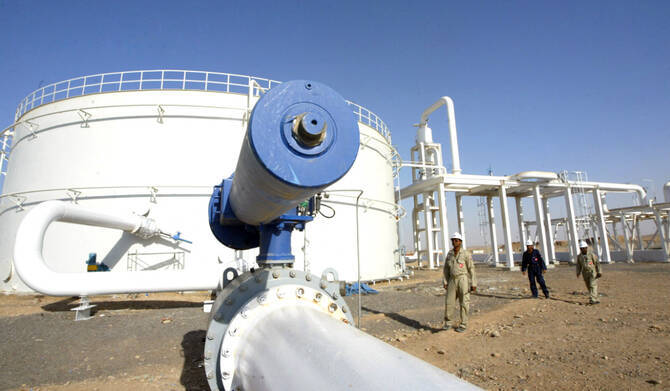
Several oilfields in Iraq's Kurdistan semi-autonomous region halted production as field infrastructure was significantly damaged, according to the regional government, following a third day of drone attacks on Wednesday. (AFP/File)
Short Url
Updated 16 July 2025
Follow

Drone strikes shut oilfields in Iraq’s Kurdistan due to infrastructure damage

  • It was not certain who had carried out the attacks and no group has claimed responsibility
  • Gulf Keystone Petroleum said it had shut production at Shaikan field

BAGHDAD: Several oilfields in Iraq’s Kurdistan semi-autonomous region halted production as field infrastructure was significantly damaged, according to the regional government, following a third day of drone attacks on Wednesday.

It was not certain who had carried out the attacks and no group has claimed responsibility for them.

Gulf Keystone Petroleum said it had shut production at Shaikan field, one of the largest oil discoveries in the Iraq’s Kurdistan region, due to attacks in the field’s vicinity.

“As a safety precaution, GKP has decided to temporarily shut-in production and has taken measures to protect staff. The company’s assets have not been impacted,” the company said in a statement. Gulf Keystone has a production sharing contract with Iraq’s Kurdistan Regional Government (KRG) with an 80 percent working interest in the license of Shaikan, located around 60 kilometers (37 miles) to the northwest of capital Irbil.

“A number of terrorist attacks were carried out by a bomb-dropping drone on the oil fields of Tawke, Peshkabour, and Ain Sifni in the independent administration of Zakho and the district of Shekhan in Duhok province,” KRG’s ministry of natural resources said.

The attacks aimed to harm the economic infrastructure of the Kurdistan region and threaten the safety of civilian workers in the energy sector, the ministry said.

Norwegian oil and gas firm DNO, which operates the Tawke and Peshkabir oilfields in the Zakho area that borders Turkiye, said it temporarily suspended production at the fields following explosions that caused no injuries.

“The damage assessment is underway and the company expects to restart production once the assessment is completed,” DNO said. DNO’s shares fell around 5 percent after the attack and were poised to see their worst day since June 25.

The fields were attacked by three bomb-laden drones, but there were no casualties, only material damage, Kurdistan’s counter-terrorism service posted on Facebook.

The Ain Sifni oilfield, operated by US-based Hunt Oil, was also attacked later in the Dohuk region of northern Iraq.

There were no further details on the attack. On Tuesday, a drone attack halted production at the Sarsang oilfield in Iraq’s Kurdistan region hours before its US operator signed a deal with Iraq to develop another field.

Iraqi Kurdistan security sources said initial investigations suggested the drone came from areas under the control of Iran-backed militias. On Monday, two drones fell on the Khurmala oilfield near Irbil in Iraqi Kurdistan, damaging water pipes at the field.


Fire from Iran, Lebanon triggers sirens across Israel

Updated 2 min 26 sec ago
Follow

Fire from Iran, Lebanon triggers sirens across Israel

  • Alerts were sounded in Jerusalem, Tel Aviv, Haifa and several other northern regions
  • The Israeli army had noticed a gradual decrease in the number of Iranian missiles launched at Israel since Saturday
JERUSALEM: The Israeli military said it had detected multiple missile barrages from Iran on Wednesday, as well as launches from Lebanon, but added that the number of missiles fired from the Islamic republic at Israel was declining.
AFP journalists heard several blasts and multiple rounds of sirens from Jerusalem, while alerts also sounded in Tel Aviv, central Israel, Haifa and several other northern regions.
“The IDF identified missiles launched from Iran toward the territory of the State of Israel. Defensive systems are operating to intercept the threat,” the military said four times throughout the afternoon and early evening.
In a statement shortly after the first salvo was announced, the military said that “several launches... from Lebanon toward Israeli territory were successfully intercepted” after sirens sounded in central Israel.
The new salvos came on the fifth day of the Middle East war, which began on Saturday with joint US-Israeli strikes on Iran.
Lebanon was dragged into the war on Monday when the Tehran-backed Hezbollah group launched an attack on Israel to “avenge” the killing of Iran’s supreme leader Ayatollah Ali Khamenei, prompting ongoing Israeli air strikes.
Israeli military spokesman Lt. Col. Nadav Shoshani told reporters Wednesday evening that the army had noticed a gradual decrease in the number of Iranian missiles launched at Israel since the start of the war.
“We are speaking about many dozens the first day going down gradually to a few dozen and very low amounts,” he said.
“The barrages are much smaller. Today, some of them weren’t even a barrage, they were just one missile,” he added.
Shoshani said that some projectiles were launched from Iraq too, where some militias act as Iran proxies.
“We’ve seen small amounts of fire coming from Iraq, mostly UAVs (drones), but the vast majority of fire is from Iran and now from Hezbollah,” he said.
Israel’s Magen David Adom (MDA) emergency services said they had evacuated to hospital two people in central Israel with mild injuries, including “a man of about 30 with shrapnel wounds and another casualty with blast injuries.”
Police said in a statement that officers were dispatched to five locations in the Jerusalem area “where various intercepted projectiles had fallen, causing only damage.”
The military said that the “majority of the launches” from Lebanon were intercepted.
Not including Wednesday’s figures, MDA said that since the start of the war its teams had provided medical treatment to 414 casualties including “10 fatalities, 2 seriously injured, 6 moderately injured and 396 lightly injured.”