

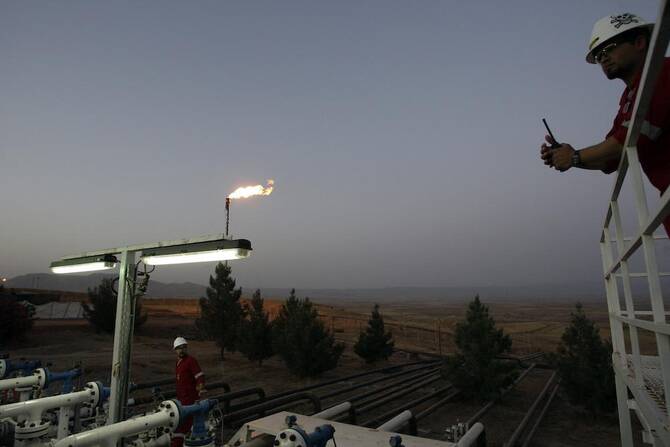
Drone attack shuts Iraq oil field run by US company

Iraq’s autonomous Kurdistan region has lucrative production-sharing deals, which allow international oil companies to rapidly recover costs and split profits between them and the government. (AFP file photo)
Short Url
Updated 15 July 2025
Follow

Drone attack shuts Iraq oil field run by US company

  • The Kurdistan natural resources ministry said the Sarsang oil field in Duhok province was hit
  • Strike called ‘an act of terrorism against the Kurdistan Region’s vital economic infrastructure’

IRBIL, Iraq: A drone strike forced a US company to suspend operations at an oil field in Iraq’s autonomous Kurdistan region Tuesday, amid a wave of similar attacks targeting the region’s energy infrastructure.

The Kurdistan natural resources ministry said the Sarsang oil field in Duhok province was hit, calling the strike “an act of terrorism against the Kurdistan Region’s vital economic infrastructure.”

The attack followed a similar drone strike a day earlier in neighboring Irbil province.

HKN Energy, the US company, said Tuesday’s blast occurred at about 7:00 a.m. (0400 GMT) at one of its production facilities in the Sarsang field.

“Operations at the affected facility have been suspended until the site is secured,” it said in a statement.

A fire broke out following the explosion, which did not cause any casualties.

Emergency response teams have contained the blaze, the company said later in an update.

In the past few weeks, there has been a spate of drone and rocket attacks mostly affecting Kurdistan.

Long plagued by conflict, Iraq has frequently experienced such attacks, often linked to regional proxy struggles.

The explosion in Sarsang field occurred a day after three explosive-laden drone attacks were reported in Kurdistan, with one drone shot down near Irbil airport, which hosts US troops, and another two hitting the Khurmala oil field causing material damage.

There has been no claim of responsibility for those attacks.

But, on July 3, the Kurdistan authorities said a drone was downed near Irbil airport, blaming the Hashed Al-Shaabi – a coalition of pro-Iran former paramilitaries now integrated into the regular armed forces.

The federal government in Baghdad rejected the accusation.

The latest attacks come at a time of heightened tension between Baghdad and Irbil over oil exports, with a major pipeline through Turkiye shut since 2023 over legal disputes and technical issues.

In May, Iraq’s federal authorities filed a complaint against the autonomous Kurdistan region for signing gas contracts with two US companies, including HKN Energy.


Sweeping US defense bill passes Congress, including real of Syria sanctions

Updated 8 sec ago
Follow

Sweeping US defense bill passes Congress, including real of Syria sanctions

WASHINGTON: The US Senate voted overwhelmingly on Wednesday to advance a $901 billion bill setting policy for the Pentagon, sending the massive piece of legislation to the White House, which has said President Donald Trump will sign it into law. The fiscal 2026 National Defense Authorization Act, or NDAA, is a compromise between separate measures passed earlier this year in the House of Representatives and Senate. It authorizes a record $901 billion in annual military spending, with a 4 percent pay raise for the troops. It also authorizes reforms to the system for acquiring military equipment and includes efforts to boost competitiveness with US archrivals China and Russia.
The Senate backed the bill by 77 to 20, with strong support from both parties. Two of the “no” votes were from Republican senators Mike Lee and Rand Paul.
“This will be the 65th year in a row, the 65th consecutive year, that Congress has come together across the aisle and across two chambers to send the president a bill designed to sustain and strengthen the national defense,” said Senator Roger Wicker of Mississippi, the Republican Senate Armed Services Committee chairman. The House passed the bill last week, by 312 to 112, also with broad bipartisan support. In a break with Trump, whose fellow Republicans hold majorities in both the House and Senate, this year’s NDAA includes several provisions to boost security in Europe, despite Trump’s release earlier this month of a National Security Strategy seen as friendly to Russia and a reassessment of the US relationship with Europe.
The fiscal 2026 NDAA provides $800 million for Ukraine — $400 million in each of the next two years — as part of the Ukraine Security Assistance Initiative, which pays US companies for weapons for Ukraine’s military.
It also authorizes the Baltic Security Initiative and provides $175 million to support Latvia, Lithuania and Estonia’s defense. And it limits the Department of Defense’s ability to drop the number of US forces in Europe to fewer than 76,000 and bars the US European Commander from giving up the title of NATO Supreme Commander.

WINS FOR BOTH PARTIES
Members of Congress take great pride in having passed the NDAA every year for more than six decades.
The measure’s record price tag is $8 billion more than Trump had requested. This month a handful of Republicans and Democrats called for the addition of a provision to strengthen military helicopter safety rules, following a fatal crash between an Army Black Hawk and an American Airlines passenger jet that killed 67 people.
Anger over that issue was not strong enough to derail the NDAA. Senate leaders have promised to address it in upcoming legislation. The NDAA also repeals the tough “Caesar” sanctions imposed on Syria under its former leader Bashar Assad. And it has a provision to withhold a chunk of Defense Secretary Pete Hegseth’s travel budget if he does not provide Congress with unedited videos of military strikes on boats in the southern Caribbean and eastern Pacific. The Trump administration has said the strikes are directed at Venezuelan drug-traffickers. The Senate vote came a day after Trump ordered a blockade of all sanctioned oil tankers entering and leaving Venezuela, his latest move to increase pressure on Venezuelan President Nicolas Maduro’s government.
It repeals the 1991 and 2002 Authorizations for the Use of Military Force (AUMFs) against Iraq, an attempt to reassert Congress’ role in deciding to send troops into combat.
During his first term, Trump said the 2002 AUMF provided legal authority for the 2020 killing in Iraq of senior Iranian military commander Qassem Soleimani.
The NDAA does not include funding to change the name of the Department of Defense to the Department of War, an idea championed by Trump but a change that cannot be formalized without congressional approval.
However, it includes some of the “culture war” efforts popular with politicians on the US right. One measure bars transgender women from participating in athletic programs designated for women at US military academies.
It also codifies into law executive orders by Trump ending diversity, equity and inclusion efforts at the Pentagon.