

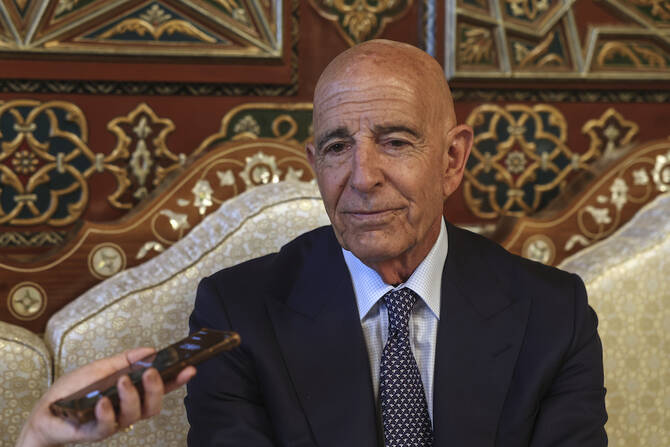

LONDON: US Special Envoy Tom Barrack has sought to clarify remarks made during his recent visit to the region, saying that his comments praising Syria’s progress were not intended as a threat to neighboring Lebanon.
“My comments yesterday praised Syria’s impressive strides, not a threat to Lebanon,” Barrack posted on X on Saturday.
“I observed the reality that Syria is moving at light speed to seize the historic opportunity presented by @POTUS’ lifting of sanctions: Investment from Turkiye and the Gulf, diplomatic outreach to neighboring countries and a clear vision for the future. I can assure that Syria’s leaders only want coexistence and mutual prosperity with Lebanon, and the US is committed to supporting that relationship between two equal and sovereign neighbors enjoying peace and prosperity,” he added.
The clarification comes after reports in Lebanese media, including from MTV Lebanon, cited Barrack as warning that Lebanon risked “going back to Bilad Al-Sham” if it failed to act quickly on regional realignment.
The term Bilad Al-Sham, historically referring to Greater Syria, encompasses present-day Syria, Lebanon, Jordan and Palestine under the Ottoman Empire; a sensitive concept in Lebanon given fears over sovereignty and outside interference.
Barrack’s comments were widely interpreted by some local outlets as a warning that Lebanon could fall under renewed Syrian influence if it failed to align with shifting regional dynamics.
Meanwhile on Saturday, the Syrian government also moved to quash speculation that it was planning escalatory steps against Lebanon over the issue of Syrian detainees held in Lebanese prisons.
A Syrian Ministry of Information official said that the detainee issue remains “a top priority” and that Damascus is committed to resolving it “swiftly through official channels between the two countries.”
Earlier reports had cited unnamed sources close to the Syrian government suggesting that diplomatic and economic retaliation was under consideration in response to what Damascus saw as Lebanon’s neglect of the detainees’ plight.
However, the Information Ministry source denied this, saying there were no such plans and reaffirming Syria’s commitment to bilateral resolution.
In an interview with Arab News on Friday, Barrack had made remarks reflecting growing US concern over Lebanon’s political inertia and the evolving role of Hezbollah.
“If Lebanon doesn’t hurry up and get in line, everyone around them will,” Barrack warned, pointing to a broader regional shift sparked by the lifting of US sanctions on Syria.
He framed the moment as pivotal for Lebanon, with pressure mounting for a new political order.
Addressing questions about Hezbollah’s future, Barrack said the group consists of “two parts,” an Iran-backed militant faction designated as a terrorist organization, and a political wing operating in Lebanon’s parliament.
He added that any disarmament process “must be led by the Lebanese government, with the full agreement of Hezbollah itself.”
Barrack said: “That process has to start with the Council of Ministers. They have to authorize the mandate. And Hezbollah, the political party, has to agree to that. But what Hezbollah is saying is, ‘OK, we understand one Lebanon has to happen.’ Why? Because one Syria is starting to happen.”
On Syria, Barrack described the lifting of sanctions on May 13 as a “strategic fresh start” for the war-ravaged nation and said that the US was not intending to pursue “nation-building or federalism.”
He called the Middle East a “difficult zip code at an amazingly historic time,” and told Arab News that the Trump administration’s new approach was designed to offer “a new slice of hope” to the Syrian people.
“President (Trump)’s message is peace and prosperity,” he said. “Sanctions gave the people hope. That’s really all that happened at that moment.”


