

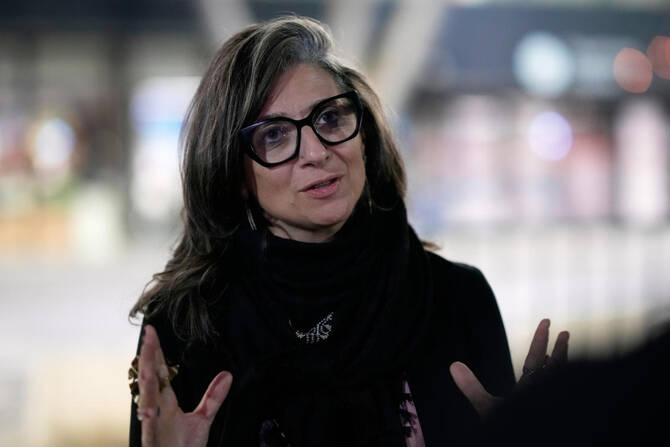

SARAJEVO, Bosnia-Herzegovina: An independent UN investigator and outspoken critic of Israel’s actions in Gaza said Thursday that “it was shocking” to learn that the Trump administration had imposed sanctions on her but defiantly stood by her view on the war.
Francesca Albanese said in an interview with The Associated Press that the powerful were trying to silence her for defending those without any power of their own, “other than standing and hoping not to die, not to see their children slaughtered.”
“This is not a sign of power, it’s a sign of guilt,” the Italian human rights lawyer said.
The State Department’s decision to impose sanctions on Albanese, the UN special rapporteur for the West Bank and Gaza, followed an unsuccessful US pressure campaign to force the Geneva-based Human Rights Council, the UN’s top human rights body, to remove her from her post.
She is tasked with probing human rights abuses in the Palestinian territories and has been vocal about what she has described as the “genocide” by Israel against Palestinians in Gaza. Both Israel and the US have strongly denied that accusation.
“Albanese’s campaign of political and economic warfare against the United States and Israel will no longer be tolerated,” Secretary of State Marco Rubio posted on social media. “We will always stand by our partners in their right to self-defense.”
The US announced the sanctions Wednesday as Israeli Prime Minister Benjamin Netanyahu was visiting Washington to meet with President Donald Trump and other officials about reaching a ceasefire deal in the war in Gaza. Netanyahu faces an arrest warrant from the International Criminal Court, which accuses him of crimes against humanity in his military offensive in Gaza.
In the interview, Albanese accused American officials of receiving Netanyahu with honor and standing side-by-side with someone wanted by the ICC, a court that neither the US nor Israel is a member of or recognizes. Trump imposed sanctions on the court in February.
“We need to reverse the tide, and in order for it to happen – we need to stand united,” she said. “They cannot silence us all. They cannot kill us all. They cannot fire us all.”
Albanese stressed that the only way to win is to get rid of fear and to stand up for the Palestinians and their right to an independent state.
The Trump administration’s stand “is not normal,” she said at the Sarajevo airport. She also defiantly repeated, “No one is free until Palestine is free.”
Albanese was en route to Friday’s 30th anniversary commemoration of the 1995 massacre in Srebrenica where more than 8,000 Bosniak Muslim men and boys in a UN-protected safe zone were killed when it was overrun by Bosnian Serbs.
The United Nations, Human Rights Watch and the Center for Constitutional Rights opposed the US move.
“The imposition of sanctions on special rapporteurs is a dangerous precedent” and “is unacceptable,” UN spokesman Stephane Dujarric said.
While Albanese reports to the Human Rights Council – not Secretary-General Antonio Guterres – the US and any other UN member are entitled to disagree with reports by the independent rapporteurs, “but we encourage them to engage with the UN human rights architecture.”
Trump announced the US was withdrawing from the council in February.
The war between Israel and Hamas began Oct. 7, 2023, when Hamas-led militants stormed into Israel and killed some 1,200 people, mostly civilians, and took 251 people captive. Israel’s retaliatory campaign has killed over 57,000 Palestinians, according to Gaza’s Health Ministry, which says women and children make up most of the dead but does not specify how many were fighters or civilians.
Nearly 21 months into the conflict that displaced the vast majority of Gaza’s 2.3 million people, the UN says hunger is rampant after a lengthy Israeli blockade on food entering the territory and medical care is extremely limited.


