

Pakistan launches location-based SMS alerts to warn millions amid deadly monsoon floods

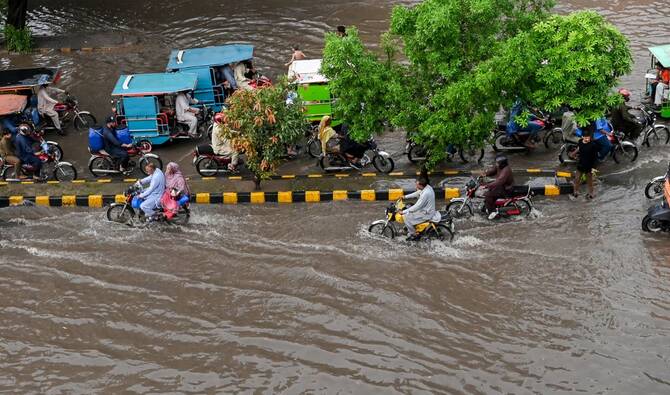
Commuters cross a flooded street after heavy monsoon rains in Lahore on July 9, 2025. (AFP)
Short Url
Updated 10 July 2025
Follow

Pakistan launches location-based SMS alerts to warn millions amid deadly monsoon floods

  • Over 23 million people in high-risk areas receive alerts via Pakistan’s largest telecom network Jazz
  • NDMA using geo-fencing and mobile apps to expand real-time disaster communication nationwide

ISLAMABAD: Pakistan has launched a location-based SMS alert system to warn citizens in flood-prone areas of imminent weather threats, state media reported on Thursday, as the country grapples with deadly monsoon rains.

The system, developed under the Disaster Early Warning System (DEW-3 – Monsoon), is a collaboration between the National Disaster Management Authority (NDMA) and Jazz, Pakistan’s largest digital telecom operator. It uses geo-fencing technology to deliver real-time alerts to millions of mobile users living in high-risk zones, enabling timely evacuations or precautionary action.

The move comes as torrential rains continue to batter parts of Pakistan, with over 80 killed since the start of the monsoon season in June.

Over 23 million Jazz subscribers live in areas identified by the NDMA as vulnerable to flooding and other climate-related disasters.

“This is a powerful demonstration of how public-private collaboration can leverage technology to protect lives and strengthen communities,” Aamir Ibrahim, CEO of Jazz, was quoted as saying in the APP statement.

“Our [Jazz] nationwide reach and location-based capabilities make us uniquely positioned to support NDMA in its mission to minimize disaster-related risks. As the monsoon season continues, this remains an ongoing effort aimed at reaching and protecting even more people in harm’s way.”

According to APP, the system sends out targeted SMS alerts using advanced geo-fencing techniques to people located directly within affected areas. These messages include clear, actionable instructions to help the public respond effectively to natural disasters.

NDMA acknowledged the partnership with Jazz, “which has enabled them to reach vulnerable populations quickly and effectively, using geo-fenced alerts to ensure no one is left uninformed in times of crisis,” APP reported.

The partnership was formalized in March 2025 to enhance Pakistan’s disaster preparedness using digital infrastructure. The system is designed to be scalable and responsive as weather patterns shift or new emergency zones emerge.

NDMA officials say the alerts are part of a wider effort to modernize disaster response by integrating digital tools and expanding risk communication channels. The authority also disseminates information through the Pak NDMA Disaster Alert mobile app, social media, and mainstream news outlets.

Pakistan has faced increasingly severe climate-related disasters in recent years, from catastrophic floods in 2022 to recurring heatwaves and droughts. The country ranks among the top ten nations most vulnerable to climate change, according to the Global Climate Risk Index, underscoring the urgent need for improved early warning and resilience systems.


‘Look ahead or look up?’: Pakistan’s police face new challenge as militants take to drone warfare

Updated 14 January 2026
Follow

‘Look ahead or look up?’: Pakistan’s police face new challenge as militants take to drone warfare

  • Officials say militants are using weapons and equipment left behind after allied forces withdrew from Afghanistan
  • Police in northwest Pakistan say electronic jammers have helped repel more than 300 drone attacks since mid-2025

BANNU, Pakistan: On a quiet morning last July, Constable Hazrat Ali had just finished his prayers at the Miryan police station in Pakistan’s volatile northwest when the shouting began.

His colleagues in Bannu district spotted a small speck in the sky. Before Ali could take cover, an explosion tore through the compound behind him. It was not a mortar or a suicide vest, but an improvised explosive dropped from a drone.

“Now should we look ahead or look up [to sky]?” said Ali, who was wounded again in a second drone strike during an operation against militants last month. He still carries shrapnel scars on his back, hand and foot, physical reminders of how the battlefield has shifted upward.

For police in the northwestern Khyber Pakhtunkhwa (KP) province, the fight against militancy has become a three-dimensional conflict. Pakistani officials say armed groups, including the Tehreek-e-Taliban Pakistan (TTP), are increasingly deploying commercial drones modified to drop explosives, alongside other weapons they say were acquired after the US military withdrawal from neighboring Afghanistan.

Security analysts say the trend mirrors a wider global pattern, where low-cost, commercially available drones are being repurposed by non-state actors from the Middle East to Eastern Europe, challenging traditional policing and counterinsurgency tactics.

The escalation comes as militant violence has surged across Pakistan. Islamabad-based Pakistan Institute for Conflict and Security Studies (PICSS) reported a 73 percent rise in combat-related deaths in 2025, with fatalities climbing to 3,387 from 1,950 a year earlier. Militants have increasingly shifted operations from northern tribal belts to southern KP districts such as Bannu, Lakki Marwat and Dera Ismail Khan.

“Bannu is an important town of southern KP, and we are feeling the heat,” said Sajjad Khan, the region’s police chief. “There has been an enormous increase in the number of incidents of terrorism… It is a mix of local militants and Afghan militants.”

In 2025 alone, Bannu police recorded 134 attacks on stations, checkpoints and personnel. At least 27 police officers were killed, while authorities say 53 militants died in the clashes. Many assaults involved coordinated, multi-pronged attacks using heavy weapons.

Drones have also added a new layer of danger. What began as reconnaissance tools have been weaponized with improvised devices that rely on gravity rather than guidance systems.

“Earlier, they used to drop [explosives] in bottles. After that, they started cutting pipes for this purpose,” said Jamshed Khan, head of the regional bomb disposal unit. “Now we have encountered a new type: a pistol hand grenade.”

When dropped from above, he explained, a metal pin ignites the charge on impact.

Deputy Superintendent of Police Raza Khan, who narrowly survived a drone strike during construction at a checkpoint, described devices packed with nails, bullets and metal fragments.

“They attach a shuttlecock-like piece on top. When they drop it from a height, its direction remains straight toward the ground,” he said.

TARGETING CIVILIANS

Officials say militants’ rapid adoption of drone technology has been fueled by access to equipment on informal markets, while police procurement remains slower.

“It is easy for militants to get such things,” Sajjad Khan said. “And for us, I mean, we have to go through certain process and procedures as per rules.”

That imbalance began to shift in mid-2025, when authorities deployed electronic anti-drone systems in the region. Before that, officers relied on snipers or improvised nets strung over police compounds.

“Initially, when we did not have that anti-drone system, their strikes were effective,” the police chief said, adding that more than 300 attempted drone attacks have since been repelled or electronically disrupted. “That was a decisive moment.”

Police say militants have also targeted civilians, killing nine people in drone attacks this year, often in communities accused of cooperating with authorities. Several police stations suffered structural damage.

Bannu’s location as a gateway between Pakistan and Afghanistan has made it a security flashpoint since colonial times. But officials say the aerial dimension of the conflict has placed unprecedented strain on local forces.

For constables like Hazrat Ali, new technology offers some protection, but resolve remains central.

“Nowadays, they have ammunition and all kinds of the most modern weapons. They also have large drones,” he said. “When we fight them, we fight with our courage and determination.”