

Pakistan to pilot digital currency, following trend set by Gulf and Asian regulators

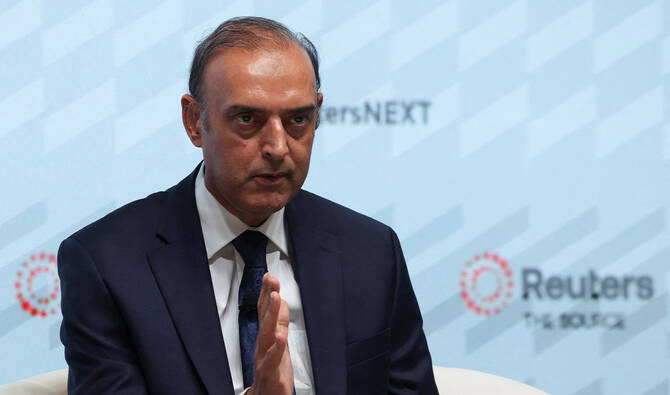
State Bank of Pakistan Governor Jameel Ahmad speaks at the Reuters NEXT Asia summit in Singapore July 9, 2025. (Reuters)
Short Url
Updated 09 July 2025
Follow

Pakistan to pilot digital currency, following trend set by Gulf and Asian regulators

  • Central bank governor says legislation for virtual assets near final stage, pilot for digital rupee expected soon
  • Central banks globally are exploring use of digital currencies as interest in blockchain-based payments grows

KARACHI/SINGAPORE: Pakistan’s central bank is preparing to launch a pilot for a digital currency and is finalizing legislation to regulate virtual assets, Governor Jameel Ahmad said on Wednesday, as the country ramps up efforts to modernize its financial system.

Central banks globally are exploring the use of digital currencies as interest in blockchain-based payments grows. Pakistan’s move follows similar steps by regulators in China, India, Nigeria and several Gulf states to test or issue digital currencies through controlled pilot programs.

Speaking at the Reuters NEXT Asia summit in Singapore, Ahmad said Pakistan was “building up our capacity on the central bank digital currency” and hoped to roll out a pilot soon.

He was speaking on a panel alongside Sri Lanka’s central bank governor, P. Nandalal Weerasinghe, with both discussing monetary policy challenges in South Asia.

Ahmad added that a new law would “lay down the foundations for the licensing and regulation” of the virtual assets sector and that the central bank was already in touch with some tech partners.

The move builds on efforts by the government-backed Pakistan Crypto Council, set up in March to drive virtual asset adoption. The PCC is exploring bitcoin mining using surplus energy, has appointed Binance founder Changpeng Zhao as a strategic adviser and plans to establish a state-run bitcoin reserve.

It has also held talks with US-based crypto firms, including the Trump-linked World Liberty Financial.

In May, the State Bank of Pakistan clarified that virtual assets were not illegal. However, it advised financial institutions not to engage with them until a formal licensing framework was in place.

“There are risks associated, and at the same time, there are opportunities in this new emerging field. So we have to evaluate and manage the risk very carefully, and at the same time not allow to let go the opportunity,” he said on the panel.

TIGHT GRIP, FALLING RATES

On the monetary policy front, Ahmad said the central bank would continue to maintain a tight policy stance to stabilize inflation within its 5–7 percent medium-term target.

Pakistan has cut its benchmark rate from a peak of 22 percent to 11 percent over the past year, as inflation fell sharply from 38 percent in May 2023 to 3.2 percent in June, averaging 4.5 percent in the 2025 fiscal year just ended, a nine-year low.

“We are now seeing the results of this tight monetary policy transfer, both on our inflation as well as on the external account,” he said.

Ahmad also said Pakistan was not overly exposed to dollar weakness, noting that the country’s foreign debt was mostly dollar-denominated and only 13 percent comprised Eurobonds or commercial loans.

“We don’t see any major impact,” he said, adding that reserves had risen to $14.5 billion from under $3 billion two years ago.

Ahmad said Pakistan’s current three-year $7 billion IMF program, which runs through September 2027, was on track and had already resulted in reforms in fiscal policy, energy pricing and the foreign exchange market.

“We are confident that after that (IMF program), maybe we will not require an immediate (follow-up).”

Pakistan’s central bank governor was asked during the panel whether Pakistan had financing plans lined up for upcoming military equipment purchases, particularly imports from China.

He responded that he was not aware of such plans, and said the central bank’s mandate remained ensuring smooth interbank market functioning and maintaining ample foreign exchange “so that there is no problem as far as trade financing is concerned.”

IMF warns against policy slippage amid weak recovery as it clears $1.2 billion for Pakistan

Updated 11 December 2025
Follow

IMF warns against policy slippage amid weak recovery as it clears $1.2 billion for Pakistan

  • Pakistan rebuilt reserves, cut its deficit and slowed inflation sharply over the past one year
  • Fund says climate shocks, energy debt, stalled reforms threaten stability despite recent gains

ISLAMABAD: Pakistan’s economic recovery remains fragile despite a year of painful stabilization measures that helped pull the country back from the brink of default, the International Monetary Fund (IMF) warned on Thursday, after it approved a fresh $1.2 billion disbursement under its ongoing loan program.

The approval covers the second review of Pakistan’s Extended Fund Facility (EFF) and the first review of its climate-focused Resilience and Sustainability Facility (RSF), bringing total disbursements since last year to about $3.3 billion.

Pakistan entered the IMF program in September 2024 after years of weak revenues, soaring fiscal deficits, import controls, currency depletion and repeated climate shocks left the economy close to external default. A smaller stopgap arrangement earlier that year helped avert immediate default, but the current 37-month program was designed to restore macroeconomic stability through strict monetary tightening, currency adjustments, subsidy rationalization and aggressive revenue measures.

The IMF’s new review shows that Pakistan has delivered significant gains since then. Growth recovered to 3 percent last year after shrinking the year before. Inflation fell from over 23 percent to low single digits before rising again after this year’s floods. The current account posted its first surplus in 14 years, helped by stronger remittances and a sharp reduction in imports. And the government delivered a primary budget surplus of 1.3 percent of GDP, a key program requirement. Foreign exchange reserves, which had dropped dangerously low in 2023, rose from US$9.4 billion to US$14.5 billion by June.

“Pakistan’s reform implementation under the EFF arrangement has helped preserve macroeconomic stability in the face of several recent shocks,” IMF Deputy Managing Director Nigel Clarke said in a statement after the Board meeting.

But he warned that Islamabad must “maintain prudent policies” and accelerate reforms needed for private-sector-led and sustainable growth.

The Fund noted that the 2025 monsoon floods, affecting nearly seven million people, damaging housing, livestock and key crops, and displacing more than four million, have set back the recovery. The IMF now expects GDP growth in FY26 to be slightly lower and forecasts inflation to rise to 8–10 percent in the coming months as food prices adjust.

The review warns Pakistan against relaxing monetary or fiscal discipline prematurely. It urges the State Bank to keep policy “appropriately tight,” allow exchange-rate flexibility and improve communication. Islamabad must also continue raising revenues, broadening the tax base and protecting social spending, the Fund said.

Despite the progress, Pakistan’s structural weaknesses remain severe.

Power-sector circular debt stands at about $5.7 billion, and gas-sector arrears have climbed to $11.3 billion despite tariff adjustments. Reform of state-owned enterprises has slowed, including delays in privatizing loss-making electricity distributors and Pakistan International Airlines. Key governance and anti-corruption reforms have also been pushed back.

The IMF welcomed Pakistan’s expansion of its flagship Benazir Income Support Program, which raises cash transfers for low-income families and expands coverage, saying social protection is essential as climate shocks intensify. But it warned that high public debt, about 72 percent of GDP, thin external buffers and climate exposure leave the country vulnerable if reform momentum weakens.

The Fund said Pakistan’s challenge now is to convert short-term stabilization into sustained recovery after years of economic volatility, with its ability to maintain discipline, rather than the size of external financing alone, determining the durability of its gains.