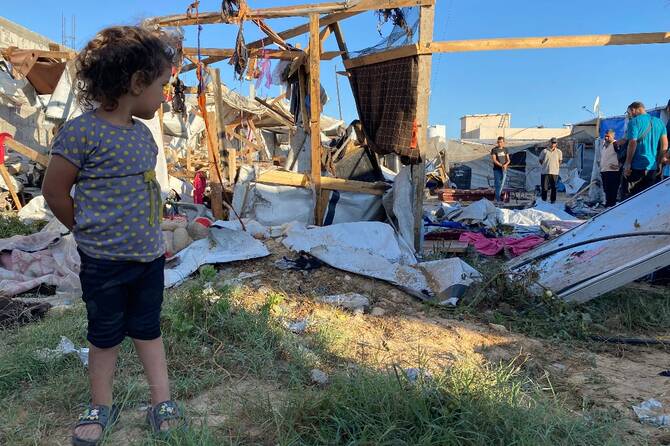

TULKARM: Malik Lutfi contemplated which of his family’s belongings to salvage in the few moments he was given while Israeli troops carried out home demolitions in the Tulkarm refugee camp where he grew up in the Israeli-occupied West Bank.
Now 51, the father of six has rented a small room in the nearby city of Tulkarm, but without access to his electronic repair shop in the cordoned-off camp, he has no income to meet the rent, sparking anxiety about his family’s future.
With bulldozers roaring outside, he said: “They kicked us out six months ago and we are still out. When you go back you try to bring anything you can, but in two hours with only our hands, you cannot bring many things.”
He said he knew many families in a worse situation even than his, pushed to living in crowded schools or on patches of farmland.
“We are waiting for help,” he said.
Israeli operations are pushing tens of thousands of West Bank Palestinians like Lutfi out of their homes, says B’Tselem, the independent Israeli human rights information center for the occupied territories.
Around 40,000 residents from the Tulkarm, Nur Shams and Jenin refugee camps have been displaced by the military operation this year, B’Tselem said.
Israel says it is acting against flashpoints of militancy, including the northern cities of Tulkarm and Jenin.
“This requires the demolition of buildings, allowing the forces to operate freely and move unhindered within the area,” an Israeli military spokesperson said in a statement on Tuesday.
“The decision to demolish these structures is based on operational necessity and was made only after considering alternative options,” the statement said.
Israeli demolitions have drawn widespread international criticism and coincide with heightened fears among Palestinians of an organized effort by Israel to formally annex the West Bank, the area seized by Israel in the 1967 Middle East war.
Reuters witnesses this week saw bulldozers plowing through buildings and wide, new roads lined by rubble that bulldozers had carved out by demolishing concrete homes. Residents piled chairs, blankets and cooking equipment onto trucks.
Tulkarm’s governor Abdullah Kamil said in recent weeks the destruction had intensified, with 106 homes and 104 other buildings in the nearby Tulkarm and Nur Shams camps destroyed.
“What is happening in Tulkarm is an Israeli political decision, the issue has nothing to do with security,” Kamil, the Palestinian governor, said. “There is nothing left in the camp, it has become a ghost camp.”
Israel’s northern West Bank operation which began in January has been one of the biggest since the Second Intifada uprising by Palestinians more than 20 years ago, involving several brigades of troops earlier this year backed by drones, helicopters and, for the first time in decades, heavy battle tanks.
SIMMERING SITUATION
As efforts ramp up in Washington and Qatar to secure a Gaza ceasefire deal, some international officials and rights groups say they are also worried about the simmering situation for Palestinians in the West Bank.
“In the northern West Bank, Israel has begun replicating tactics and combat doctrines honed in its current offensive on Gaza,” said Shai Parnes, public outreach director at B’Tselem.
“This includes increased ... widespread and deliberate destruction of homes and civilian infrastructure, and forced displacement of civilians from areas designated by the military as combat zones.”
Israeli hard-liners inside and outside the government have called repeatedly for Israel to annex the West Bank, a kidney-shaped area around 100 kilometers (62 miles) long that Palestinians see as the core of a future independent state, along with Gaza and with East Jerusalem as its capital.
Israeli government ministers deny that the West Bank operation has any wider purpose than battling militant groups. The Israeli military in its statement said it was following international law and targeting militancy.
Kamil, the Palestinian governor, said displacement was putting pressure on a community already reeling economically, with thousands sheltering in mosques, schools and overcrowded homes with relatives.
Returning for the first time in six months, Lutfi said he was shocked at the scale of damage.
“Most people when they come back to look at their homes, they find them destroyed, the destruction that meets them is enormous: wide streets, destroyed infrastructure and electricity,” he said. “If we want to rebuild, it will take a long time.”