

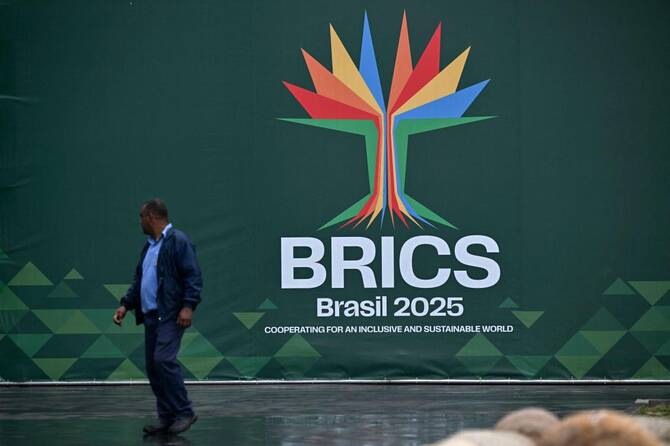

RIO DE JANEIRO, Brazil: A summit of BRICS nations will convene in Rio de Janeiro on Sunday and Monday, with members hoping to weigh in on global crises while tiptoeing around US President Donald Trump’s policies.
The city, with beefed-up security, will play host to leaders and diplomats from 11 emerging economies including China, India, Russia and South Africa, which represent nearly half of the world’s population and 40 percent of its GDP.
Brazil’s left-wing President Luiz Inacio Lula da Silva will have to navigate the absence of Chinese President Xi Jinping, who will miss the summit for the first time.
Beijing will instead be represented by its Prime Minister Li Qiang.
Russian leader Vladimir Putin, who is facing a pending International Criminal Court (ICC) arrest warrant, will not travel to Brazil, but is set to participate via video link, according to the Kremlin.
Iran’s President Masoud Pezeshkian, fresh from a 12-day conflict with Israel and a skirmish with the United States, will also be absent, as will his Egyptian counterpart Abdel Fattah El-Sisi, a Brazilian government source said.
Tensions in the Middle East, including Israel’s ongoing war in Gaza, will weigh on the summit, as well as the grim anticipation of tariffs threatened by Trump due next week.
“We’re anticipating a summit with a cautious tone: it will be difficult to mention the United States by name in the final declaration,” Marta Fernandez, director of the BRICS Policy Center at Rio’s Pontifical Catholic University said.
China, for example, “is trying to adopt a restrained position on the Middle East,” Fernandez said, pointing out that Beijing was also in tricky tariff negotiations with Washington.
“This doesn’t seem to be the right time to provoke further friction” between the world’s two leading economies, the researcher said.
BRICS members did not issue a strong statement on the Iran-Israel conflict and subsequent US military strikes due to their “diverging” interests, according to Oliver Stuenkel, an international relations professor at the Getulio Vargas Foundation.
Brazil nevertheless hopes that countries can take a common stand at the summit, including on the most sensitive issues.
“BRICS (countries), throughout their history, have managed to speak with one voice on major international issues, and there’s no reason why that shouldn’t be the case this time on the subject of the Middle East,” Brazil’s Foreign Minister Mauro Vieira said.
However, talks on finding an alternative to the dollar for trade between BRICS members are likely dead in the water.
For Fernandez, it is almost “forbidden” to mention the idea within the group since Trump threatened to impose 100 percent tariffs on countries that challenge the dollar’s international dominance.
Brazil, which in 2030 will host the COP30 UN climate conference, also hopes to find unity on the fight against climate change.
Artificial intelligence and global governance reform will also be on the menu.
“The escalation of the Middle East conflict reinforces the urgency of the debate on the need to reform global governance and strengthen multilateralism,” said foreign minister Vieira.
Since 2023, Egypt, the United Arab Emirates, Ethiopia, Iran and Indonesia have joined the BRICS, formed in 2009 as a counter-balance to leading Western economies.
But, as Fernandez points out, this expansion “makes it all the more difficult to build a strong consensus.”


