

Pakistan’s inflation rate to remain within 3-4% range in June — finance ministry

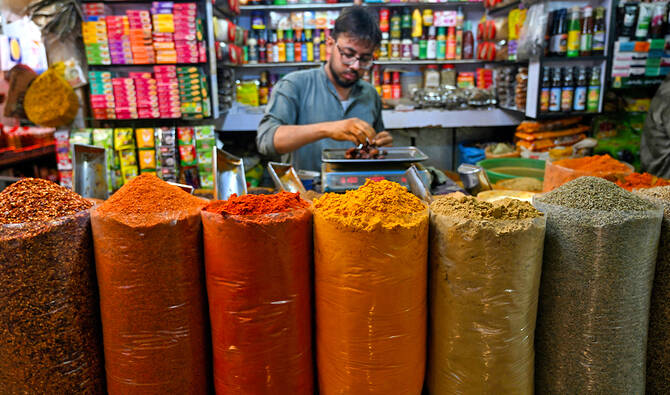
A shopkeeper sells spices at a market in Karachi on June 10, 2025. (AFP/File)
Short Url
Updated 30 June 2025
Follow

Pakistan’s inflation rate to remain within 3-4% range in June — finance ministry

  • Higher remittances and exports to keep current account in surplus, report say
  • Topline Securities sees FY25 inflation averaging 4.6%, expects no major rate changes

ISLAMABAD: Pakistan’s inflation is expected to remain between 3–4% in June, the country’s finance ministry said in its monthly economic outlook report on Monday, reflecting a sharp decline from the record highs of 2023, when inflation peaked at 38% amid political turmoil and external account pressure.

Annual inflation rose to 3.5% in May 2025, up from just 0.3% in April, according to official data from the Pakistan Bureau of Statistics. However, it remains far below the 38% peak recorded in May 2023 amid political turmoil and external account pressure.

“Inflation is expected to remain within the range of 3.0–4.0 percent for June 2025,” the finance ministry said, citing stable food supplies and fiscal discipline.

The ministry said recent economic indicators showed signs of recovery, with increased lending to the private sector suggesting a pickup in production and business confidence. On the external front, it projected that higher remittances from overseas workers and a modest uptick in exports would help maintain a current account surplus for the full fiscal year ending June 30, 2025.

From July 2024 to April 2025, federal revenue growth outpaced expenditures, which the ministry attributed to the effectiveness of its fiscal reform measures. Net federal receipts grew by 44.4% to Rs8,124.2 billion, up from Rs5,627.5 billion a year earlier.

“The rise in revenues is primarily contributed by 68.1% growth in non-tax collections,” the report said. “Similarly, tax collection witnessed a significant increase, as in Jul-May FY2025, it grew by 25.9% to Rs10,233.9 billion from Rs8,125.7 billion last year.”

Breakdowns of tax categories showed a 33.8% increase in federal excise duty, a 27% rise in direct taxes, a 26.5% jump in sales tax, and a 16.3% increase in customs duties.

Independent analysts say the macroeconomic outlook is improving, though risks remain. 
Brokerage house Topline Securities estimated on Monday that June 2025 inflation will clock in at around 3.2%, compared to 12.6% in the same month last year. This would bring average inflation for FY2025 to 4.6%, a significant drop from 23.9% in FY2024.

On a month-on-month basis, Topline expects a slight 0.2% increase in overall prices, driven largely by a 0.4% rise in the housing index due to fuel cost adjustments in electricity bills. However, food prices are forecast to decline by 0.5%, led by falling poultry prices.

Within the sensitive price index (SPI) basket, sharp price increases were observed in tomatoes (59.3%), potatoes (26.4%), eggs (7.4%), fresh fruits (5.7%) and onions (5.0%), while notable declines were seen in chicken (-32.5%), fresh vegetables (-12.2%), LPG (-6.6%), vegetable ghee (-0.4%), and cooking oil (-0.4%).

Topline said the recently announced FY2026 federal budget was broadly non-inflationary, with minimal changes to the tax structure and no major new levies, in line with IMF-supported fiscal goals. However, it cautioned that the government’s move to raise fixed charges for domestic gas consumers could push inflation slightly higher in coming months.

With gas having a weight of about 1.1% in the urban consumer price index, the brokerage estimated the hike could result in a 23% month-on-month increase in the gas index, translating to a 0.85 percentage point uptick in headline inflation.

Looking ahead, Topline projected that average inflation for FY2026 would hover around 5.4%, assuming no major shocks to the domestic supply chain or global commodity prices. It also expects the central bank to keep interest rates steady, noting that the full impact of recent rate cuts, totaling 1,100 basis points, has yet to fully transmit through the economy.


Pakistan to invest $1 billion in AI by 2030 in push to modernize economy

Updated 5 sec ago
Follow

Pakistan to invest $1 billion in AI by 2030 in push to modernize economy

  • PM says government will introduce AI curriculum in schools nationwide
  • The transformation plan will help train 1 million non-IT professionals in AI

ISLAMABAD: Prime Minister Shehbaz Sharif on Monday announced that Pakistan would invest $1 billion in artificial intelligence (AI) by 2030, in a major step to modernize the South Asian nation’s digital economy.

Pakistan, a country of 240 million people, seeks to become a key participant in the global AI economy, amid growing interest from governments in the Global South to harness AI for productivity, skills development and innovation.

The South Asian nation has been actively developing its AI landscape and approved its National AI Policy in July last year, which was followed by the launch of the country’s sovereign AI cloud and a startup fund.

Speaking at the launch of the Indus AI Week 2026 in Islamabad, Sharif unveiled a multi-pronged roadmap intended to transform Pakistan from a provider of IT technicians into a global hub for AI expertise.

“I am pleased to announce that the Government of Pakistan is committed to invest $1 billion in AI by 2030, which will go a long way in building AI ecosystem in our country,” he told policymakers and international tech experts at Islamabad’s Jinnah Convention Center.

Sharif detailed several flagship initiatives to support this transformation, including a sweeping educational reform, at the event organized by the Information Technology (IT) Ministry, which will be running until Feb. 15, featuring strategic dialogues on sovereign AI and technical showcases.

“AI curriculum will be introduced not only in all federally controlled or run schools, but also in all schools of AJK, that is Azad Jammu and Kashmir, and Gilgit-Baltistan, as well as remote parts of Balochistan,” he said.

The government will provide 1,000 fully funded PhD scholarships in AI to postgraduates to bolster high-level research, according to the PM. It plans to launch a nationwide program to train 1 million “non-IT professionals in AI skills” to enhance productivity and improve livelihoods across traditional sectors of the economy.

Sharif emphasized that the focus would remain on high-impact sectors, including agriculture, mines and minerals, and the empowerment of Pakistan’s youth which makes up 60 percent of its 240 million population.

“We will, God willing, bring in programs to transform them from IT technicians to AI experts, which will lead to our agriculture production in terms of its yield, its quality, its efficiency, like never before,” he said.

Drawing parallels to previous digitization efforts in the Punjab province, such as land record digitization and the establishment of the first IT university in Lahore, Sharif framed the AI push as a “gamechanger” for national governance. He noted the Federal Board of Revenue is already undergoing a digital overhaul to curb smuggling and tax evasion.

“Pakistan is absolutely ready to accept the challenge and walk with our global partners absolutely with great commitment and dedication,” he said. “Our commitment is solid, unwavering. We will never look back.”