Pakistan approves 10% gas price hike for industry, power plants under IMF conditions

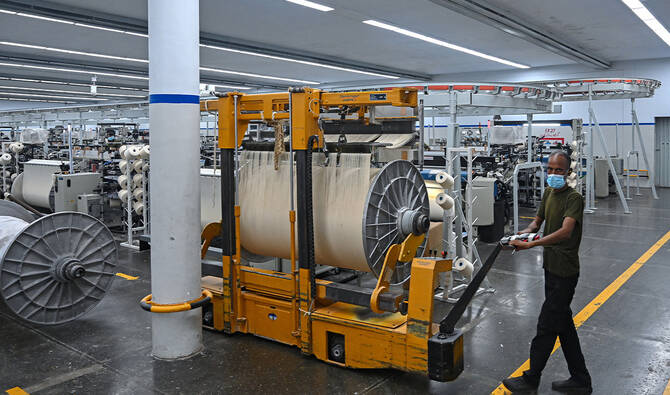
In this picture taken on July 20, 2023, a worker shifts a fabric roll at the Kohinoor Textile Mills in Lahore, Pakistan. (AFP/File)
Short Url
Updated 27 June 2025
Follow

Pakistan approves 10% gas price hike for industry, power plants under IMF conditions

  • ECC spares households in gas price hike, with only fixed charges adjusted to recover costs
  • It also approves grant for defense ministry to cover shortfall in salaries, allowances and dues

KARACHI: Pakistan on Friday approved a 10 percent increase in natural gas prices for industrial users and power plants starting next month, in line with reforms mandated by the International Monetary Fund (IMF) to ensure cost recovery and tariff rationalization, an official statement said.

The decision was taken by the Economic Coordination Committee (ECC) of the Cabinet, chaired by Finance Minister Muhammad Aurangzeb.

While prices for bulk consumers and gas-fired power plants will rise, household consumers will be shielded from the increase.

“To protect household consumers, gas prices will remain unchanged, with only fixed charges revised,” the Finance Division said in a statement released after the meeting. “However, prices for bulk consumers, industrial units and power plants will be increased by an average of 10 percent.”

The statement said the revised pricing structure, submitted by the Petroleum Division, complies with regulatory obligations under the OGRA Ordinance and meets structural benchmarks under Pakistan’s ongoing loan program with the IMF.

It also supports a shift from cross-subsidies to direct, targeted assistance for low-income consumers.

DEFENSE GRANT

The ECC also approved a Rs15.8 billion ($55.3 million) supplementary grant for the Ministry of Defense to cover a shortfall in salaries, allowances and pending dues.

The funding includes disbursements under the prime minister’s compensation package for martyrs of the recent Pakistan-India war fought last month.

In a separate decision, the committee gave in-principle approval to launch a risk coverage scheme for small farmers and underserved regions by August 14.

The program is expected to bring 750,000 new borrowers into the formal credit system and unlock a Rs300 billion ($1.05 billion) agricultural loan portfolio over three years (FY2026-28).

The statement said the total budgetary support for the scheme, covering risk coverage and bank operating costs, is estimated at Rs37.5 billion ($131.25 million), to be disbursed between FY2027 and FY2031.

The government has directed relevant ministries to incorporate additional safeguards before the official rollout.


Pakistan to invest $1 billion in AI by 2030 in push to modernize economy

Updated 5 sec ago
Follow

Pakistan to invest $1 billion in AI by 2030 in push to modernize economy

  • PM says government will introduce AI curriculum in schools nationwide
  • The transformation plan will help train 1 million non-IT professionals in AI

ISLAMABAD: Prime Minister Shehbaz Sharif on Monday announced that Pakistan would invest $1 billion in artificial intelligence (AI) by 2030, in a major step to modernize the South Asian nation’s digital economy.

Pakistan, a country of 240 million people, seeks to become a key participant in the global AI economy, amid growing interest from governments in the Global South to harness AI for productivity, skills development and innovation.

The South Asian nation has been actively developing its AI landscape and approved its National AI Policy in July last year, which was followed by the launch of the country’s sovereign AI cloud and a startup fund.

Speaking at the launch of the Indus AI Week 2026 in Islamabad, Sharif unveiled a multi-pronged roadmap intended to transform Pakistan from a provider of IT technicians into a global hub for AI expertise.

“I am pleased to announce that the Government of Pakistan is committed to invest $1 billion in AI by 2030, which will go a long way in building AI ecosystem in our country,” he told policymakers and international tech experts at Islamabad’s Jinnah Convention Center.

Sharif detailed several flagship initiatives to support this transformation, including a sweeping educational reform, at the event organized by the Information Technology (IT) Ministry, which will be running until Feb. 15, featuring strategic dialogues on sovereign AI and technical showcases.

“AI curriculum will be introduced not only in all federally controlled or run schools, but also in all schools of AJK, that is Azad Jammu and Kashmir, and Gilgit-Baltistan, as well as remote parts of Balochistan,” he said.

The government will provide 1,000 fully funded PhD scholarships in AI to postgraduates to bolster high-level research, according to the PM. It plans to launch a nationwide program to train 1 million “non-IT professionals in AI skills” to enhance productivity and improve livelihoods across traditional sectors of the economy.

Sharif emphasized that the focus would remain on high-impact sectors, including agriculture, mines and minerals, and the empowerment of Pakistan’s youth which makes up 60 percent of its 240 million population.

“We will, God willing, bring in programs to transform them from IT technicians to AI experts, which will lead to our agriculture production in terms of its yield, its quality, its efficiency, like never before,” he said.

Drawing parallels to previous digitization efforts in the Punjab province, such as land record digitization and the establishment of the first IT university in Lahore, Sharif framed the AI push as a “gamechanger” for national governance. He noted the Federal Board of Revenue is already undergoing a digital overhaul to curb smuggling and tax evasion.

“Pakistan is absolutely ready to accept the challenge and walk with our global partners absolutely with great commitment and dedication,” he said. “Our commitment is solid, unwavering. We will never look back.”