

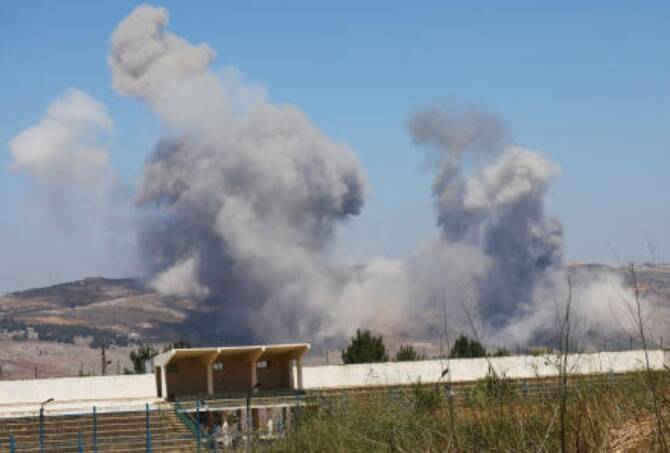

BEIRUT: A series of Israeli airstrikes targeted southern Lebanon on Friday, including a residential building in Nabatieh, located 77 km south of Beirut.
According to the Ministry of Health, the raids killed two people, including the owner of a shop located within the targeted building, and injured 15 others.
Lebanon’s Prime Minister Nawaf Salam has condemned the attacks, calling them “a blatant violation of national sovereignty and of the ceasefire agreement reached in November.
“They also threaten the stability we are striving to maintain.”
According to official and security sources, the Israeli army launched a wave of violent and extensive raids on the hills surrounding Nabatieh. This marks the second-largest assault on Nabatieh since the ceasefire.
The strikes appear to have targeted ammunition depots, as prolonged explosions were heard across the area.
Rumors Nabatieh suggest that the missile that hit the building was the result of explosions at the weapons depots targeted by Israeli airstrikes.
It is said that a missile flew from the depots and hit the building, rather than it being the result of an Israeli military drone.
However, this information has not been confirmed by anyone, except the Israeli side, which denied targeting the building.
More than 20 airstrikes were launched on Nabatieh within 15 minutes. This formed a ring of fire around its forests, valleys and hills, in particularly the Ali Al-Taher hills, Jarmaq, Al-Dabshah, Kfar Tebnit heights and Nabatieh Al-Fawqa.
As explosions echoed across southern Lebanon, a security source stated that “the missiles used in this attack were likely concussion missiles given the intensity of the blasts.”
Residents claimed that the targeted sites included Hezbollah warehouses and tunnels used by the group.
Dozens of homes in Kfar Tebnit, Nabatieh Al-Fawqa and Kafr Rumman sustained damage, with windows shattered by the blasts. Rocks and debris from the strikes also blocked the Nabatieh-Khardali road.
The Israeli army carried out similar attacks in the area at the beginning of May.
Israeli army spokesman Avichay Adraee said that “Israeli warplanes targeted a site used by Hezbollah to operate fire control and defense systems in Jabal Shqif, southern Lebanon.”
He claimed: “The site was part of an underground project that had been put out of service following previous Israeli airstrikes on the area. The army observed attempts to restore the site, which is why the terrorist infrastructure in the area was struck.”
Israeli Army Radio reported that “extensive raids are once again targeting underground structures in southern Lebanon after restoration efforts were detected.”
The Israeli army insists on blocking any restoration efforts or the removal of debris from the destroyed border area.
Earlier this morning, an Israeli drone dropped a stun grenade near two pickup trucks in the town of Ramyeh while the drivers were loading scrap metal. The drivers fled the scene, and no injuries were reported.
The ceasefire agreement faces a political deadlock because it is linked to several issues including the disarmament of Hezbollah forces north of the Litani River, Israel’s withdrawal from five occupied Lebanese hills, and the granting of social rights to Palestinian refugees.
In this context, former head of the Progressive Socialist Party, Walid Jumblatt, a key political figure in Lebanon, revealed unexpectedly that “his party had handed its weapons over to the relevant authorities about three weeks ago.”
During a press conference on Wednesday evening, Jumblatt reiterated that he had informed President Joseph Aoun of his decision immediately after the latter’s election, “and of his intention to fill constitutional vacancies,” a declaration that sparked political debate on Friday.
Jumblatt announced that “the weapons that were stored at a compromised site were intended for use in acts of murder.” He explained that he “alerted the presidency and the competent agencies to take possession of this arsenal before any disaster occurred.
“The handover took place about three weeks ago, but I chose to remain discreet to preserve stability, as wars were raging in the east and west, and have now calmed down, thank God.”
Jumblatt revealed that the “weapons were gradually accumulated following the events of May 2008 between the sovereign forces and Hezbollah and its allies.”
All parties in Lebanon had surrendered their weapons after the signing of the Taif Agreement, with the exception of Hezbollah, which considered its arsenal at the time as “weapons of resistance against Israel.”
Jumblatt added: “There was great tension between the PSP and the other party (Hezbollah) which resulted in casualties on both sides. I made significant efforts with everyone and the state, and even with Hezbollah itself.
“We had contact with the party when necessary, and we were able to bring the issue to a halt. However, the weapons existed; some were purchased, and others were scattered in some areas.
“I worked to assemble the weapons in a central location, and I collected most of them, light and medium weapons, along with some 23-caliber machine guns and others. The weapons were handed over to the state.”
Jumblatt emphasized that “today, a new chapter has opened in the Middle East, and the previous means of confrontation are no longer viable.”
“All weapons must be under the authority of the state,” he added.
“Therefore, if there is a Lebanese party or Lebanese parties, or even non-Lebanese parties, that possess weapons, I hope that they will hand them over to the state in the proper form and manner.”
He also called for “the need to grant Palestinians in Lebanon their full rights to work and live with dignity, away from the policies of segregation and containment.”
“There are occupied border points and villages that have been completely destroyed,” Jumblatt said, rejecting any link between the handover of weapons and Israel’s withdrawal.
He emphasized “adherence to UN resolutions, especially Resolution 1701 and the Taif Agreement.”
Regarding Shebaa Farms — an area still occupied by Israel, which Hezbollah considers its duty to liberate it — Jumblatt highlighted the international debate over whether the territory was part of Lebanon or Syria.
He highlighted Syria’s refusal to submit relevant documentation to the UN and recalled an “agreement reached in the Lebanese National Dialogue in 2006.
“The three of us, Parliament Speaker Nabih Berri and former Hezbollah Secretary-General Hassan Nasrallah and I, agreed to go to Syria to demarcate the borders of the Shebaa Farms.”
He added: “If the farms are Lebanese, we would proceed to the UN, and if not, we would go to the UN to determine the farms’ fate.
“The Shebaa Farms are Syrian, occupied by Israel and fall under the scope of Resolution 242. Mount Hermon remains under occupation, partly Syrian and partly Lebanese.”


