

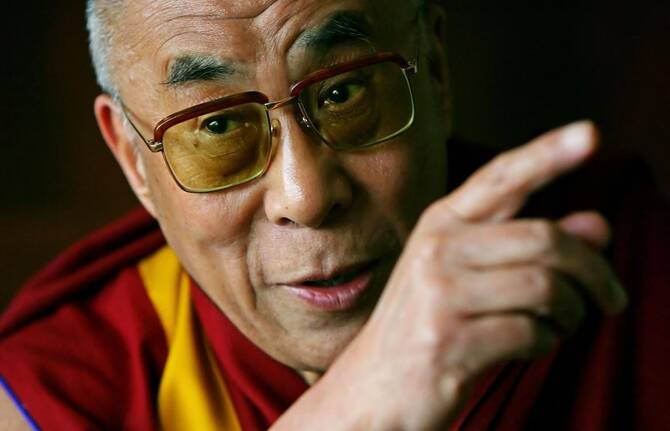

DEHRADUN, India: Tibetans in exile celebrate the 90th birthday of spiritual leader the Dalai Lama next week, an occasion overshadowed by uncertainty about the future of the role and what it means for their movement.
The charismatic Nobel Peace Prize-winning Buddhist – who Tibetans say is the 14th reincarnation of the 600-year-old post – will reveal if there will be another Dalai Lama after him.
The inevitable change ahead brings wider concerns for Tibetans over the struggle to keep their identity alive after generations in exile, following a failed 1959 uprising against Chinese rule.
There is widespread support among Tibetans in exile for the Dalai Lama role to remain, said Dawa Tashi, once jailed in Tibet for his criticism of Beijing.
The Dalai Lama has said the institution will continue only if there is popular demand.
“I strongly believe the reincarnation of the 14th Dalai Lama will continue,” said Tashi, of the India-based Tibetan Center for Human Rights and Democracy.
“This hope is not only shared by Tibetans inside and outside Tibet, but by thousands who are connected to the Dalai Lama across the world,” he said.
The leader, who turns 90 on July 6, and thousands of other Tibetans have lived in exile in India since Chinese troops crushed the uprising in the Tibetan capital Lhasa.
The Dalai Lama has been lauded by his followers for his tireless campaign for greater autonomy for Tibet, a vast high-altitude plateau in China about the size of South Africa.
The Dalai Lama handed over political authority in 2011 to an exiled government chosen democratically by 130,000 Tibetans globally.
At the same time, he warned that the future of his spiritual post faced an “obvious risk of vested political interests misusing the reincarnation system.”
Many Tibetans in exile fear China will name a successor to bolster its control over Tibet.
The Dalai Lama has said that if there is a successor it will come from the “free world” outside China’s control.
The Dalai Lama has long said he does not seek full independence for Tibet.
Beijing says the territory is an integral part of China and that the Dalai Lama “has no right to represent the Tibetan people.”
Whatever the Dalai Lama decides about his role, “the freedom movement must continue regardless,” said Kunga Tashi, a 23-year-old Tibetan software engineer in India’s tech hub Bengaluru.
“The Chinese government and even Tibetans still equate the Dalai Lama with the freedom struggle,” he said. “And that is why his reincarnation feels like a turning point.”
The Dalai Lama, recognized worldwide in his red robes and wide smile, lives an austere monastic life in India’s Himalayan hill town of McLeod Ganj. He has said he wants to live until 113.
Penpa Tsering, the sikyong or head of the government which is also based in McLeod Ganj, said that senior Buddhist elders, or lamas, will meet the Dalai Lama on July 2.
The same day they will open the grand meeting of religious leaders, during which a video message by the Dalai Lama will be broadcast.
No details of its message have been released.
The Dalai Lama’s translator of nearly four decades, Thupten Jinpa, believes that “the continuity of the institution will remain,” meaning that, in time, there “will be a new Dalai Lama.”
“Today, many young Tibetans prioritize personal success over collective struggle,” said Geshema Tenzin Kunsel, a nun in her 50s from Dolma Ling Nunnery, near McLeod Ganj.
“In his absence, I fear what our future might look like.”
Tibetans who spoke to AFP say they will keep up their campaign no matter what happens in the coming weeks.
“While we haven’t yet achieved our goal of returning to a free Tibet, we’ve come further than anyone could have imagined – and that’s because of His Holiness (the Dalai Lama),” said Sonam Topgyal, 26, a university student in New Delhi.
Nepal-based Sakina Batt, 35, a former civil servant with the Tibetan administration, is part of Tibet’s minority Muslim population.
She too believes that the reincarnation process should “continue as it has for generations, preserving its sacred tradition without interruption.”
But she also said that it depended on the people, not just one leader.
“The future of Tibetans depends on unity and resilience,” she said. “It’s ultimately up to us to shape our own destiny.”


