

National Assembly passes $62 billion Pakistan budget for next fiscal year

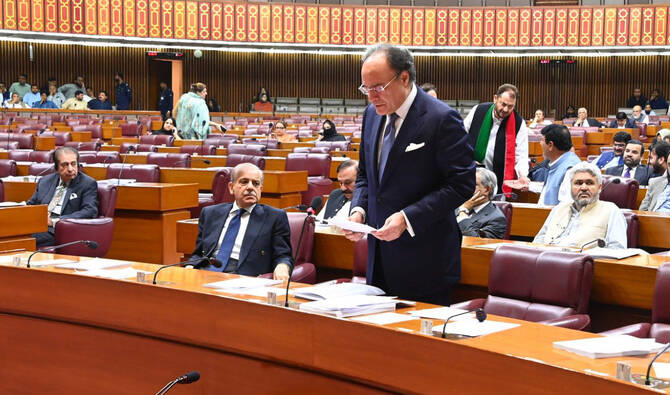
Pakistan Finance Minister Muhammad Aurangzeb speaks during the parliamentary session at the National Assembly of Pakistan in Islamabad on June 26, 2025. (Photo courtesy: Facebook/NA)
Short Url
Updated 27 June 2025
Follow

National Assembly passes $62 billion Pakistan budget for next fiscal year

  • Budget reflects Pakistan’s attempt to balance security concerns with fiscal reform efforts under $7 billion IMF loan program
  • Government has aimed to reduce fiscal deficit to 3.9% of GDP for next year’s budget, increase defense spending by over 20%

ISLAMABAD: The lower house of Pakistan’s parliament passed the federal budget for the next fiscal year on Thursday, which has a total outlay of Rs17.57 trillion [$62 billion] and projects economic growth at 4.2%, state-run media reported.

The federal government unveiled the federal budget on June 10, which reflects a 7% decrease in overall spending compared to the current fiscal year. The largest portion of the budget – Rs8.21 trillion ($29 billion), or nearly half of total expenditures – will go toward debt servicing, continuing to strain Pakistan’s fiscal space.

Another salient feature of the budget is Pakistan’s move to increase defense spending by more than 20% in the 2025-26 fiscal year to Rs2.55 trillion ($9.04 billion). Islamabad seeks to bolster military capabilities following Pakistan’s worst confrontation with India in nearly three decades in May.

“The National Assembly has passed the federal budget for the next fiscal year, with a total outlay of 17,573 billion rupees, focusing on sustainable and inclusive economic growth,” state broadcaster Radio Pakistan reported.

The House passed the budget with certain amendments, giving effect to the federal government’s proposals for the financial year set to begin from July 1.

The bill was read out in the National Assembly and approved clause by clause before the session was adjourned until 11 am, Friday.

Pakistan remains under a $7 billion IMF loan program approved last year, and the budget reflects an attempt to balance security concerns with ongoing fiscal reform efforts.

The government has aimed to reduce the fiscal deficit to 3.9% of the GDP for the next year’s budget. While it has projected a growth of 4.2% for the upcoming year, Pakistan’s economy grew just 2.6% in 2024/25, falling short of its 3.6% target due to weak agriculture and industrial output. Inflation has been projected for next year’s budget at 7.5%.

The Federal Board of Revenue (FBR), Pakistan’s main tax authority, has been tasked with collecting Rs14.1 trillion of the projected Rs19.3 trillion in gross revenue in the budget, marking a 19% year-on-year increase.

While announcing the budget on June 10, Finance Minister Muhammad Aurangzeb had announced plans to grow IT exports to $25 billion over the next five years and forecast a rise in workers’ remittances to $38 billion by the end of the current fiscal year.


Pakistan says $50 million meat export deal with Tajikistan nearing finalization

Updated 09 December 2025
Follow

Pakistan says $50 million meat export deal with Tajikistan nearing finalization

  • Islamabad expects to finalize agreement soon after Dushanbe signals demand for 100,000 tons
  • Pakistan is seeking to expand agricultural trade beyond rice, citrus and mango exports

ISLAMABAD: Tajikistan has expressed interest in importing 100,000 tons of Pakistani meat worth more than $50 million, with both governments expected to finalize a supply agreement soon, Pakistan’s food security ministry said on Tuesday.

Pakistan is trying to grow agriculture-based exports as it seeks regional markets for livestock and food commodities, while Tajikistan, a landlocked Central Asian state, has been expanding food imports to support domestic demand. Pakistan currently exports rice, citrus and mangoes to Dushanbe, though volumes remain small compared to national production, according to official figures.

The development came during a meeting in Islamabad between Pakistan’s Federal Minister for National Food Security and Research Rana Tanveer Hussain and Ambassador of Tajikistan Yusuf Sharifzoda, where agricultural trade, livestock supply and food-security cooperation were discussed.

“Tajikistan intends to purchase 100,000 tons of meat from Pakistan, an import valued at over USD 50 million,” the ambassador said, according to the ministry’s statement, assuring full facilitation and that Islamabad was prepared to meet the demand.

The statement said the two sides agreed to expand cooperation in meat and livestock, fresh fruit, vegetables, staple crops, agricultural research, pest management and standards compliance. Pakistan also proposed strengthening coordination on phytosanitary rules and establishing pest-free production zones to support long-term exports.

Pakistan and Tajikistan have long maintained political ties but bilateral food trade remains below potential: Pakistan produces 1.8 million tons of mangoes annually but exported just 0.7 metric tons to Tajikistan in 2024, while rice exports amounted to only 240 metric tons in 2022 out of national output of 9.3 million tons. Pakistan imports mainly ginned cotton from Tajikistan.