

India rejects signing Shanghai Cooperation Organization statement seen as pro-Pakistan

India's Defense Minister Rajnath Singh attends the Shanghai Cooperation Organisation (SCO) Defence Ministers' Meeting in Qingdao, Shandong province, China, on June 26, 2025. (Reuters)
Short Url
Updated 26 June 2025
Follow

India rejects signing Shanghai Cooperation Organization statement seen as pro-Pakistan

  • Indian Defense says statement diluted India’s position on critical issues such as terrorism, regional security
  • Singh, without explicitly naming Pakistan, urged the SCO to criticize countries that use “cross-border terrorism”

NEW DELHI, India: Beijing’s bid for enhanced regional leadership suffered a setback Thursday when India rejected signing a joint statement put before members of the China-backed Shanghai Cooperation Organization, saying it was pro-Pakistan in not mentioning April’s terror attack on Indian tourists.

Indian Defense Minister Rajnath Singh said the statement diluted India’s position on critical issues such as terrorism and regional security, a person familiar with the matter told The Associated Press on condition of anonymity because he wasn’t authorized to speak to the media.

India blames Pakistan for backing the gunmen behind the April 22 killing of 26 people, most of them Indian Hindu tourists, in India-controlled Kashmir, and has described it as a terror attack. Islamabad denies the charge.

Singh alleged that the joint statement “suited Pakistan’s narrative” because it did not include that attack but mentioned militant activities in Balochistan, the person said. Pakistan has repeatedly accused India of backing Balochistan freedom movement, allegations that India denies.

The signing ceremony came during a meeting of defense ministers of the Shanghai Cooperation Organization, a regional grouping formed by China and Russia to counter US influence in Asia.
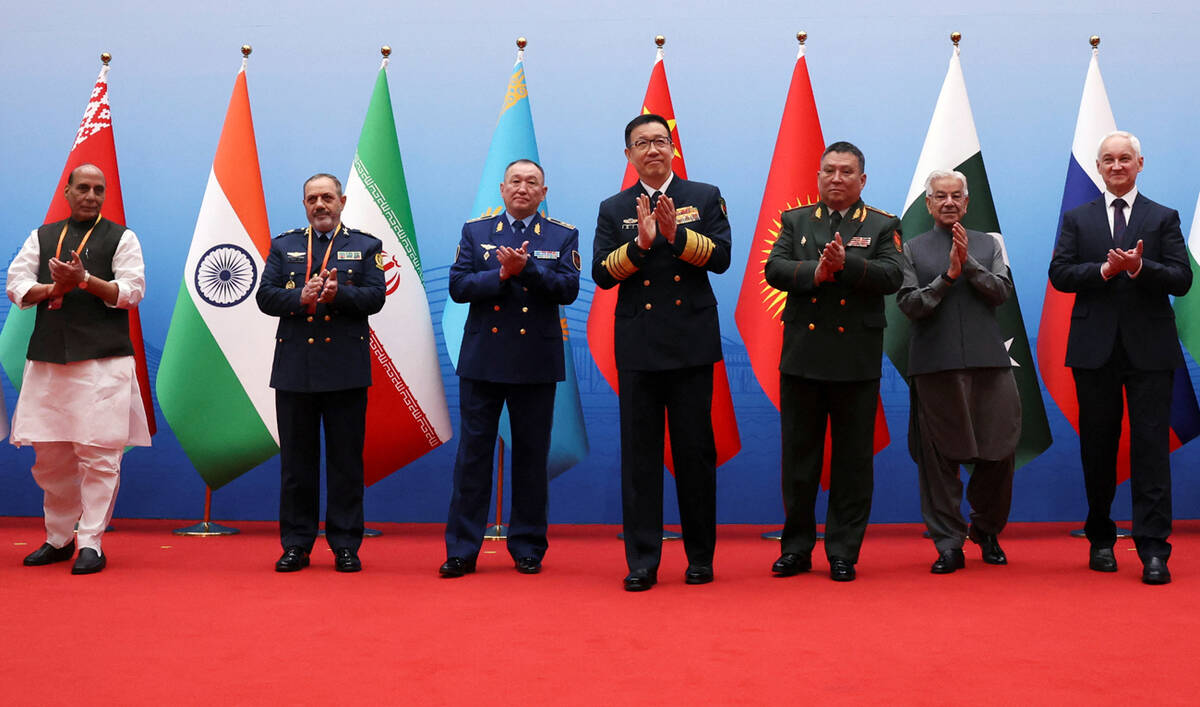


Chinese Defense Minister Dong Jun, India’s Defense Minister Rajnath Singh, Iran’s Defense Minister Aziz Nasirzadeh, Kazakhstan’s Defense Minister Dauren Kosanov, Kyrgyzstan’s Defense Minister Ruslan Mukambetov, Pakistan’s Defense Minister Khawaja Asif and Russia’s Defense Minister Andrei Belousov applaud following a group photo, before the Shanghai Cooperation Organization (SCO) Defense Ministers’ Meeting in Qingdao, Shandong province, China on June 26, 2025. (REUTERS)

China has largely taken over running the SCO, staging joint drills and holding summits, while Russia is embroiled in its full-scale invasion of Ukraine and international isolation.

While little known globally, the SCO has become one of China’s main instruments to expand its political and economic reach into areas traditionally neutral, such as India, or closely linked to Russia such as Central Asia.

Thursday’s meeting took place in the east China city of Qingdao, home to China’s northern fleet.

Singh, without explicitly naming Pakistan, urged the SCO to criticize countries that use “cross-border terrorism as an instrument of policy and provide shelter to terrorists.” He said members should unite in eliminating terrorism and ensure accountability for those who aid such activities.

“Peace and prosperity cannot co-exist with terrorism and proliferation of weapons of mass destruction in the hands of non-state actors and terror groups. Dealing with these challenges requires decisive action,” said Singh, according to a defense ministry statement.

The April 22 killings embroiled the two nuclear-armed nations in the most serious military confrontation in decades. After days of exchanging fire, they agreed to end all military actions under a US-brokered ceasefire.

On Wednesday, Chinese Defense Minister Dong Jun held one-on-one meetings with his counterparts from Belarus, Iran, Pakistan, Kyrgyzstan and Russia. India, Kazakhstan, Tajikistan and Uzbekistan are also members.

“Unilateralism and protectionism are surging, while hegemonic, high-handed, and bullying acts severely undermine the international order, making these practices the biggest sources of chaos and harm,” Dong said according to the official Xinhua News Agency, in a swipe at the US and its allies.

China and India have decades-old border disputes and Beijing has become one of Pakistan’s closest allies.


Dozens killed as security forces repulse separatist attacks in Pakistan’s Balochistan

Updated 4 sec ago
Follow

Dozens killed as security forces repulse separatist attacks in Pakistan’s Balochistan

  • The attacks unfolded early Saturday when outlawed Baloch Liberation Army members attacked several cities in the restive region
  • Security official says 37 militants, 10 security personnel killed in skirmishes that revived memories of similar attack in 2024

QUETTA/ISLAMABAD: Dozens of militants and security personnel and policemen were killed as Pakistani security forces repulsed coordinated attacks by separatist militants in the southwestern Balochistan province, officials said on Saturday, in the latest incident of violence in the insurgency-hit region.

Separatist militants, affiliated with the Balochistan Liberation Army (BLA), launched “coordinated” attacks in several cities of Balochistan early Saturday, according to a senior police official, who requested anonymity.

The attacks in the provincial capital of Quetta began at around 6am with a powerful explosion, followed by intense gunfire that lasted for two hours along with multiple explosions. Residents of Dalbandin and Nuhski said they heard explosions and gunfire, while similar attacks were launched in Mastung, Gwadar, Pasni and Turbat.

A security official said Pakistani forces had repulsed the attacks and killed 37 “Indian-backed militants,” who were in continuous contact with “their handlers in Afghanistan.” Islamabad has frequently blamed such attacks on India and Afghanistan, an allegation consistently denied by Kabul and New Delhi.

“The terrorists of Fitna Al-Hindustan (Indian-backed Baloch separatist groups) launched coordinated attacks this morning at more than 12 locations, including Quetta, Noshki, Dalbandin, Pasni, and Gwadar,” the security official said.

“In these attacks, 37 terrorists have been eliminated. Throughout the operation, the terrorists were reportedly in continuous contact with their handlers in Afghanistan. Ten security personnel were martyred while few others were injured.”

Security personnel shift an injured man at a hospital in Quetta on January 31, 2026, following an attack by Baloch separatists. Ethnic Baloch separatists launched "coordinated" attacks across Pakistan's Balochistan province on January 31, killing at least four policemen, officials said, the latest violence in insurgency-hit southwest region. (AFP)

A senior official at the Civil Hospital in Quetta told Arab News they had received 15 bodies, including nine policemen.

“Eight injured with bullet wounds were brought to the hospital,” said the official, who spoke on condition of anonymity. “Five of them were later shifted to the Combined Military Hospital (CMH) Quetta.”

Balochistan, which borders Iran and Afghanistan, is the site of a decades-long insurgency waged by Baloch separatist groups who often attack security forces and foreigners, and kidnap government officials.

Shahid Rind, the Balochistan chief minister’s aide for media and political affairs, said police and paramilitary Frontier Corps (FC) had foiled the attacks and were chasing the assailants.

“After the killing of more than 70 terrorists at different places in Balochistan in the last two days, terrorists have attempted to attack at a few places in Balochistan, which have been foiled by timely action by the police and FC,” he said on X.

“At present, the pursuit of the fleeing terrorists is underway. More details will be revealed very soon.”

Family members mourn the death of a relative killed in an attack by Baloch separatists, at a hospital in Quetta on January 31, 2026. Ethnic Baloch separatists launched "coordinated" attacks across Pakistan's Balochistan province on January 31, killing at least four policemen, officials said, the latest violence in insurgency-hit southwest region. (AFP)

In a statement issued on Saturday, BLA said the group had launched ‘Operation Herof 2.0,’ which included a series of attacks in multiple cities of Balochistan.

Saturday’s attacks follow coordinated attacks carried out by the group in Aug. 2024 in various districts of Balochistan which killed dozens of people.

The separatists accuse the central government of stealing the region’s resources to fund development elsewhere in the country. The Pakistani government denies the allegations and says it is working for the uplift of local communities in Balochistan.

Pakistan Railways suspended train service from Balochistan to other parts of the country for a day, following Saturday’s attacks.

“Quetta-Peshawar bound Jaffar Express, and Quetta-Chaman passenger trains have been canceled due to the prevailing security situation in Balochistan,” Muhammad Kashif, the railways controller in Quetta division, told Arab News.