
BEIJING: When Israel attacked Iran nearly two weeks ago, the Chinese government, a longtime friend of Iran, jumped into action — at least, when it came to words. It condemned the attacks. Its leader, Xi Jinping, got on the phone with the Russian leader and urged a ceasefire. Its foreign minister spoke with his counterpart in Iran.
But that’s where China stopped. The usual rhetoric was delivered. De-escalation and dialogue were trumpeted. Yet China offered no material support.
Despite Beijing’s clout as a near-peer rival to the United States and its ambition to play a bigger role on the world stage, Beijing refrained from offering military support to Iran, let alone getting directly involved in the conflict. The decision underscored the limitations it faces in the Middle East.
“Beijing lacks both the diplomatic capabilities and the risk appetite to quickly intervene in, and to think it can successfully navigate, this fast-moving and volatile situation,” said Jude Blanchette, director of the China Research Center at RAND.
Given the tangled politics of the Middle East, where China holds substantial economic and energy stakes yet wields minimal military influence, Beijing “isn’t inclined to stick its neck out,” Blanchette added. Instead, the Chinese government opts to remain “a measured, risk‑averse actor.”
China weighs commercial interests
Zhu Feng, dean of the School of International Relations at Nanjing University in eastern China, said volatility in the Middle East is not in China’s interests.
“From China’s point of view, the Israel-Iran conflicts challenge and impact China’s business interests and economic security,” Zhu said. “This is something China absolutely does not want to see.”
After the Iranian parliament floated a plan to shut down the strategically located Strait of Hormuz over the weekend, China spoke against it. “China calls on the international community to step up efforts to de-escalate conflicts and prevent regional turmoil from having a greater impact on global economic development,” said Guo Jiakun, a spokesman for the Chinese foreign ministry.
On Tuesday, following the ceasefire announcement, US President Donald Trump wrote in a social media post: “China can now continue to purchase Oil from Iran,” suggesting the ceasefire would prevent the disruption of Iranian oil production.
A 2024 report by the US Energy Information Administration contained estimates suggesting that roughly 80 percent to 90 percent of the oil exported by Iran went to China. The Chinese economy could struggle to preserve its industrial production without the roughly 1.2 million barrels of oil and other fossil fuels provided by Iran.
Craig Singleton, senior China fellow at the Washington-based think tank Foundation for Defense of Democracies, summed up Beijing’s responses as “steady oil buys and ritual calls for ‘dialogue’.”
“That’s about it,” Singleton said. “No drones or missile parts, no emergency credit line. Just words calibrated to placate Tehran without rattling Riyadh or inviting US sanctions.”
Beijing’s muted responses also expose the gap between China’s great-power rhetoric and its real reach in the region. Said Singleton: “China’s Gulf footprint is commercial, not combat-ready. When missiles fly, its much-touted strategic partnership with Iran shrinks to statements. Beijing wants discounted Iranian oil and a ‘peace-broker’ headline, while letting Washington shoulder the hard-power risks.”
In statements, China sides with Iran and pledges to mediate
At the United Nations, China, a permanent member of the Security Council, teamed up with Russia and Pakistan in putting forward a draft resolution condemning “in the strongest terms” the attacks against peaceful nuclear sites and facilities in Iran. They called for “an immediate and unconditional ceasefire” even though the United States, another permanent member on the council, is almost certain to veto the proposal.
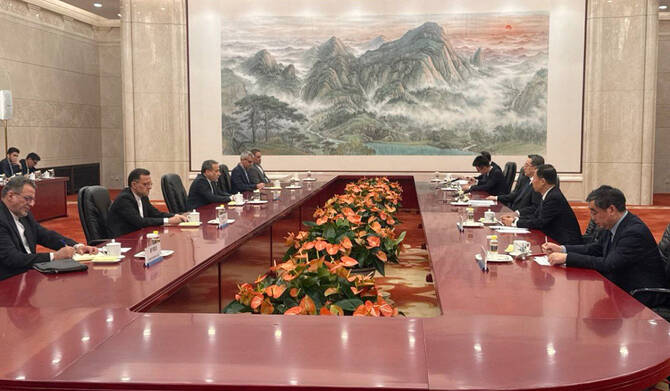
Shortly after Israel attacked Iran, Chinese Foreign Minister Wang Yi had a phone call with his Iranian counterpart, Abbas Araghchi, and told him that “China explicitly condemned Israel’s violation of Iran’s sovereignty, security and territorial integrity.” Wang, using common diplomatic language, said China was “ready to maintain communication with Iran and other relevant parties to continue playing a constructive role in de-escalating the situation.”
Wang later spoke with foreign ministers of Oman and Egypt; both nations are key mediators in the region. And late last week, before the US got involved militarily, Xi spoke with Russian President Vladimir Putin; the two agreed to stay in closer contact over Iran and work toward de-escalation. But China stayed away from any direct involvement, and Russia also had muted responses to the Israel-Iran conflict.
Iran is an important link in Xi’s ambitious global project Belt and Road Initiative, and in 2023 joined the Shanghai Cooperation Organization, a security group by Russia and China to counter the US-led NATO. It has conducted joint exercises with China, including this year’s “Maritime Security Belt 2025” in the Gulf of Oman, in which Russia also took part. On Wednesday, Beijing will convene a meeting of defense ministers of SCO member nations.
As important as Iran is to China, it is only part of Beijing’s calculus, according to an analysis by the Soufan Center, a New York-based organization that focuses on global security challenges.
In an intel brief, the center said the conflict has revealed that Beijing’s support for its partners, especially those in confrontation with the United States, “is limited by a complex matrix of interests, including its desire to avoid alienating major economic partners and escalating tensions with the West.”