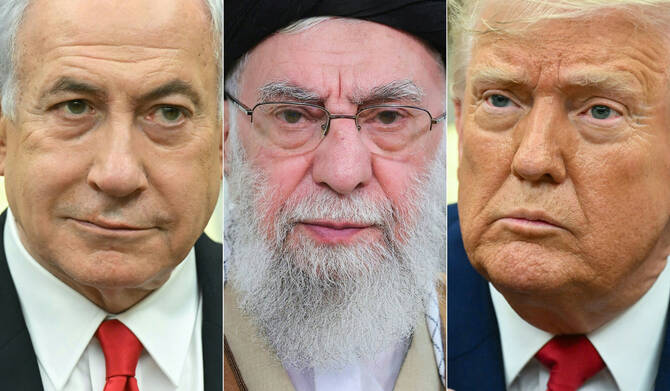


WASHINGTON: The whipsaw chain of events involving Iran, Israel and the United States that culminated in a surprise ceasefire has raised many questions about how the Trump administration will approach the Middle East going forward.
Yet, the answer to the bottom line question — “what’s next?” — remains unknowable and unpredictable. That is because President Donald Trump has essentially sidelined the traditional US national security apparatus and confined advice and decision-making to a very small group of top aides operating from the White House.
While there is uncertainty about whether the ceasefire between Iran and Israel will hold, it opens the possibility of renewed talks with Tehran over its nuclear program and reinvigorating stalled negotiations in other conflicts.
Watching for next steps on Trump’s social media
Outside experts, long consulted by presidential administrations on policy, have been forced like the general public to follow Trump’s social media musings and pronouncements for insights on his thinking or the latest turn of events.
Even Congress does not appear to be in the loop as top members were provided only cursory notifications of Trump’s weekend decision to hit three Israeli nuclear facilities and briefings on their impact scheduled for Tuesday were abruptly postponed.
State Department spokeswoman Tammy Bruce, whose agency has played a key role in formulating Iran policy for decades, repeatedly on Tuesday deferred questions to the White House and Trump’s posts.
“The secretary of state was in a dynamic with the president that is a private dynamic as that team was addressing a war and the nature of how to stop it,” she told reporters. “I can’t speak to how that transpired or the decisions that were made.”
Trump’s announcement Monday that Israel and Iran agreed to a ceasefire took many in the administration by surprise — as did his post Tuesday that China is now free to import Iranian oil.
It’s an apparent 180-degree shift from Trump’s “maximum pressure campaign” on Iran since he withdrew from the 2015 Iran nuclear agreement during his first term. US officials were left wondering if that meant wide-ranging sanctions aimed at cutting off Iran’s energy revenue were being eased or reversed.
Assessing the damage to Iran’s nuclear program
While the extent of the damage from 11 days of Israeli attacks and Saturday’s strikes by US bunker-buster bombs is not yet fully known, a preliminary assessment from the Defense Intelligence Agency said the nuclear program had been set back only a few months and was not “completely and fully obliterated” as Trump has said.
According to people familiar with the report, it found that while the strikes at the Fordo, Natanz and Isfahan nuclear sites did significant damage, they were not totally destroyed.
Still, most experts believe the facilities will require months or longer to repair or reconstruct if Iran chooses to try to maintain its program at previous levels.
Vice Admiral Brad Cooper, deputy commander of US Central Command, who has been nominated to lead forces in the Middle East, told lawmakers Tuesday that Iran still possesses “significant tactical capability” despite the American strikes. He pointed to Iran’s attempt to retaliate with missile launches at a US base in Qatar.
In response to a question about whether the Iranians still pose a threat to US troops and Americans worldwide, Cooper replied, “They do.”
Trump, after announcing the ceasefire, boasted that Iran will never again have a nuclear program.
However, there are serious questions about whether Iran’s leadership, which has placed a high premium on maintaining its nuclear capabilities, will be willing to negotiate them away.
Restarting US-Iran nuclear talks is possible
Another major question is what happens with negotiations over Iran’s nuclear program. It is not entirely clear who in Iran has the authority to make a deal or even agree to reenter talks with the US or others.
Ray Takeyh, a former State Department official and senior fellow at the Council on Foreign Relations, said Iranian leadership is at a moment of disarray — making it difficult to return to the table.
“The country’s leadership and the regime is not cohesive enough to be able to come to some sort of negotiations at this point, especially negotiations from the American perspective, whose conclusion is predetermined, namely, zero enrichment,” he said.
Karim Sadjadpour, an Iran expert at the Carnegie Endowment for International Peace, agreed, saying that “the biggest challenge right now is who is in charge in Tehran.”
“Is there an Iranian negotiation team empowered to make consequential decisions?” he said. “The issue is that (Trump) is dealing with an Iranian government whose longtime identity has been based on hostility toward the the United States.”
Still, a US official said Tuesday that special envoy Steve Witkoff is ready to resume negotiations if Trump tells him to and Iran is willing. The official spoke on condition of anonymity to discuss sensitive diplomatic matters.
Witkoff has maintained an open line of direct communication via text messages with Iranian Foreign Minister Abbas Araghchi.
In the aftermath of the US strikes, Vice President JD Vance and Secretary of State Marco Rubio both stressed that diplomacy is still Trump’s preferred method for ending the conflict permanently.
“We didn’t blow up the diplomacy,” Vance told NBC’s “Meet the Press” on Sunday. “The diplomacy never was given a real chance by the Iranians. And our hope … is that this maybe can reset here. The Iranians have a choice. They can go down the path of peace or they can go down the path of this ridiculous brinksmanship.”
Rubio echoed those comments.
“We’re prepared right now, if they call right now and say we want to meet, let’s talk about this, we’re prepared to do that,” he said. “The president’s made that clear from the very beginning: His preference is to deal with this issue diplomatically.”
The Israel-Iran ceasefire could affect Trump’s approach to other conflicts
If it holds, the ceasefire could offer insight to the Trump administration as it tries to broker peace in several other significant conflicts with ties to Iran.
An end — even a temporary one — to the Iran-Israel hostilities may allow the administration to return to talks with mediators like Egypt and Qatar to seek an end to the war between Israel and the Iranian-backed militant group Hamas.
In Syria, a further shift away from now-weakened Iranian influence — pervasive during ousted leader Bashar Assad’s reign — could open new doors for US-Syria cooperation. Trump already has met the leader of the new Syrian government and eased US sanctions.
Similarly, tense US relations with Lebanon also could benefit from a reduced Iranian role in supporting the Hezbollah militant group, which has been a force of its own — rivaling if not outperforming the Lebanese Armed Forces, particularly near the Israeli border.
If an Iran-Israel ceasefire holds, it also could allow Trump the time and space to return to stalled efforts to broker a ceasefire between Russia and Ukraine.
Russia and Iran have substantial economic and military cooperation, including Tehran providing Moscow with drones that the Russian military has relied on heavily in its war against Ukraine.
Russia has stepped up attacks on Ukraine in recent days as Israel attacked sites in Iran, perhaps expecting the world’s attention to shift away from its three-year-old invasion.