Israel says killed three Iranian commanders in fresh wave of strikes

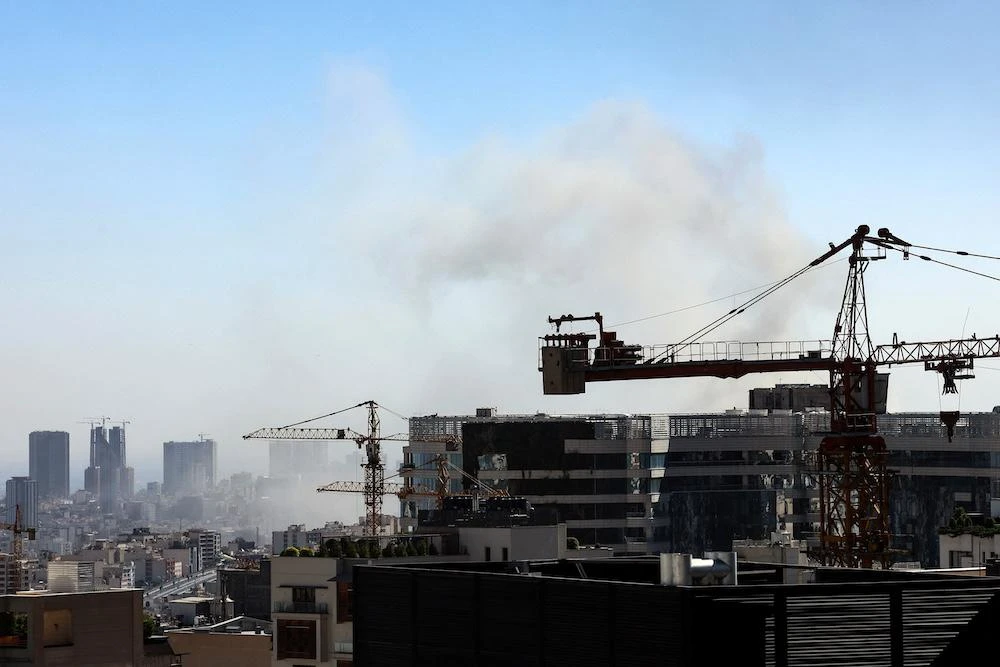
Smoke rises above buildings in Tehran following an Israeli strike on June 18, 2025. (AFP)
Short Url
Updated 21 June 2025
Follow

Israel says killed three Iranian commanders in fresh wave of strikes

  • Israel’s military said its fighter jets successfully targeted top Iranian official Saeed Izadi
  • It also announced the deaths of two other commanders from Iran’s Revolutionary Guards

JERUSALEM: Israel said Saturday it had killed three Iranian commanders in its unprecedented bombing campaign across the Islamic republic, which Foreign Minister Gideon Saar claimed had already delayed Tehran’s presumed nuclear plans by two years.

Israel’s military said its fighter jets successfully targeted top Iranian official Saeed Izadi, in charge of coordination with Palestinian militant group Hamas, in Qom south of Tehran and announced the deaths of two other commanders from Iran’s Revolutionary Guards.

As Israel continued to strike Iran’s nuclear facilities and military targets, Israeli Foreign Minister Gideon Saar said in an interview that by the country’s own assessment, it had “already delayed for at least two or three years the possibility for them to have a nuclear bomb.”

“We will do everything that we can do there in order to remove this threat,” Saar told German newspaper Bild, asserting Israel’s onslaught would continue.

Israel and Iran have traded wave after wave of devastating strikes, after Israel launched its aerial campaign on June 13, saying Tehran was on the verge of developing a nuclear weapon — an ambition Iran has denied.

Israel said it had attacked Iran’s Isfahan nuclear site for a second time after its air force said it had also launched salvos against missile storage and launch sites in central Iran.

The military later said it struck military infrastructure in southwest Iran.

US President Donald Trump warned on Friday that Tehran has a “maximum” of two weeks to avoid possible American air strikes, as Washington weighs whether to join Israel’s unprecedented bombing campaign.

Iranian Foreign Minister Abbas Araghchi arrived in Istanbul on Saturday, for a meeting of the Organization of Islamic Cooperation to discuss the conflict.

Top diplomats from Britain, France and Germany met Araghchi in Geneva on Friday, and urged him to resume talks with the United States that had been derailed by Israel’s attacks.

But Araghchi told NBC News after the meeting that “we’re not prepared to negotiate with them (the United States) anymore, as long as the aggression continues.”

Trump was dismissive of European diplomatic efforts, telling reporters, “Iran doesn’t want to speak to Europe. They want to speak to us. Europe is not going to be able to help in this.”

Trump also said he is unlikely to ask Israel to stop its attacks to get Iran back to the table.

“If somebody’s winning, it’s a little bit harder to do,” he said.

Any US involvement would likely feature powerful bunker-busting bombs that no other country possesses to destroy an underground uranium enrichment facility in Fordo.

A US-based NGO, the Human Rights Activists News Agency, said on Friday that based on its sources and media reports at least 657 people have been killed in Iran, including 263 civilians.

Iran’s health ministry said on Saturday at least 350 people had been killed in the Israeli strikes including military commanders, nuclear scientists and civilians.

Nasrin, 39, who gave only her first name, explained she had been thrown across a room in her Tehran home by an Israeli strike.

“I just hit the wall. I don’t know how long I was unconscious. When I woke up, I was covered in blood from head to toe,” she said as she received treatment at Hazrat Rasool hospital in the Iranian capital.

Traffic police and Fars news agency reported congestion on roads into Tehran on Saturday, indicating some inhabitants were returning to the capital.

Internet access remained highly unstable and limited in Tehran on Saturday, with slow connections and many sites still inaccessible, according to AFP journalists.

Iran’s retaliatory strikes have killed at least 25 people, in Israel, according to official figures.

Overnight, Iran said it targeted central Israel with drones and missiles.

Israeli rescuers said there were no casualties after an Iranian missile struck a residential building in Beit She’an.

At the site of the strike in the north of Israel, mounds of soil had been gouged from the ground and the wall of a ground-floor room destroyed.

Israel’s National Public Diplomacy Directorate said more than 450 missiles have been fired at the country so far, along with about 400 drones.

Iran’s Revolutionary Guards said they had targeted military sites and air force bases.

Western powers have repeatedly expressed concerns about the rapid expansion of Iran’s nuclear program, questioning in particular the country’s accelerated uranium enrichment.

The International Atomic Energy Agency’s chief Rafael Grossi has said that Iran is the only country without nuclear weapons to enrich uranium to 60 percent.

However, it added that there was no evidence Tehran had all the components to make a functioning nuclear warhead.

Grossi told CNN it was “pure speculation” to say how long it would take Iran to develop weapons.

Palestinian PM: Gaza reconstruction advancing amid US talks, Saudi support

In an interview with Arab News, Mohammed Mustafa said “Palestinian objective is clear,’ but we need to ‘get Gaza right first.’
Updated 13 sec ago
Follow

Palestinian PM: Gaza reconstruction advancing amid US talks, Saudi support

  • In an interview with Arab News, Mohammed Mustafa said “Palestinian objective is clear,’ but we need to ‘get Gaza right first’
  • Speaking at Davos panel, PM calls Kingdom a key stakeholder in the Palestinian cause

DAVOS: Palestinian Prime Minister Mohammed Mustafa told Arab News that progress is underway in Gaza’s reconstruction talks, with clear dialogue between the Palestinian Authority, US President Donald Trump and Special Envoy Steve Witkoff.

“I think the Palestinian objective is pretty clear, it has been for a long time, which is to establish their own independent state, (achieve) international resolution,” Mustafa said, noting that “we need to get Gaza right first.”

Despite a ceasefire taking hold earlier in 2025, Gaza remains under what the international community describes as an Israeli-enforced blockade. Basic supplies such as food and medicine are still subject to Tel Aviv’s scrutiny, which controls all access in and out of the Strip.

On Sunday, Trump announced that his Gaza plan had entered its second phase, in which Hamas would release all remaining hostages, Israel would free more Palestinian prisoners and fully withdraw its forces — a step international actors say should pave the way from ceasefire to lasting peace.

The formation of a technocratic National Committee for the Administration of Gaza, or NCAG, composed of Palestinian figures, marks the first concrete step toward implementing the plan and restoring Palestinian ownership of the next phase.

A precise timeline for reconstruction remains unclear, with analysts warning that major works hinge on Hamas disarmament — a politically fraught task assigned to the Gaza Peace Board.

“It’s going to take more than two years to fix Gaza, but at least we want to make sure that things are in the right direction,” continued Mustafa, adding that the West Bank remains part of the broader conversation.

He stressed the urgency of reunifying Gaza’s institutions with the West Bank to achieve the PA’s political goal of independence. 

“Our priority is what’s happening to our people in Gaza today. Despite four months passing (after) the ceasefire, people are still dying. Yes, there is a ceasefire but it’s not fully observed due to Israeli military actions,” he said, stressing that “shelter is the biggest challenge” at the moment.

Mustafa revealed he held “very active and useful” talks with US officials on Tuesday, saying both sides “share the same goals” on the matter.

Later in his panel, Mustafa said a Palestinian reform plan is in the works with the help of partners including Saudi Arabia.

In a session at the World Economic Forum in Davos, Mustafa said Saudi Arabia and other partners such as Egypt and Jordan were not just contributors but key stakeholders in the Palestinian cause.

“Saudi Arabia along with France have been working with us on the two state solution and integrating it,” he said.

“We want to work with the board of peace to ensure that they do their part of things to prepare for reconstruction efforts,” he added.

Mustafa said although some view the Oslo treaty as outdated, it still holds its place as an internationally recognized framework.

“According to the Oslo agreement, Israel should have withdrawn from most of the West Bank and Gaza. We want to see Israel respecting this agreement,” he said.

“The Israelis did not respect the economic part of the treaty. We are praying for a heavy price, not only in Gaza and people being killed every day. But also actions on the ground in the West Bank. We said clearly, we want to achieve our goals by peaceful means,” he said.

“Israel today holds $4 billion of our government’s money. They control the borders and collect the tax fines. For the past four months they have sent zero dollars. Our ability to govern has been impacted due to this,” Mustafa said.

In a sideline interview with Arab News, Palestinian Ambassador to Switzerland Ibrahim Mohammad Khraishi said that he met an Egyptian minister who expressed hope that the Rafah crossing could soon reopen on both sides.

“We need the understanding from all,” Khraishi said. “Yes, we have this administrative committee (as part of the Gaza Peace Board), but without the Palestinian Authority, they cannot deliver. Because we have everything. We have the institutions, we have the government,” Khraisi said.

Commenting on recent West Bank developments, including Israeli bulldozers razing the UNRWA compound in occupied East Jerusalem on Tuesday, he warned: “This is the scenario for the Israelis. For them, there is nothing to talk about. It’s total crash and destruction. Now, what they are doing in West Bank is on the way.”