

Israel restarts limited gas exports amid ongoing conflict, Egypt still waiting

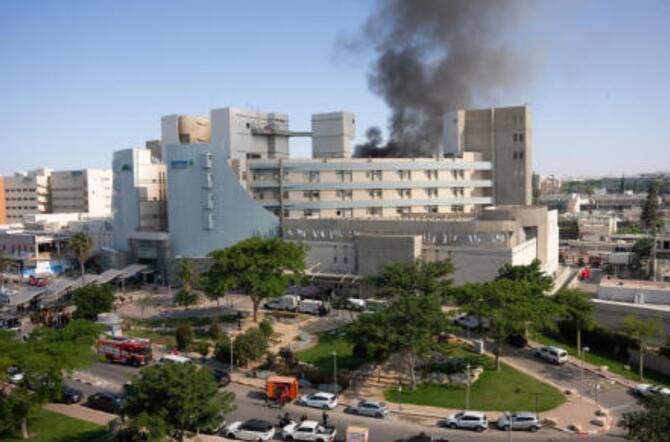
Smoke billows from a building at Soroka Hospital in Beersheba in southern Israel following an Iranian missile attack, on June 19, 2025. (AFP)
Short Url
Updated 19 June 2025
Follow

Israel restarts limited gas exports amid ongoing conflict, Egypt still waiting

  • A ministry spokesperson said exports are now resuming “from surpluses, after domestic needs are met“
  • An energy ministry source said most of the limited exported gas is currently flowing to Jordan

CAIRO: Israel has resumed limited natural gas exports from surplus supplies, the country’s Energy Ministry said on Thursday, nearly a week after shutting down two key offshore fields as Israel and Iran waged an air battle.

A ministry spokesperson told Reuters that exports are now resuming “from surpluses, after domestic needs are met.”

An energy ministry source said most of the limited exported gas is currently flowing to Jordan, and only “tiny volumes” reached Egypt this week.

Egyptian fertilizer producers, who were forced to halt operations due to the supply disruption, told Reuters they have yet to receive any gas but expect flows to resume next week.

The Egyptian Petroleum Ministry did not immediately respond to a Reuters request for comment.

Following military escalation in the region, Israel halted exports on June 13 after closing the Leviathan field, operated by Chevron and the Karish field operated by Energean. Only the Tamar field has remained operational, supplying mainly domestic demand.

Israeli Energy Minister Eli Cohen said on Wednesday that exports would only resume once military authorities deemed it safe.

“I don’t want to use our strategic storage, so therefore, I needed to cut exports,” he told Reuters.

Egypt, which has increasingly relied on Israeli gas since a domestic production decline in 2022, is scrambling to compensate for the supply gap.

The country has ramped up fuel oil use in power plants and has signed deals to import over $8 billion worth of liquefied natural gas, while preparing additional floating regasification units.

Israeli gas typically accounts for up to 60 percent of Egypt’s total gas imports and around a fifth of its total consumption, according to data from the Joint Organizations Data Initiative (JODI).


Trial opens in Tunisia of NGO workers accused of aiding migrants

Updated 3 sec ago
Follow

Trial opens in Tunisia of NGO workers accused of aiding migrants

  • Aid workers accused of assisting irregular migration to Tunisia went on trial on Monday, as Amnesty International criticized what it called “the relentless criminalization of civil society”
TUNIS: Aid workers accused of assisting irregular migration to Tunisia went on trial on Monday, as Amnesty International criticized what it called “the relentless criminalization of civil society” in the country.
Six staff members of the Tunisian branch of the France Terre d’Asile aid group, along with 17 municipal workers from the eastern city of Sousse, face charges of sheltering migrants and facilitating their “illegal entry and residence.”
If convicted, they face up to 10 years in prison.
Migration is a sensitive issue in Tunisia, a key transit point for tens of thousands of people seeking to reach Europe each year.
A former head of Terre d’Asile Tunisie, Sherifa Riahi, is among the accused and has been detained for more than 19 months, according to her lawyer Abdellah Ben Meftah.
He told AFP that the accused had carried out their work as part of a project approved by the state and in “direct coordination” with the government.
Amnesty denounced what it described as a “bogus criminal trial” and called on Tunisian authorities to drop the charges.
“They are being prosecuted simply for their legitimate work providing vital assistance and protection to refugees, asylum seekers and migrants in precarious situations,” Sara Hashash, Amnesty’s deputy MENA chief, said in the statement.
The defendants were arrested in May 2024 along with about a dozen humanitarian workers, including anti-racism pioneer Saadia Mosbah, whose trial is set to start later this month.
In February 2023, President Kais Saied said “hordes of illegal migrants,” many from sub-Saharan Africa, posed a demographic threat to the Arab-majority country.
His speech triggered a series of racially motivated attacks as thousands of sub-Saharan African migrants in Tunisia were pushed out of their homes and jobs.
Thousands were repatriated or attempted to cross the Mediterranean, while others were expelled to the desert borders with Algeria and Libya, where at least a hundred died that summer.
This came as the European Union boosted efforts to curb arrivals on its southern shores, including a 255-million-euro ($290-million) deal with Tunis.