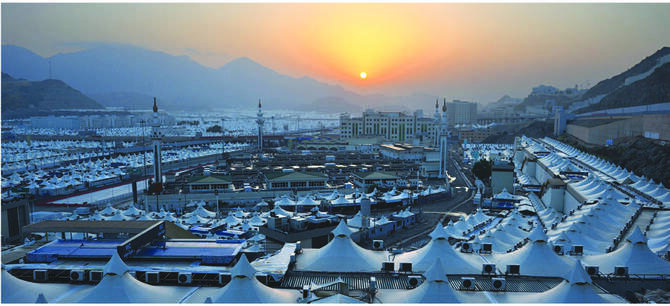

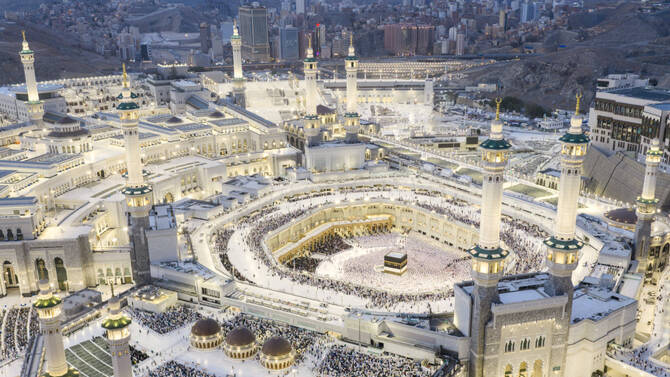

MAKKAH: Over 1.5 million pilgrims have arrived in Saudi Arabia from outside the kingdom for Hajj, according to a Saudi official, exceeding the number of international visitors last year despite the war in the Middle East.
The conflict triggered by the US and Israeli strikes on Iran in late February saw Tehran order waves of strikes on targets in Saudi Arabia and across the Gulf, prompting widespread air traffic disruptions and causing travel costs to surge.
Major Gulf airlines in the UAE, Qatar, and Bahrain have worked to quickly restore much of their operational capacity after weeks of airspace closures and flight cancelations.
Despite the complications, pilgrims have continued to flock to Saudi Arabia to participate in this year’s Hajj.
“The total number of pilgrims arriving from abroad has reached 1,518,153,” Saleh Al-Murabba, the commander of Saudi Arabia’s Hajj Passport Forces, told a press conference late Friday.
These figures are expected to rise further over the next two days as pilgrims continue to arrive from abroad ahead of the formal rituals that mark the beginning of the Hajj on Monday.
Last year, the total number of pilgrims at the Hajj reached 1,673,320, including 1,506,576 from outside Saudi Arabia.
The Hajj, one of the five pillars of Islam, must be performed at least once by all Muslims with the means.
Faith over fear
For Fadel, there was never any doubt in his mind that he would attend this year’s Hajj pilgrimage in Saudi Arabia despite the war and a US government travel advisory.
“Even if the war were still ongoing, I would not have backed out,” the 49-year-old US national, who asked that only his first name be used, told AFP.
“We are undoubtedly in the safest place in the world,” he added, referring to a passage from the Qur'an.
This sentiment is common among many Muslims from Western nations who have come to Saudi Arabia for the upcoming Hajj in the wake of the devastating war in the Middle East.
This year’s rites, drawing Muslim worshippers from across the world, follow waves of Iranian strikes on targets in Saudi Arabia and its Gulf neighbors after the United States and Israel attacked the Islamic republic in late February.
An uneasy ceasefire has largely held since April, even though negotiations between the United States and Iran have failed to reach agreement.
Amid the uncertainty, the American embassy in Riyadh last month advised US citizens not to participate in the Hajj.
“Due to the ongoing security situation and intermittent travel disruptions, we advise reconsidering participation in Hajj this year,” a statement released by the embassy read.
The US State Department told AFP its diplomatic missions in Saudi Arabia remain open with “adjusted staffing levels” and were “ready to support Americans who require assistance.”
“If the conflict breaks out again, there is a strong possibility of real disruptions to pilgrim travel,” said Umer Karim, an expert on Saudi Arabia at the University of Birmingham in Britain.
“They could find themselves stranded, which could create additional logistical and hosting challenges.”
‘Very anxious’
But for many, the chance to perform the sacrosanct Muslim rite has taken precedence over the fears of instability caused by the war.
Sayed, a 47-year-old Australian who will attend the Hajj for the seventh time, said there were no “second thoughts about coming here,” even as his own government issued an advisory urging citizens to reconsider travel to the region.
“When you make the intention to come, you come with a reason and a purpose. And that’s why you’re here and put your faith in God that everything will be fine,” he told AFP while standing outside Makkah’s Grand Mosque dressed in white garments.
As more than a million pilgrims poured into the holy city ahead of the Hajj, the breadth and diversity of the global Islamic community was on vivid display, with many carrying paraphernalia such as bags and umbrellas showing their country of origin.
“This is an opportunity that comes once in a life and I decided not to miss it,” said Ibrahim Diab, a 63-year-old German national, despite the “shaky situation in the Gulf.”
But even amid the euphoric atmosphere in Makkah ahead of the Hajj, some pilgrims said fears about the war had troubled them ahead of the journey.
“I was very anxious about it,” 36-year-old British accountant Imad Ahmad told AFP.
Ahmad said his trip to Saudi Arabia was briefly interrupted in Jordan on Wednesday after the military there said it had shot down an unidentified drone in the country’s airspace.
But he also said there was no doubt that he would continue on his journey to Makkah.
“I will come, whichever way I can, inshallah,” he added.