

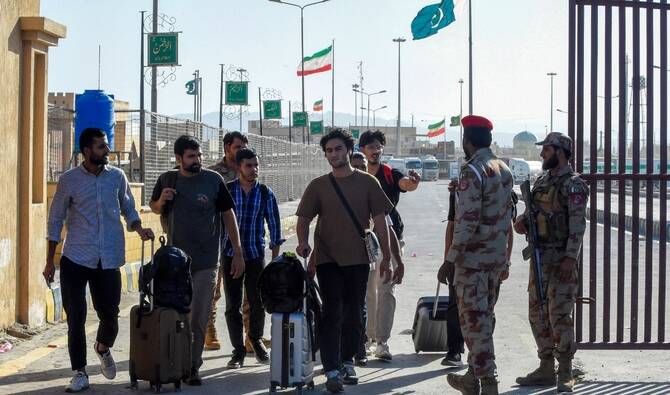

ISLAMABAD: The foreign office said on Thursday about 3,000 Pakistani nationals have been evacuated from Iran following the Israeli attack, adding the country’s diplomatic mission is working to facilitate stranded students seeking urgent evacuation.
A week of Israeli air and missile strikes, which began on June 13, has led to the killing of many of Iran’s top-ranking military officials and ordinary people. In response, Tehran’s retaliatory strikes have also killed about two dozen civilians in Israel.
Following Friday’s escalation, Iran closed its airspace to commercial flights, stranding hundreds of expatriates, including Pakistani religious tourists, students and workers.
“The evacuation is moving smoothly and so far, nearly 3,000 Pakistani nationals have already been evacuated,” foreign office spokesperson Shafqat Ali Khan told reporters in his weekly media briefing.
“Our consulates in Zahedan and Mashhad have been active round the clock, extending all possible facilitation and support to our nationals who are in Iran,” he said, expressing gratitude to the Iranian authorities for their sensitivity and all possible facilitation and help extended in this process.
Khan said the Pakistani mission was using multiple routes to evacuate citizens, including via the Gabr and Taftan border crossings, through Ashgabat, Baku and even Baghdad, through special flights.
“It’s an ongoing process as there are logistical challenges at times, but we are working together with the Iranian authorities to resolve them if a problem arises,” he added.
The spokesperson said there is a sizeable Pakistani community in Iran, with many of them living in the neighboring state for years with their families after marrying local people.
STRANDED STUDENTS
Speaking to Arab News from various cities across Iran, Pakistani students expressed serious concerns about their safety and appealed for immediate evacuation.
“I have been stranded here since the suspension of flight operations due to the regional tensions,” Muhammad Hussain, a Pakistani medical student at Qom University of Medical Sciences, told Arab News over the phone.
“The situation is becoming more tense, we are now hearing continuous explosions, which has increased our concern for safety,” he said, adding that he tried to reach out to the Pakistan embassy as well who asked him to travel to the Chabahar border.
“I am unable to get any means to go there,” he said, urging the Pakistan government and the embassy to arrange special transport to take them to border.
“Our families are extremely worried, and we just want to go back,” he added.
Noman Khan, an MBBS student in Urmia, a city in Iran’s Azerbaijan province, said he was part of a group of Pakistani students, including 10 girls, awaiting repatriation amid the ongoing situation.
“We contacted the embassy to evacuate us and, about two days ago, they asked us to book a bus ourselves, promising to send the payment,” he informed, adding that even after more than 60 hours, they were still waiting for the payment without which they were unable to get transport to cross border.
“We have female students with us as well who are also scared as nearby cities were also hit by missiles,” he continued.
“Our city is about two hours away from Tabriz and almost two to three drones were shot down in our city as well.”
Saman Yunus, another medical student at Iran University of Medical Sciences, said that due to the ongoing Iran-Israel conflict, they had been traveling for the past four days.
“The Pakistani Embassy advised us that it would be safer to go to the Chabahar border and assured us that any issues related to accommodation or other needs would be resolved within minutes,” she told Arab News.
However, she said the biggest problem they faced was that the border was not open 24/7 and there was no accommodation available.
“As a result, we had to spend the entire night on the roadside and we contacted both our university and the embassy, but no help was provided,” she continued, adding they were now heading to Pakistani consulate in Zahedan, hoping they would facilitate a safe border crossing.
“A representative there has assured us that they will handle it as soon as possible and ensure we safely cross border,” she added.


