

Pakistan reduces sales tax on imported solar panels from 18% to 10% amid parliamentary pushback

1 / 2
A worker unloads solar panels from a vehicle at a market, in Karachi, Pakistan March 26, 2025. (REUTERS)
2 / 2
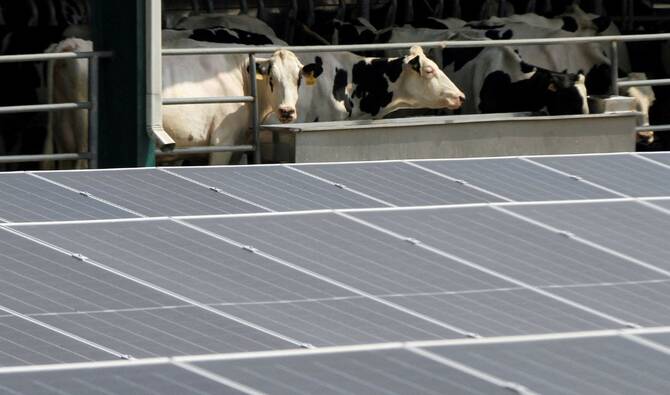
View of solar panels with cows in the background at an Interloop owned dairy farm, in Sheikhupura, Pakistan April 8, 2025. (REUTERS)
Short Url
Updated 19 June 2025
Follow

Pakistan reduces sales tax on imported solar panels from 18% to 10% amid parliamentary pushback

  • The government proposed 18% GST on imported solar panels during budget 2025-26
  • Pakistan imported 17 gigawatts of solar panels in 2024, twice the previous year’s volume

ISLAMABAD: Pakistan’s Deputy Prime Minister Ishaq Dar on Wednesday said the general sales tax (GST) on imported solar panels had been reduced from 18% to 10% for the current year, following concerns raised by a parliamentary finance body.

The Senate Standing Committee on Finance and Revenue had urged the government a day earlier to withdraw the proposed 18% GST on imported solar panels, noting that some stakeholders had begun stockpiling equipment ahead of the federal budget to avoid the new levy.

The country’s proposed federal budget for the 2025-26 fiscal year included an 18% GST on the import and local supply of solar panels and related equipment, prompting concern from industry stakeholders and clean energy advocates.

Pakistan imported 17 gigawatts (GW) of solar panels in 2024, twice the volume recorded the year before, to meet rising consumer demand, according to the Global Electricity Review 2025.

“The 18 percent on top of 46% was an additional burden,” Dar told the National Assembly.

“So, regarding this, after consultations and deliberations, we have decided that this year we will keep a 10% sales tax and not 18%.”

Dar highlighted how this was the most debated subject after the budget was announced.

He also explained that around 46% of components used in solar installations in Pakistan were imported while the remaining 54% including inverters and other equipment were locally sourced and already subject to standard taxation.

Solar energy has supplied 25% of Pakistan’s grid electricity so far this year, placing the country among fewer than 20 globally that generate at least a quarter of their monthly power from solar farms.

Industry stakeholders and clean energy activists had warned that the added cost in tax could slow the rapid adoption of rooftop solar systems by households and businesses, potentially undermining national targets for expanding the share of renewables in the country’s energy mix.

Pakistan increased its solar electricity generation at a rate more than three times the global average in 2025, driven by a surge in solar capacity imports that were over five times higher than in 2022, according to data from Ember, a UK-based energy think tank.

This rapid growth in both capacity and output has propelled solar energy from being the country’s fifth-largest power source in 2023 to the top spot in 2025.


Pakistan drop express pacer Rauf from T20 World Cup squad

Updated 26 min 46 sec ago
Follow

Pakistan drop express pacer Rauf from T20 World Cup squad

LAHORE: Pakistan left out express pacer Haris Rauf from the 15-man squad named Sunday for next month’s Twenty20 World Cup jointly hosted by India and Sri Lanka.

The 32-year-old finished with 20 wickets in the Big Bash League in Australia but selector Aaqib Javed said Rauf doesn’t fit in the combination.

“Rauf has played a lot of cricket for Pakistan but we kept conditions in Sri Lanka in mind while selecting the squad,” Javed told a news conference.

Rauf is also the highest wicket-taker for Pakistan in T20I cricket with 133 in 94 matches.

Salman Agha will lead the squad.

Another pacer Shaheen Shah Afridi was declared fit and included in the squad with Naseem Shah and relatively inexperienced Salman Mirza the other fast bowlers in the squad.

Pakistan will play all their matches in Sri Lanka and will not travel to India under an agreement decided last year due to political tensions between the two countries.

Pakistan have been placed in Group A with archrivals India, Namibia, Netherlands and United States for the February 7 to March 8 tournament.

Pakistan open their campaign against the Netherlands in Colombo on February 7.

In the 20-team tournament, each team are set to play four group games with the top two teams qualifying for the Super Eight Stage.

Changes to T20 World Cup squads can be made for any reason until January 31 and after that with approval from the Event Technical Committee.

In the final build-up for the World Cup, Pakistan will face Australia in a three-match T20I series in Lahore on January 29, 31 and February 1.

Squad: Salman Agha (captain), Abrar Ahmed, Babar Azam, Faheem Ashraf, Fakhar Zaman, Khawaja Nafay, Mohammad Nawaz, Salman Mirza, Naseem Shah, Sahibzada Farhan, Saim Ayub, Shaheen Shah Afridi, Shadab Khan, Usman Khan, Usman Tariq