

Pakistan drop express pacer Rauf from T20 World Cup squad

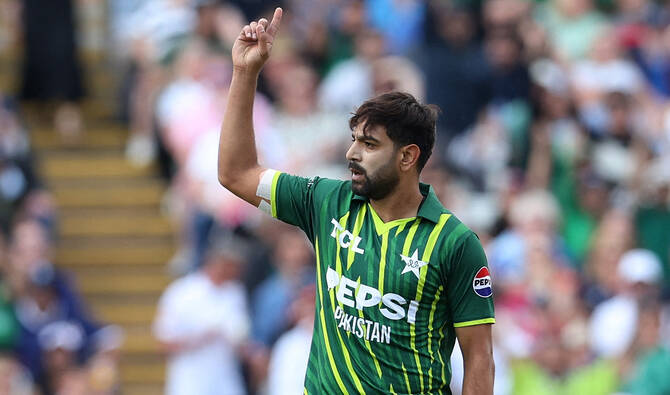
Pakistan's Haris Rauf celebrates after taking the wicket of England's Jos Buttler, caught out by Shadab Khan during the second T20 International of England v Pakistan at Edgbaston Cricket Ground in Birmingham, Britain on May 25, 2024. (Reuters)
Short Url
Updated 25 January 2026
Follow

Pakistan drop express pacer Rauf from T20 World Cup squad

LAHORE: Pakistan left out express pacer Haris Rauf from the 15-man squad named Sunday for next month’s Twenty20 World Cup jointly hosted by India and Sri Lanka.

The 32-year-old finished with 20 wickets in the Big Bash League in Australia but selector Aaqib Javed said Rauf doesn’t fit in the combination.

“Rauf has played a lot of cricket for Pakistan but we kept conditions in Sri Lanka in mind while selecting the squad,” Javed told a news conference.

Rauf is also the highest wicket-taker for Pakistan in T20I cricket with 133 in 94 matches.

Salman Agha will lead the squad.

Another pacer Shaheen Shah Afridi was declared fit and included in the squad with Naseem Shah and relatively inexperienced Salman Mirza the other fast bowlers in the squad.

Pakistan will play all their matches in Sri Lanka and will not travel to India under an agreement decided last year due to political tensions between the two countries.

Pakistan have been placed in Group A with archrivals India, Namibia, Netherlands and United States for the February 7 to March 8 tournament.

Pakistan open their campaign against the Netherlands in Colombo on February 7.

In the 20-team tournament, each team are set to play four group games with the top two teams qualifying for the Super Eight Stage.

Changes to T20 World Cup squads can be made for any reason until January 31 and after that with approval from the Event Technical Committee.

In the final build-up for the World Cup, Pakistan will face Australia in a three-match T20I series in Lahore on January 29, 31 and February 1.

Squad: Salman Agha (captain), Abrar Ahmed, Babar Azam, Faheem Ashraf, Fakhar Zaman, Khawaja Nafay, Mohammad Nawaz, Salman Mirza, Naseem Shah, Sahibzada Farhan, Saim Ayub, Shaheen Shah Afridi, Shadab Khan, Usman Khan, Usman Tariq


Pakistan hails Bangladesh’s ‘historic democratic transition’ as ties gather momentum

Updated 6 sec ago
Follow

Pakistan hails Bangladesh’s ‘historic democratic transition’ as ties gather momentum

  • Ahsan Iqbal visits Dhaka for the swearing-in of PM-elect Tarique Rahman after recent elections
  • Islamabad calls for building connectivity, expanding trade and shaping a stable region together

ISLAMABAD: Pakistan’s Planning Minister Ahsan Iqbal on Tuesday congratulated Bangladesh on a “historic democratic transition,” as he pointed to positive momentum in Pakistan-Bangladesh relations during a visit to Dhaka for the oath-taking of Prime Minister-elect Tarique Rahman.

Bangladesh’s parliament was sworn in earlier in the day, marking the first elected legislature since a deadly 2024 uprising that toppled the government of Sheikh Hasina. Rahman, 60, is chief of the Bangladesh Nationalist Party (BNP) and won a landslide victory in the February 12 elections.

He is set to formally take office later on Tuesday after lawmakers pledged loyalty before their country’s chief election commissioner.

The Pakistani minister said in a social media post on X he met Bangladesh’s Chief Adviser, Muhammad Yunus, and congratulated him “on the successful conduct of elections and the historic democratic transition.”

“Our discussions focused on opening a new, forward-looking chapter in Pakistan-Bangladesh relations,” he said. “I expressed appreciation for the positive momentum in bilateral ties, including growing trade engagement, revival of direct air connectivity, and renewed people-to-people contacts.”

Pakistan’s Minister for Planning, Development and Special Initiatives, Ahsan Iqbal (left), paid a courtesy call on Chief Adviser Professor Muhammad Yunus (right) at the State Guest House Jamuna in Dhaka, Bangladesh, on February 17, 2026. (AhsanIqbal/X)

“We agreed that the current regional and geopolitical environment demands greater economic cooperation, connectivity, and collaboration between our two countries,” he added.

Iqbal also extended an invitation to Yunus to visit Pakistan to institutionalize cooperation in youth empowerment, innovation and sustainable development.

“Pakistan and Bangladesh share deep cultural, historical, and social affinities,” he said. “It is time to transform these affinities into structured economic partnerships, academic exchanges, and regional cooperation. Our future lies in building connectivity, expanding trade, empowering youth, and shaping a stable and prosperous South Asia together.”

Bangladesh’s Prime Minister-elect Rahman has pledged to restore economic stability and revive growth after months of turmoil that rattled investor confidence in the world’s second-largest garment exporter. In his victory speech, he described the outcome as a win for democracy but warned of challenges, including a fragile economy and weakened institutions.

Pakistan and Bangladesh have improved bilateral ties amid a recent thaw in relations. The two countries were part of the same state until Bangladesh’s secession following a bloody civil war in 1971, an event that long cast a shadow over ties.

Relations have warmed since August 2024, after the ouster of Hasina, who was widely viewed as close to India. While Islamabad and Dhaka have moved closer, ties between Bangladesh and New Delhi remain strained over India’s decision to grant asylum to Hasina.