Oil Updates — prices steady as Iran-Israel conflict enters sixth day

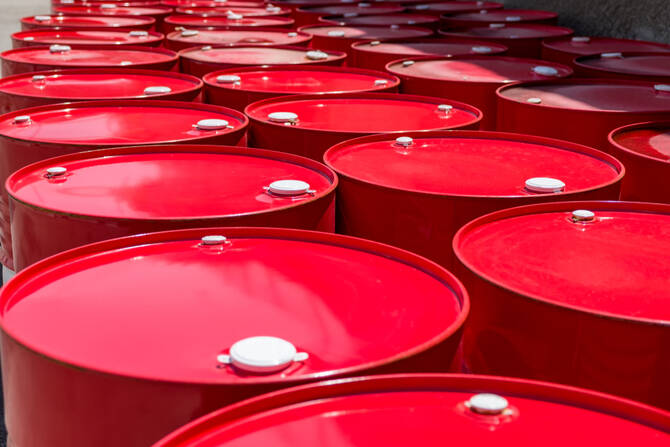
Brent crude futures slipped 49 cents, or 0.6 percent, to $75.96 a barrel by 9:20 Saudi time. Shutterstock
Short Url
Updated 18 June 2025
Follow

Oil Updates — prices steady as Iran-Israel conflict enters sixth day

  • Market fears potential Straight of Hormuz closure, analysts say
  • Middle East conflict complicates Fed interest rate decision

LONDON: Oil prices steadied on Wednesday, recovering early losses to register moderate gains after the previous session’s 4 percent advance as markets weighed up the chance of supply disruptions from the Iran-Israel conflict and potential direct US involvement.

Brent crude futures rose 28 cents, or 0.4 percent, to $76.73 a barrel by 2:36 p.m. Saudi time. US West Texas Intermediate crude was up 40 cents, or 0.5 percent, at $75.24. Both contracts had lost more than 1 percent earlier in the session.

US President Trump warned on social media on Tuesday that US patience was wearing thin and called for an “unconditional surrender” from Iran, an option that Iran’s leader Ayatollah Ali Khamenei rejected on Wednesday.

While Trump said there was no intention to kill Khamenei “for now,” his comments suggested a tougher stance toward Iran as he considers whether to increase US involvement.

A source familiar with internal discussions said one of the options Trump and his team are considering included joining Israel in strikes against Iranian nuclear sites.

Direct US involvement threatens to widen the conflict, putting energy infrastructure in the region at higher risk of attack, analysts say.

“The biggest fear for the oil market is the shutdown of the Strait of Hormuz,” ING analysts said in a note.

“Almost a third of global seaborne oil trade moves through this chokepoint. A significant disruption to these flows would be enough to push prices to $120 (a barrel).”

Iran is OPEC’s third-largest producer, extracting about 3.3 million barrels per day of crude oil.

Meanwhile, Iran’s ambassador to the UN in Geneva said on Wednesday that Tehran has conveyed to Washington that it will respond firmly to the US if it becomes directly involved in Israel’s military campaign.

Markets are also awaiting news from a second day of US Federal Reserve discussions on Wednesday, in which the central bank is expected to leave its benchmark overnight interest rate in the range of 4.25 percent to 4.50 percent.

However, the Middle East conflict and risk of slowing global growth could push the Fed to cut rates by 25 basis points in July, sooner than current expectations of September, said Tony Sycamore, market analyst at trading platform IG.

Lower interest rates generally boost economic growth and demand for oil.

Complicating the decision for the Fed, however, is the Middle East conflict’s potential creation of a new source of inflation via surging oil prices.

US crude stocks fell by 10.1 million barrels in the week ended June 13, market sources told Reuters, citing American Petroleum Institute figures on Tuesday. Official Energy Information Administration data is due later on Wednesday. 


Saudi POS spending jumps 28% in final week of Jan: SAMA

Updated 06 February 2026
Follow

Saudi POS spending jumps 28% in final week of Jan: SAMA

RIYADH: Saudi Arabia’s point-of-sale spending climbed sharply in the final week of January, rising nearly 28 percent from the previous week as consumer outlays increased across almost all sectors. 

POS transactions reached SR16 billion ($4.27 billion) in the week ending Jan. 31, up 27.8 percent week on week, according to the Saudi Central Bank. Transaction volumes rose 16.5 percent to 248.8 million, reflecting stronger retail and service activity. 

Spending on jewelry saw the biggest uptick at 55.5 percent to SR613.69 million, followed by laundry services which saw a 44.4 percent increase to SR62.83 million. 

Expenditure on personal care rose 29.1 percent, while outlays on books and stationery increased 5.1 percent. Hotel spending climbed 7.4 percent to SR377.1 million. 

Further gains were recorded across other categories. Spending in pharmacies and medical supplies rose 33.4 percent to SR259.19 million, while medical services increased 13.7 percent to SR515.44 million. 

Food and beverage spending surged 38.6 percent to SR2.6 billion, accounting for the largest share of total POS value. Restaurants and cafes followed with a 20.4 percent increase to SR1.81 billion. Apparel and clothing spending rose 35.4 percent to SR1.33 billion, representing the third-largest share during the week. 

The Kingdom’s key urban centers mirrored the national surge. Riyadh, which accounted for the largest share of total POS spending, saw a 22 percent rise to SR5.44 billion from SR4.46 billion the previous week. The number of transactions in the capital reached 78.6 million, up 13.8 percent week on week. 

In Jeddah, transaction values increased 23.7 percent to SR2.16 billion, while Dammam reported a 22.2 percent rise to SR783.06 million. 

POS data, tracked weekly by SAMA, provides an indicator of consumer spending trends and the ongoing growth of digital payments in Saudi Arabia.  

The data also highlights the expanding reach of POS infrastructure, extending beyond major retail hubs to smaller cities and service sectors, supporting broader digital inclusion initiatives.  

The growth of digital payment technologies aligns with Saudi Arabia’s Vision 2030 objectives, promoting electronic transactions and contributing to the Kingdom’s broader digital economy.