

Provincial court delivers Pakistan’s first-ever conviction for insider trading

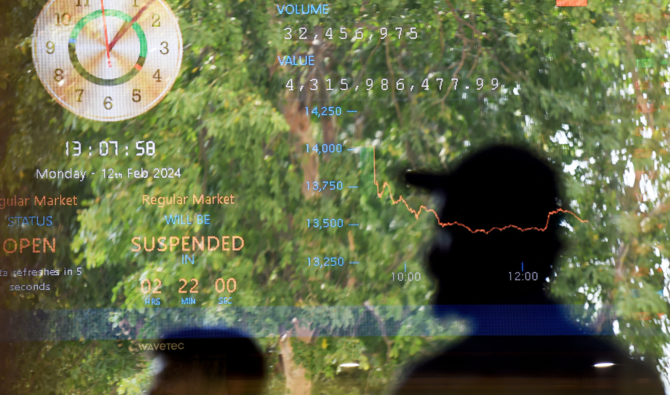
Stock brokers monitor share prices displayed on a digital screen during a trading session at the Pakistan Stock Exchange (PSX) in Karachi on February 12, 2024. (AFP)
Short Url
Updated 17 June 2025
Follow

Provincial court delivers Pakistan’s first-ever conviction for insider trading

  • SECP says bank official misused insider information related to investment, disinvestment decisions for “personal gain“
  • Financial regulator says court slaps $30,380 penalty on convict, with the amount to be deposited within seven days

KARACHI: A Pakistani court recently handed its first-ever conviction for insider trading, the Securities and Exchange Commission of Pakistan (SECP) said on Tuesday, hailing the judgment as one which will boost investors’ confidence in the country’s capital markets. 

Insider trading refers to the practice of buying or selling a publicly traded company’s securities while in possession of material information that is not yet public information. The SECP said it had filed a case against Zakir Hussain Somji, assistant vice president of investments at Habib Metropolitan Bank (HMB) Limited, after inspecting suspicious trading activity from Jan. 1, 2014, to Feb. 2, 2016.

The regulator said it was suspected that the accused, through his position at HMB, misused insider information related to the bank’s investment and disinvestment decisions for personal gain. The SECP said a probe revealed Somji bought 11,795,100 shares of various companies, including 1,230,900 shares (10.43 percent) acquired from HMB. He sold 11,836,600 shares — 4,915,200 (41.52 percent) of which were sold back to HMB, earning an “unlawful profit” of Rs2,866,646 [$10,116.39]. 

“Sindh Special Court (Offences in Banks) handed out first ever conviction for insider trading in the history of Pakistan in a case filed by The Securities and Exchange Commission of Pakistan (SECP),” the regulator said. 

It said Somji had been convicted by the court on June 14 for violating provisions of Section 128 of the Securities Act, 2015, which related to insider trading. 

The regulator said the court slapped Somji with a penalty of Rs 8,599,938 [$30,380] which was three times the “unlawful gain.”

“The amount is to be deposited within seven days, failing which the convict will be remanded to jail until full payment is made,” the SECP said. 

The regulator said the judgment reaffirms SECP’s mandate to ensure market integrity and investor protection.

“It sets a strong precedent for future enforcement actions and sends a clear message that market abuse and regulatory violations shall not be tolerated,” it added. 


Pakistan bank enables Shariah-compliant digital payment facility for passengers at Islamabad airport

Updated 23 February 2026
Follow

Pakistan bank enables Shariah-compliant digital payment facility for passengers at Islamabad airport

  • Pakistan is a cash-dominated market where a significant portion of transactions in the informal sector are made without any taxes, officials say
  • The move comes amid Pakistan’s efforts to introduce a cashless model at airports under which only digital service providers can provide services

KARACHI: Aik, Pakistan’s first Islamic digital bank, has enabled fully digital payments at Islamabad International Airport to offer travelers and passengers secure, Shariah compliant digital transaction facility.

The development comes amid Pakistan’s efforts to introduce a cashless model at airports across the country, under which only digital service providers can provide services to customers.

Aik, a subsidiary of Bank Islami, said it has onboarded merchants across the Islamabad airport and integrated QR code deployments at key touchpoints to allow passengers and visitors to make secure, seamless, and Shariah-compliant digital transactions at all counters, retail outlets, and service points.

It said the implementation complies with the regulations and framework set by the State Bank of Pakistan (SBP) and is a working model for a large-scale adoption of cashless systems in public infrastructure.

“This deployment reflects our commitment to building practical digital infrastructure that improves everyday transactions,” Aik Chief Officer Ashfaque Ahmed said in a statement.

“By enabling a fully cashless environment at a major national gateway, we are supporting efficiency, transparency, and financial inclusion at scale. This is not only a project; it is a foundation for Pakistan’s cashless future.”

Pakistan is a cash-dominated market where a significant portion of transactions, particularly in the informal sector, are conducted in cash. Officials say many of these transactions are aimed at avoiding taxes.

In recent years, the SBP has taken steps to ensure a transition toward a more cashless economy so that transactions are more traceable, reducing chances of tax evasion and corruption.

By digitizing Islamabad airport, aik said it continues to invest in secure and accessible financial solutions that “expand digital participation and support national economic modernization.”