

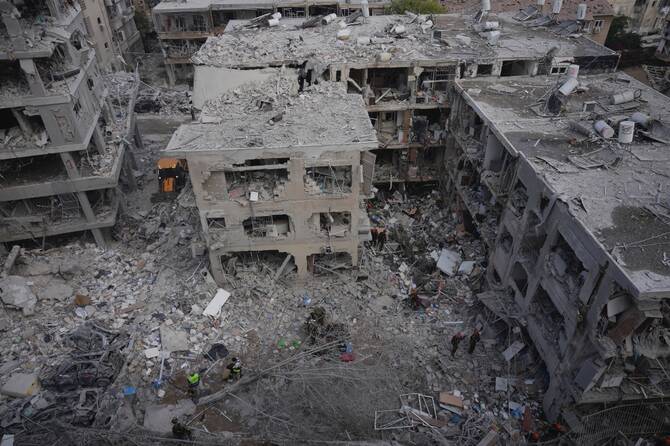

DUBAI: Israel and Iran opened a new chapter in their long history of conflict when Israel launched a major attack with strikes early Friday that set off explosions in the Iranian capital of Tehran.
Israel said it targeted nuclear and military facilities, killing Iran’s top military and nuclear scientists.
Israel’s attack comes as tensions have escalated over Iran’s rapidly advancing nuclear program, which Israel sees as a threat to its existence.
Here is a timeline of some significant events in the hostilities between the two countries:
Early days
1967 — Iran takes possession of its Tehran Research Reactor under America’s “Atoms for Peace” program.
1979 — Shah Mohammad Reza Pahlavi, fatally ill, flees Iran as popular protests against him surge. Pahlavi maintained economic and security ties with Israel. Ayatollah Ruhollah Khomeini returns to Tehran and the Islamic Revolution sweeps him to power. Students seize the United States Embassy in Tehran, beginning the 444-day hostage crisis. Iran’s nuclear program goes fallow under international pressure. Iran’s new theocracy identifies Israel as a major enemy.
August 2002 — Western intelligence services and an Iranian opposition group reveal Iran’s secret Natanz nuclear enrichment facility.
June 2003 — Britain, France and Germany engage Iran in nuclear negotiations.
October 2003 — Iran suspends uranium enrichment.
February 2006 — Iran announces it will restart uranium enrichment following the election of hard-line President Mahmoud Ahmadinejad. Britain, France and Germany walk out of stalled negotiations.
June 2009 — Iran’s disputed presidential election sees Ahmadinejad reelected despite fraud allegations, sparking Green Movement protests and violent government crackdown.
October 2009 — Under President Barack Obama, the US and Iran open a secret backchannel for messages in the sultanate of Oman.
Iran’s nuclear program is a primary target
2010 — The Stuxnet computer virus is discovered and widely believed to be a joint US-Israeli creation. The virus disrupted and destroyed Iranian centrifuges.
July 14, 2015 — World powers and Iran announce a long-term, comprehensive nuclear agreement that limits Tehran’s enrichment of uranium in exchange for the lifting of economic sanctions.
2018 — Prime Minister Benjamin Netanyahu says Israel obtained tens of thousands of pages of data showing Iran covered up its nuclear program before signing a deal with world powers in 2015. An ex-Mossad chief confirms the information was obtained by more than a dozen non-Israeli agents from safes in Tehran in 2018. President Donald Trump unilaterally withdraws from Iran’s nuclear deal with world powers.
2020 — Alleged Israeli attacks against Iran’s nuclear program are stepped up significantly after the disintegration of the 2015 nuclear deal meant to keep Iran from developing nuclear weapons.
July 2020 — A mysterious explosion tears apart a centrifuge production plant at Iran’s Natanz nuclear enrichment facility. Iran blames the attack on Israel.
November 2020 — A top Iranian military nuclear scientist, Mohsen Fakhrizadeh, is killed by a remote-controlled machine gun while traveling in a car outside Tehran. A top Iranian security official accuses Israel of using “electronic devices” to remotely kill the scientist, who founded Iran’s military nuclear program in the 2000s.
April 11, 2021 — An attack targets Iran’s underground nuclear facility in Natanz. Iran blames Israel, which does not claim responsibility, but Israeli media widely reports the government orchestrated a cyberattack that caused a blackout at the facility.
April 16, 2021 — Iran begins enriching uranium up to 60 percent, its highest purity ever and a technical step from weapons-grade levels of 90 percent.
June 2022 — Iran accuses Israel of poisoning two nuclear scientists in different cities within three days of each other, though circumstances remain unclear.
Mideast wars
Oct. 7, 2023 — Hamas militants from the Gaza Strip storm into Israel, killing 1,200 people and taking 250 hostage, beginning the most intense war between Israel and Hamas. Iran, which has armed Hamas, offers support to the militants.
Feb. 14, 2024 — An Israeli sabotage attack causes multiple explosions on an Iranian natural gas pipeline running from Iran’s western Chaharmahal and Bakhtiari province to cities on the Caspian Sea.
April 1, 2024 — An Israeli airstrike demolishes Iran’s Consulate in Damascus, Syria, killing 16 people, including two Iranian generals.
April 14, 2024 — Iran launches an unprecedented missile and drone attack on Israel, firing over 300 missiles and attack drones in response to the Israeli airstrike in Damascus. Working with a US-led international coalition, Israel intercepts much of the incoming fire.
April 19, 2024 — A suspected Israeli strike hits an air defense system near an airport in Isfahan, Iran.
July 31, 2024 — Hamas leader Ismail Haniyeh is assassinated by an apparent Israeli airstrike during a visit to Tehran. Israel had pledged to kill Haniyeh and other Hamas leaders over the Oct. 7 attack.
Sept. 27, 2024 — Israeli airstrike kills Hezbollah leader Hassan Nasrallah. Formed by Iranian Revolutionary Guard members who went to Lebanon in 1982 to fight invading Israeli forces, Hezbollah was the first group that Iran backed and used as a way to export its brand of political Islam.
Oct. 1, 2024 — Iran launches its second direct attack on Israel, though a US-led coalition and Israel shoot down most of the missiles.
Oct. 16, 2024 — Israel kills Hamas leader Yahya Sinwar in the Gaza Strip.
Oct. 26, 2024 — Israel openly attacks Iran for the first time, striking air defense systems and sites associated with its missile program.
April 30, 2025 — Iran executes a man it said worked for Israel’s Mossad foreign intelligence agency and played a role in the killing of Revolutionary Guard Col. Hassan Sayyad Khodaei in Tehran on May 22, 2022.
Friday, June 13, 2025 — Israel launches blistering attacks on the heart of Iran’s nuclear and military structure, deploying warplanes and drones previously smuggled into the country to assault key facilities and kill top generals and scientists.
Saturday, June 14, 2025 — Israel expands its airstrikes to include targets in Iran’s energy industry as Iranian missile and drone attacks continue on Israel.
Sunday, June 15, 2025 — Israel unleashes airstrikes across Iran for a third day and threatens even greater force as some Iranian missiles evade Israeli air defenses to strike buildings in the heart of the country. Planned talks on Iran’s nuclear program in Oman between the United States and Tehran, which could provide an off-ramp, are called off.


