

At UN, Iran accuses US of being complicit in Israeli strikes

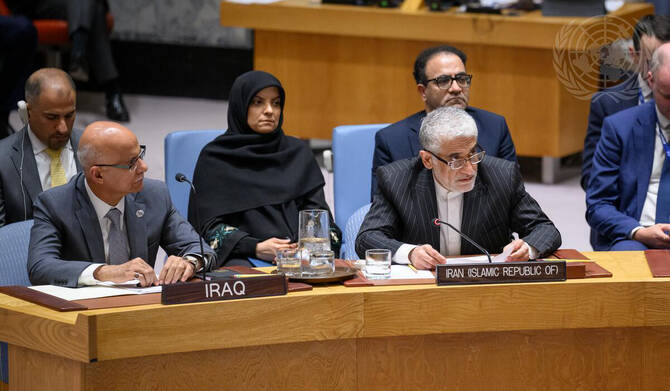
Amir Saeid Iravani (R), Iran's U.N. Ambassador, addresses the Security Council meeting on threats to international peace and security. (Photo UN)
Short Url
Updated 14 June 2025
Follow

At UN, Iran accuses US of being complicit in Israeli strikes

  • Council the above-ground pilot enrichment plant at Iran's Natanz nuclear site had been destroyed, and that Iran has reported that nuclear sites at Fordow and Isfahan were also attacked

UNITED NATIONS: Iran accused the United States of being complicit in Israel’s attacks on the Islamic Republic, which Washington denied, telling Tehran at the United Nations Security Council that it would “be wise” to negotiate over its nuclear program.

Iran launched retaliatory strikes on Israel late on Friday after Israel attacked Iran earlier in the day.

Israel’s UN Ambassador Danny Danon said Iran had been “preparing for war” and Israel’s strikes were “an act of national preservation.”

His Iranian counterpart, Amir Saeid Iravani, accused Israel of seeking “to kill diplomacy, to sabotage negotiations, and to drag the region into wider conflict,” and he said Washington’s complicity was “beyond doubt”.

“Those who support this regime, with the United States at the forefront, must understand that they are complicit,” Iravani told the Security Council. “By aiding and enabling these crimes, they share full responsibility for the consequences.”

HIGHLIGHTS

• UN Security Council met over Israel's strikes on Iran

• US says Iran would 'be wise' to negotiate on nuclear program

• Iran accuses US of being complicit in Israel's strikes

US President Donald Trump said Friday that he had given Tehran a 60-day ultimatum, which expired on Thursday, to make a deal over its escalating uranium enrichment program.

A sixth round of US-Iran talks had been scheduled to take place in Oman on Sunday, but it was unclear whether it would go ahead. Danon said Israel had been patient despite mounting risks.

“We waited for diplomacy to work ... We watched negotiations stretch on, as Iran made false concessions or refused the most fundamental conditions,” Danon told the Security Council. He said intelligence had confirmed Iran could have produced enough fissile material for multiple bombs within days.

Senior US official McCoy Pitt said the United States will continue to seek a diplomatic resolution that ensures Iran will never acquire a nuclear weapon or pose a threat to stability in the Middle East.

“Iran’s leadership would be wise to negotiate at this time,” Pitt told the council.

While Washington was informed of Israel’s initial strikes ahead of time it was not militarily involved, he said.

UN nuclear watchdog chief Rafael Grossi told the Security Council the above-ground pilot enrichment plant at Iran’s Natanz nuclear site had been destroyed, and that Iran has reported that nuclear sites at Fordow and Isfahan were also attacked.


Netanyahu says Israel and Hamas will enter ceasefire’s second phase soon

Updated 5 sec ago
Follow

Netanyahu says Israel and Hamas will enter ceasefire’s second phase soon

  • Says the second phase addresses the disarming of Hamas and withdrawal of Israeli troops from Gaza
  • Second stage also includes the deployment of an international force to secure Gaza and forming a temporary Palestinian government

TEL AVIV, Israel: Israeli Prime Minister Benjamin Netanyahu said Sunday that Israel and Hamas are “very shortly expected to move into the second phase of the ceasefire,” after Hamas returns the remains of the last hostage held in Gaza.
Netanyahu spoke during a news conference with visiting German Chancellor Friedrich Merz and stressed that the second phase, which addresses the disarming of Hamas and the withdrawal of Israeli troops from Gaza, could begin as soon as the end of the month.
Hamas has yet to hand over the remains of Ran Gvili, a 24-year-old police officer who was killed in the Hamas-led Oct. 7, 2023, attack that sparked the war. His body was taken to Gaza.
The ceasefire’s second stage also includes the deployment of an international force to secure Gaza and forming a temporary Palestinian government to run day-to-day affairs under the supervision of an international board led by US President Donald Trump.
A senior Hamas official on Sunday told The Associated Press the group is ready to discuss “freezing or storing or laying down” its weapons as part of the ceasefire in a possible approach to one of the most difficult issues ahead.

Netanyahu says second phase will be challenging
Netanyahu said few people believed the ceasefire’s first stage could be achieved, and the second phase is just as challenging.
“As I mentioned to the chancellor, there’s a third phase, and that is to deradicalize Gaza, something that also people believed was impossible. But it was done in Germany, it was done in Japan, it was done in the Gulf States. It can be done in Gaza, too, but of course Hamas has to be dismantled,” he said.
The return of Gvili’s remains — and Israel’s return of 15 bodies of Palestinians in exchange — would complete the first phase of Trump’s 20-point ceasefire plan.
Hamas says it has not been able to reach all remains because they are buried under rubble left by Israel’s two-year offensive in Gaza. Israel has accused the militants of stalling and threatened to resume military operations or withhold humanitarian aid if all remains are not returned.
A group of families of hostages said in a statement that “we cannot advance to the next phase before Ran Gvili returns home.”
Meanwhile, Israeli military Chief of Staff Lt. Gen. Eyal Zamir on Sunday called the so-called Yellow Line that divides the Israeli-controlled majority of Gaza from the rest of the territory a “new border.”
“We have operational control over extensive parts of the Gaza Strip and we will remain on those defense lines,” Zamir said. “The Yellow Line is a new border line, serving as a forward defensive line for our communities and a line of operational activity.”
Germany says support for Israel is unchanged
Merz said Germany, one of Israel’s closest allies, is assisting with the implementation of the second phase by sending officers and diplomats to a US-led civilian and military coordination center in southern Israel, and by sending humanitarian aid to Gaza.
The chancellor also said Germany still believes that a two-state-solution is the best possible option but that “the German federal government remains of the opinion that recognition of a Palestinian state can only come at the end of such a process, not at the beginning.”
The US-drafted plan for Gaza leaves the door open to Palestinian independence. Netanyahu has long asserted that creating a Palestinian state would reward Hamas and eventually lead to an even larger Hamas-run state on Israel’s borders.
Netanyahu also said that while he would like to visit Germany, he hasn’t planned a diplomatic trip because he is concerned about an arrest warrant issued by the International Criminal Court, the UN’s top war crimes court, last year in connection with the war in Gaza.
Merz said there are currently no plans for a visit but he may invite Netanyahu in the future. He added that he is not aware of future sanctions against Israel from the European Union nor any plans to renew German bans on military exports to Israel.
Germany had a temporary ban on exporting military equipment to Israel, which was lifted after the ceasefire began on Oct. 10.
Israel kills militant in Gaza
The Israeli military said it killed a militant who approached its troops across the Yellow Line.
Gaza’s Health Ministry says Israeli forces have killed more than 370 Palestinians since the start of the ceasefire, and that the bodies of six people killed in attacks had been brought to local hospitals over the past 24 hours.
In the original Hamas-led attack in 2023, the militants killed around 1,200 people and took more than 250 others hostage. Almost all the hostages or their remains have been returned in ceasefires or other deals.
Israel’s offensive in Gaza has killed at least 70,360 Palestinians, according to Gaza’s Health Ministry, which operates under the Hamas-run government. The ministry does not differentiate between civilians and combatants, but says that nearly half the dead have been women and children. The ministry is part of Gaza’s Hamas government and its numbers are considered reliable by the UN and other international bodies.