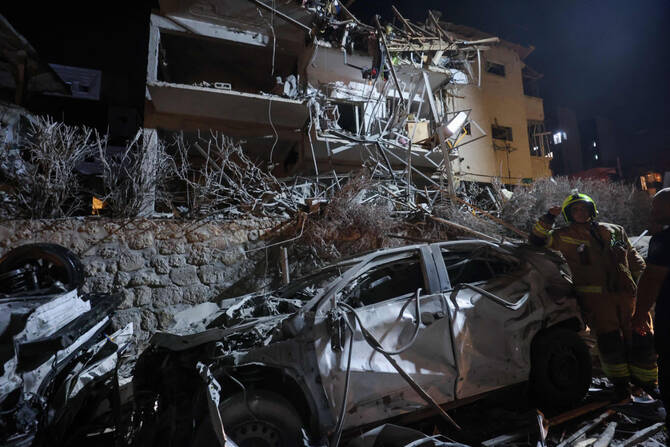
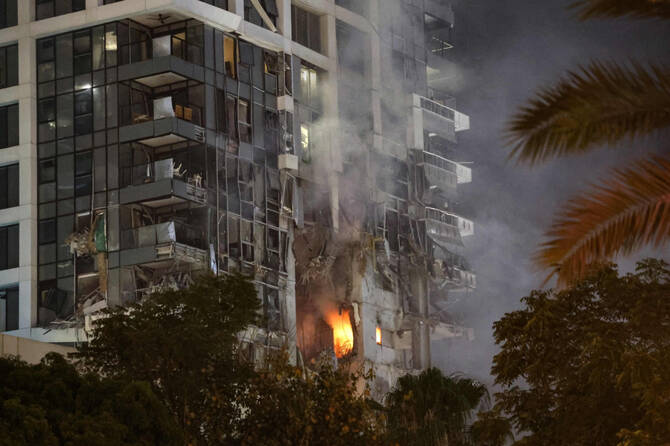
WASHINGTON: American air defense systems and Navy assets in the Middle East helped Israel shoot down incoming ballistic missiles Friday that Tehran launched in response to Israeli strikes on Iran’s nuclear facilities and top military leaders, US officials said.
The US has both ground-based Patriot missile defense systems and Terminal High Altitude Air Defense systems in the region capable of intercepting ballistic missiles, which Iran fired in multiple barrages in retaliation for Israel’s initial attack.
Naval assets also were involved in assisting Israel as Iran fired missiles at Tel Aviv, one official said. It was not immediately clear if ships fired interceptors or if their advanced missile tracking systems helped Israel identify incoming targets.
The United States also is shifting military resources, including ships, in the Middle East in response to the strikes.
The Navy has directed the destroyer USS Thomas Hudner, which is capable of defending against ballistic missiles, to begin sailing from the western Mediterranean Sea toward the eastern Mediterranean and has directed a second destroyer to begin moving forward so it can be available if requested by the White House, US officials said.
American fighter jets also are patrolling the sky in the Middle East to protect personnel and installations, and air bases in the region are taking additional security precautions, the officials said.
The officials spoke on the condition of anonymity to provide details not yet made public or to discuss ongoing operations.
President Donald Trump met with his National Security Council principals Friday to discuss options.
The forces in the region have been taking precautionary measures for days, including having military dependents voluntarily depart regional bases, in anticipation of the strikes and to protect personnel in case of a large-scale response from Tehran.
Typically around 30,000 troops are based in the Middle East, and about 40,000 troops are in the region now, according to a US official. That number surged as high as 43,000 last October amid the ongoing tensions between Israel and Iran as well as continuous attacks on commercial and military ships in the Red Sea by the Iranian-backed Houthis in Yemen.
The Navy has additional assets that it could surge to the Middle East if needed, particularly its aircraft carriers and the warships that sail with them. The USS Carl Vinson is in the Arabian Sea — the only aircraft carrier in the region.
The carrier USS Nimitz is in the Indo-Pacific and could be directed toward the Middle East if needed, and the USS George Washington just left its port in Japan and could also be directed to the region if so ordered, one of the officials said.
Then-President Joe Biden initially surged ships to protect Israel following the Oct. 7, 2023, attacks by Hamas that launched the war in Gaza. It was seen as a deterrent against Hezbollah and Iran at the time.
On Oct. 1, 2024, US Navy destroyers fired about a dozen interceptors in defense of Israel as the country came under attack by more than 200 missiles fired by Iran.


![]()
![]()
![]()

US helps Israel shoot down barrage of Iranian missiles

Short Url
https://arab.news/zjh6z
US helps Israel shoot down barrage of Iranian missiles
- US also is shifting military resources, including ships, in the Middle East in response to the strikes
- About 40,000 troops are in the Mideast region now, according to a US official


Latest updates




Recommended


© 2026 SAUDI RESEARCH & PUBLISHING COMPANY, All Rights Reserved And subject to Terms of Use Agreement.