





SUMMARY
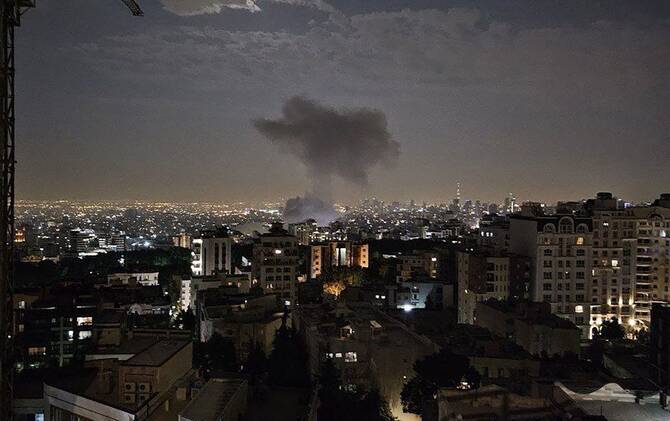
Israel launched a major wave of airstrikes targeting over 100 Iranian sites, including nuclear facilities early Friday.
High-ranking Iranian officials were killed, including IRGC chief Hossein Salami, Gen. Mohammad Bagheri, and nuclear scientists.
Iran reported 78 fatalities and over 320 injuries, mostly civilians, due to Israel’s strikes.
Iran retaliated in the evening with over 100 drones and 100–150 ballistic missiles targeting Israeli cities.
Explosions and air-raid sirens were reported in Tel Aviv, Jerusalem, and even Amman; several missiles bypassed Israeli defenses and caused damage.
At least three people were killed in Israel, with 63 injured according to updated figures.
Iran says dialogue with the US over Tehran’s nuclear program is “meaningless” after Israel’s biggest-ever military strike.
Israel’s military said Saturday it was striking dozens of missile launchers in Iran.
Tehran has warned the US, UK and France that their bases and ships in the region will be targeted if they help stop Iranian strikes on Israel – Iran state media.
JERUSALEM: Iran launched retaliatory missile strikes on Israel into Saturday morning, killing at least three people and wounding dozens, after a series of blistering Israeli attacks on the heart of Iran’s nuclear program and its armed forces.
Israel’s assault used warplanes, as well as drones smuggled into the country in advance, to assault key facilities and kill top generals and scientists. Iran’s UN ambassador said 78 people were killed and more than 320 wounded in the attacks.
Iran fires a second wave of missiles at Israel
Iran fired dozens of missiles at Israel on Friday night, lighting up the skies above Jerusalem and Tel Aviv, in response to a large-scale attack on Tehran's nuclear facilities and military leadership.
The rumble of explosions could be heard throughout Jerusalem, and Israeli TV stations showed plumes of smoke rising in Tel Aviv after an apparent missile strike.
Around 60 people have been injured, according to Israeli media.
Israeli emergency services said Iran rocket fire on a residential area killed two people in the coastal plain on Saturday.
“Among the casualties: a woman around 60 was rescued without signs of life, a man around 45 was evacuated in critical condition... and was later pronounced dead,” the Magen David Adom said in a statement, adding that 19 others were wounded.
A spokesperson for Beilinson Hospital in Tel Aviv said a woman was killed in an Iranian missile strike, bringing the total number of fatalities in the barrages from Iran to three.
The army said dozens of missiles had been launched and said it had ordered residents across the country to move into bomb shelters.
The strikes came in retaliation for Israeli attacks on Iran early Friday with a barrage of airstrikes that took out top military officers and hit nuclear and missile sites, calling it just the beginning and raising the potential for an all-out war between the two bitter Middle East adversaries. It appeared to be the most significant attack Iran has faced since its 1980s war with Iraq.
Iran quickly retaliated, sending a swarm of drones at Israel as Supreme Leader Ayatollah Ali Khamenei warned of “severe punishment.” Iran had been censured by the UN’s atomic watchdog a day earlier for not complying with obligations meant to prevent it from developing a nuclear weapon.
Israel’s Defense Minister Israel Katz said on Saturday the Iranian leadership had crossed a red line by firing at civilians and will “pay a heavy price for it”.
Iranian deaths
Iran’s UN ambassador said Friday that 78 people have been killed and over 320 injured in Israeli attacks.
Ambassador Amir Saeid Iravani told an emergency meeting of the U.N. Security Council that Israel’s “barbaric and criminal attack” and assassinations were against senior military officials and nuclear scientists. But he said “the overwhelming majority” of victims were civilians, women and children.
For years, Israel had threatened such a strike and successive American administrations had sought to prevent it, fearing it would ignite a wider conflict across the Middle East and possibly be ineffective at destroying Iran’s dispersed and hardened nuclear program.
Countries in the region condemned Israel’s attack, while leaders around the globe called for immediate deescalation from both sides.
READ: Saudi Arabia leads Arab condemnation of Israel attacks on Iran
Israel’s military said about 200 aircraft were involved in the initial attack on about 100 targets. Two security officials said the country’s Mossad spy agency was also able to position explosive drones inside Iran ahead of time and then activate them to target missile launchers at an Iranian base near Tehran.
They said Israel had also smuggled precision weapons into central Iran as well as strike systems on vehicles, which were activated as the attack began to hit Iranian air defenses.
The officials spoke on condition of anonymity to discuss the highly secretive missions and it was not possible to independently confirm their claims. There was no official comment.
The Israeli attack hit several sites, including Iran’s main nuclear enrichment facility at Natanz, where black smoke could be seen rising into the air. Later in the morning, Israel said it had also destroyed dozens of radar installations and surface-to-air missile launchers in western Iran.
Israel military spokesman Brig. Gen. Effie Defrin said Israel has “significantly damaged” Natanz and that the operation was “still in the beginning.”
Among those killed were three of Iran’s top military leaders, one who oversaw the entire armed forces, Gen. Mohammad Bagheri, one who led the paramilitary Revolutionary Guard, Gen. Hossein Salami, and another who ran the Guard’s ballistic missile program, Gen. Amir Ali Hajjizadeh.
READ: After Israel strikes Iran, airlines divert flights, airspace closed
Iran confirmed all three deaths, which were a significant blow to Tehran’s governing theocracy and will complicate efforts to retaliate against Israel.
Khamenei said other top military officials and scientists were also killed.
In its first response, Iran fired more than 100 drones at Israel. Israel said the drones were being intercepted outside its airspace, and it was not immediately clear whether any got through.
READ: King Salman orders Saudi officials to aid stranded Iranian Hajj pilgrims
King Salman on Friday ordered Saudi authorities to ensure that Iranian Hajj pilgrims stranded in the Kingdom receive all necessary support until it is safe for them to return home.
The directive came shortly after Israeli authorities launched early-morning airstrikes against Iran, which they said targeted nuclear sites, nuclear scientists and military chiefs. Tehran closed the country’s airspace in the aftermath.
The plan to provide help to stranded Iranian pilgrims was presented to the king by Crown Prince Mohammed bin Salman, the Saudi Press Agency reported. The Ministry of Hajj and Umrah has been tasked with ensuring they receive all necessary support.
US President Donald Trump urged Iran to reach a deal with Washington on its nuclear program, warning on his Truth Social platform that Israel’s attacks “will only get worse.”
Without saying whether he was privy to specific Israeli plans, Trump said “there is still time to make this slaughter, with the next already planned attacks being even more brutal, come to an end.”
“Iran must make a deal, before there is nothing left, and save what was once known as the Iranian Empire,” he wrote. “No more death, no more destruction, JUST DO IT, BEFORE IT IS TOO LATE.”

READ: Netanyahu calls on Iranians to unite against ‘evil and oppressive regime’
Israeli Prime Minister Benjamin Netanyahu called on Iranians Friday to unite against what he described as an “evil and oppressive regime,” telling them Israel was engaged in “one of the greatest military operations in history.”
“The time has come for the Iranian people to unite around its flag and its historic legacy, by standing up for your freedom from the evil and oppressive regime,” Netanyahu said in a video statement after Israel struck over 200 military and nuclear sites in the Islamic republic.
READ: UN nuclear watchdog says ‘closely monitoring’ situation after Israel strikes Iran
Officials in Washington had cautioned Israel against an attack during continued negotiations over Iran’s nuclear enrichment program. They stressed the US had not been involved and warned against any retaliation targeting US interests or personnel.
Israel told the Trump administration that large-scale attacks were coming, US officials said on condition of anonymity to describe private diplomatic discussions. On Wednesday the US pulled some American diplomats from Iraq’s capital and offered voluntary evacuations for the families of US troops in the wider Middle East.
Israel calls attacks preemptive strikes on Iran’s nuclear program
Israeli leaders cast the attack as necessary to head off an imminent threat that Iran would build nuclear bombs, though it remains unclear how close the country is to achieving that or whether Iran had actually been planning a strike. Iran maintains its nuclear program is for civilian purposes only.
“This is a clear and present danger to Israel’s very survival,” Israeli Prime Minister Benjamin Netanyahu claimed as he vowed to pursue the attack for as long as necessary to “remove this threat.”
READ: Saudi crown prince discuss repercussions of Israel-Iran clash with Macron, Meloni
Saudi Crown Prince Mohammed bin Salman on Friday talked with the leaders of France and Italy Friday about the latest developments in the region, according to the Saudi Press Agency.
During a phone call, the crown prince and France’s President Emmanuel Macron discussed the repercussions of Israeli strikes on Iran, which has killed 78 people, including generals and scientists, and wounded 320 others.
Iran retaliated later in the day, raining missiles and weaponized drones on Israeli cities, causing destruction.
In a separate call with Italy’s Prime Minister Giorgia Meloni, the two leaders “emphasized the necessity of making every effort to de-escalate the situation, the importance of exercising restraint, and resolving all disputes through diplomatic means,” the SPA report said.
READ: Iran’s Khamenei warns Israel faces ‘bitter and painful fate’
Over the past year, Israel has been targeting Iran’s air defenses, hitting a radar system for a Russian-made air defense battery in April 2024 and surface-to-air missile sites and missile manufacturing facilities in October.
Nervous Israelis rushed to supermarkets in Tel Aviv, Jerusalem and elsewhere to buy bottled water and other supplies, and circulated messages on WhatsApp groups advising each other to prepare their shelters for potential long-term use.
Iran claims Israel targeted residential areas
Khamenei said in a statement that Israel “opened its wicked and blood-stained hand to a crime in our beloved country, revealing its malicious nature more than ever by striking residential centers.”
For Netanyahu, the operation distracts attention from Israel’s ongoing and increasingly devastating war in Gaza, which is now over 20 months old.
There is a broad consensus in the Israeli public that Iran is a major threat, and Israel’s opposition leader, Yair Lapid, a staunch critic of Netanyahu, offered his “full support” for the mission against Iran. But if Iranian reprisals cause heavy Israeli casualties or major disruptions to daily life, public opinion could shift quickly.
Iran said it had downed two warplanes and that a female pilot had been captured. The Israelis denied the claim.
The Iran-backed Lebanese militant group Hezbollah issued a statement that offered condolences and condemned the attack, but did not threaten to join Iran in its retaliation. Hezbollah’s latest war with Israel — which killed much of the group’s senior leadership — ended with a US-brokered ceasefire in November.
Netanyahu expressed hope the attacks would trigger the downfall of Iran’s theocracy, saying his message to the Iranian people was that the fight was not with them, but with the “brutal dictatorship that has oppressed you for 46 years.”
“I believe that the day of your liberation is near,” he said.
In addition to targeting nuclear and military sites, Israel aimed its attacks at officials leading Iran’s nuclear program and its ballistic missile arsenal. The International Atomic Energy Agency confirmed that an Israeli strike hit Iran’s uranium enrichment facility at Natanz and said it was closely monitoring radiation levels.
‘Enough escalation. Time to stop,’ UN chief says after Israel-Iran strikes
The UN chief called Friday for Israel and Iran to halt their escalating conflict, after the two countries exchanged a barrage of missiles.
“Enough escalation. Time to stop. Peace and diplomacy must prevail,” Antonio Guterres said on X after Israel’s “preemptive” strikes on Iran and Tehran’s counter-attack.
The strike on Iran pushed the Israeli military to its limits, requiring the use of aging air-to-air refuelers to get its fighter jets close enough to attack. It wasn’t immediately clear if Israeli jets entered Iranian airspace or just fired so-called “standoff missiles” over another country. People in Iraq heard fighter jets overhead at the time of the attack.
Tension had been growing for weeks ahead of attacks
The potential for an attack had been apparent for weeks as angst built over Iran’s nuclear program.
Once the attacks were underway, the US Embassy in Jerusalem issued an alert telling American government workers and their families to shelter in place until further notice.
US Secretary of State Marco Rubio said Israel took “unilateral action against Iran” and that Israel advised the US that it believed the strikes were necessary for its self-defense.
“We are not involved in strikes against Iran, and our top priority is protecting American forces in the region,” Rubio said in a statement released by the White House.
Trump is scheduled to attend a meeting of his National Security Council on Friday in the White House Situation Room.
Israel has long been determined to prevent Iran from developing nuclear weapons, a concern laid bare on Thursday when the Board of Governors at the International Atomic Energy Agency for the first time in 20 years censured Iran over its refusal to work with its inspectors. Iran immediately announced it would establish a third enrichment site and install more advanced centrifuges.
Even so, there are multiple assessments on how many nuclear weapons Iran could conceivably build, should it choose to do so. Iran would need months to assemble, test and field any weapon, which it so far has said it has no desire to do. US intelligence agencies also assess Iran does not have a weapons program at this time.
In a sign of the far-reaching implications of the emerging conflict, Israel’s main airport was closed and benchmark Brent crude spiked on news of the attack, rising nearly 8 percent before retreating slightly.


