

Japan’s foreign minister praises Djibouti’s work on maritime security

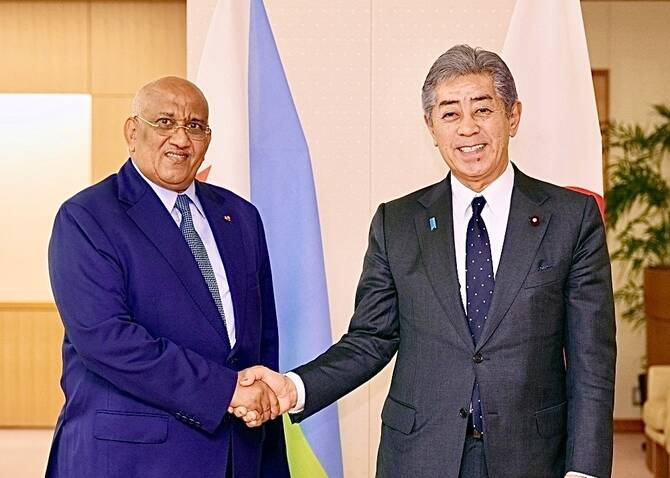
Japanese foreign minister Takeshi Iwaya met with Dileita Mohamed Dileita, President of the National Assembly of the Republic of Djibouti. (MOFA)
Short Url
Updated 13 June 2025
Follow

Japan’s foreign minister praises Djibouti’s work on maritime security

TOKYO: Japanese foreign minister Takeshi Iwaya met with Dileita Mohamed Dileita, President of the National Assembly of the Republic of Djibouti, on Friday and praised the “deepening of cooperation between the two countries in the field of maritime security.”

Iwaya stated that Djibouti, located at the southern end of the Red Sea and an important sea lane linking Europe and Asia, is a strategically important partner in the quest for a “Free and Open Indo-Pacific (FOIP).”

Referring to the good relations between the two countries and his own special attachment toward Japan, President Dileita expressed his appreciation and gratitude for Japan’s development cooperation in various fields and for the Self-Defense Force facility in Djibouti, noting the strategic importance of his country.

The two sides exchanged views on issues that included the regional situation in Africa and in East Asia and agreed to further strengthening bilateral relations and cooperation in regional and international arena, with a view to TICAD 9 in August and Expo 2025 Osaka, Kansai, Japan.

• This article originally appeared on Arab News Japan


Taiwan to send team to assess US rare earth deposits

Updated 4 sec ago
Follow

Taiwan to send team to assess US rare earth deposits

TAIPEI: Taiwan plans to ‌send officials to assess US rare earths deposits with a goal to have such minerals refined on the island, ​Economy Minister Kung Ming-hsin said on Wednesday.
President Donald Trump’s administration has stepped up efforts to secure US supplies of critical minerals after China rattled senior officials and global markets last year by withholding rare earths required by American automakers and other industrial manufacturers.
Trump last week launched a US ‌strategic stockpile of critical ‌minerals, called Project Vault, ​backed ‌by $10 ⁠billion in ​seed funding ⁠from the US Export-Import Bank and $2 billion in private funding.
While semiconductor powerhouse Taiwan is not formally part of that scheme, it has previously held talks with the United States on how it can help, given Taipei’s concerns about over-reliance on a China-centric ⁠supply chain.
China views Taiwan as its ‌own territory and ‌has stepped up its military threats.
Speaking ​to reporters in Taipei, ‌Kung said the ministry’s Geological Survey and Mining ‌Management Agency would go to the United States to assess rare earths deposits there.
“Specifically, what rare-earth elements they contain and whether they are suitable. In other words, ‌whether those are the rare earths we actually need. So we still need ⁠to investigate,” he ⁠said.
Given Taiwan does not mine such elements itself, it can instead play a role in refining the materials from other countries, Kung added.
“The technology is not an issue; the next step is scaling up,” he said.
Taiwan consumes 1,500 metric tons of rare earth annually, a figure projected to rise to 2,000 metric tons given economic growth, Kung added.
“Our goal is to expand production ​capacity to meet ​half of our demand by then, strengthening the supply chain.