

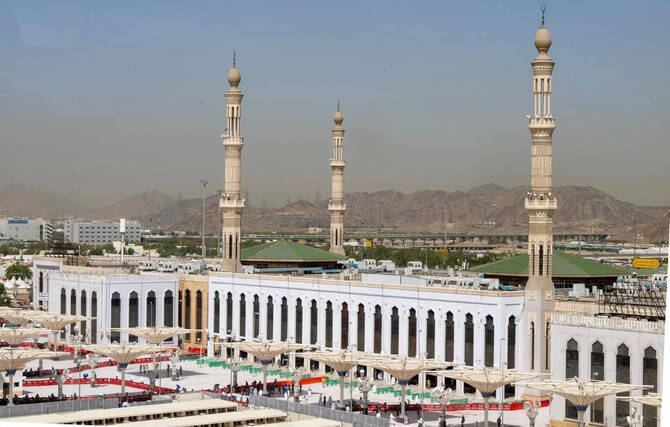

MAKKAH: In Makkah, the holiest city in Islam, spiritual significance extends far beyond the Grand Mosque. Scattered throughout the city are historic mosques that witnessed pivotal moments in Islamic history.
Yet, amid the dense crowds and the rapid pace of modern development, many pilgrims and Umrah performers remain unaware of these sacred sites, quietly tucked away within the city’s expanding urban landscape.
Fawaz Al-Dahas, professor of history at Umm Al-Qura University, said that Makkah is home to several mosques of profound historical and religious value, yet they remain largely overlooked, receiving neither the media attention nor the organized religious visits they merit.
Al-Dahas highlighted the significance of Namirah Mosque in Arafat, where the Prophet delivered his sermon during the Farewell Pilgrimage. He said that this mosque was not merely a physical structure, but a sacred site where the foundational principles of Islam were proclaimed. He also referenced the Bay’ah Mosque in Mina, which commemorates the pivotal moment when the Ansar pledged allegiance to the Prophet, paving the way for the Hijrah and the establishment of the Islamic state.
According to Al-Dahas, the importance of these mosques transcends their geographic locations, reflecting their profound political and religious significance in Islamic history.
Al-Dahas shed light on Al-Rayah Mosque: “Located in the Jarwal neighborhood, where the Prophet’s banner was raised on the day of the Conquest of Makkah, a powerful symbol of victory tempered by forgiveness.”
He also drew attention to Al-Hudaibiya Mosque, situated west of Makkah, where the historic Bay’at Al-Ridwan pledge took place, an event referenced in the Holy Qur’an. He said that while the mosque still stands on the original site of the Treaty of Hudaibiya, it remains largely unknown, with few visitors aware of its exact location.
Mohammed Al-Joud, a Hajj and Umrah specialist, said that these mosques were not merely historical structures, but vital educational landmarks that enrich a pilgrim’s understanding of the deeper spiritual dimensions of Hajj. He pointed to Al-Khayf Mosque in Mina, where the Prophet and prophets before him are believed to have prayed, as a powerful symbol of the continuity of prophethood: “Yet, many pilgrims remain unaware of its significance outside the Hajj season.”
Al-Joud also highlighted Al-Mashar Al-Haram Mosque in Muzdalifah, which is mentioned in the Holy Qur’an, emphasizing that awareness of such sacred sites bridges the rituals of Hajj with their Qur’anic and historical roots, enhancing the spiritual journey.
Al-Joud also drew attention to Al-Kabsh Mosque in Mina, linked to the story of the sacrifice of Ismail. He explained that the mosque symbolizes the values of sacrifice and obedience, yet remains largely overlooked in media coverage and excluded from most pilgrimage programs. He described it as an essential part of a broader, interconnected network of sacred sites that trace the prophetic journey — from revelation to migration, and from peace to conquest.
Al-Dahas underscored the importance of launching awareness initiatives to shed light on these mosques and restore their rightful standing. He said that safeguarding Makkah’s Islamic heritage was not limited to preserving its prominent landmarks, but also required reviving these historically significant mosques, which once stood as pivotal markers along the journey of the prophetic message.
He said that reconnecting pilgrims with these sacred sites revived the educational and historical depth of Hajj, enriching the journey with a more profound, informed, and spiritually immersive experience.


