

Saudi Arabia honors Pakistani army chief with King Abdulaziz Medal

1 / 4
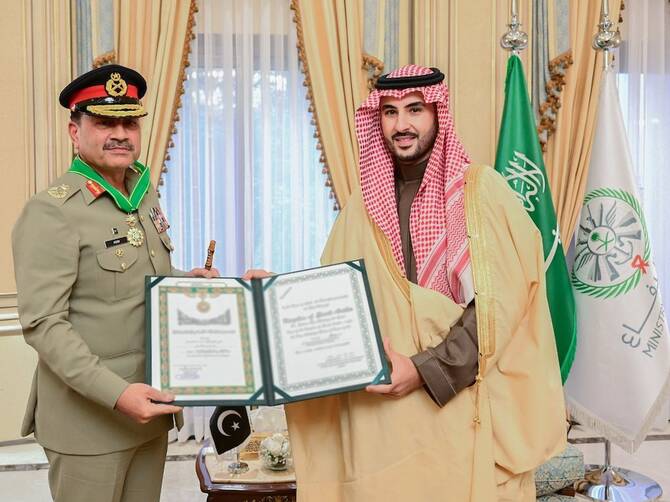
Saudi Arabia’s Minister of Defense Prince Khalid bin Salman presented the King Abdulaziz Medal of the First Class to Pakistan’s Chief of Army Staff on Sunday in a ceremony at his office in Riyadh. (SPA)
2 / 4
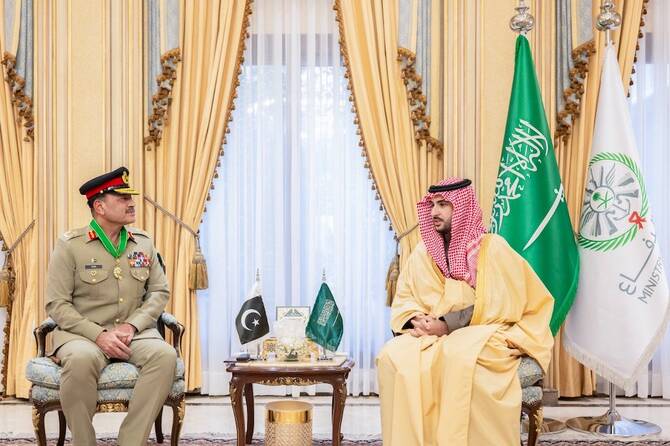
Saudi Arabia’s Minister of Defense Prince Khalid bin Salman presented the King Abdulaziz Medal of the First Class to Pakistan’s Chief of Army Staff on Sunday in a ceremony at his office in Riyadh. (SPA)
3 / 4
Saudi Arabia’s Minister of Defense Prince Khalid bin Salman presented the King Abdulaziz Medal of the First Class to Pakistan’s Chief of Army Staff on Sunday in a ceremony at his office in Riyadh. (SPA)
4 / 4
Saudi Arabia’s Minister of Defense Prince Khalid bin Salman presented the King Abdulaziz Medal of the First Class to Pakistan’s Chief of Army Staff on Sunday in a ceremony at his office in Riyadh. (SPA)
Short Url
Updated 22 December 2025
Follow

Saudi Arabia honors Pakistani army chief with King Abdulaziz Medal

  • Chief of Army Staff Field Marshal Asim Munir receives award in Riyadh

RIYADH: Defense Minister Prince Khalid bin Salman presented the King Abdulaziz Medal of the First Class to Pakistan’s army chief at a ceremony in his Riyadh office on Sunday, the Saudi Press Agency reported.

Chief of Army Staff Field Marshal Asim Munir was given the award following a royal order from King Salman, the SPA added.

The medal recognizes Munir’s efforts to strengthen Saudi-Pakistani relations.

Prince Khalid congratulated him on his appointment as army chief and wished him success.

Their meeting included a review of historical ties, strategic defense cooperation, and discussions on promoting international peace and security.

Attendees from the Saudi Arabia side included Deputy Minister of Defense Prince Abdulrahman bin Mohammed bin Ayyaf, Chief of the General Staff Lt. Gen. Fayyad bin Hamed Al-Ruwaili, and senior defense officials.

The Pakistani delegation was led by Ambassador Ahmed Farooq, alongside senior military officials including Maj. Gen. Muhammad Jawad Tariq and Brig. Gen. Mohsin Javed.


Books to deepen your understanding of Islam this Ramadan

Updated 10 sec ago
Follow

Books to deepen your understanding of Islam this Ramadan

DHAHRAN: Since Ramadan is upon us, Arab News ventured to the Ithra Library at the King Abdulaziz Center for World Culture in Dhahran, known as Ithra, both spaces designed by the Norwegian architectural firm Snohetta, known for iconic projects like the Bibliotheca Alexandrina in Egypt.

Up on the fourth floor of the architectural marvel at Ithra that houses 360,000 physical books — 60 percent of which are in Arabic and the rest in English with a curated selection of titles in other languages dedicated to linguistic learning — the collection offers titles on numerous topics. There are also digital books available and plenty of places to sit and flip through pages.

It is widely known that the auspicious first word that was revealed to the Prophet Muhammad was “iqra” or “read.” This occurred in the Cave of Hira, where the Angel Gabriel appeared and commanded the Prophet to recite. Reading is a pillar in acquiring knowledge and thus the perfect activity this month.

It is also noted that in Surah Al-Baqarah, it states that Ramadan was the month in which the Qur’an was revealed, hence its emphasis on most Muslims attempting to read it during the holy month.

Fittingly, the first of the Ithra Library’s 51 columns welcomes visitors to the space with a phrase from the Qur’an on the infinity of knowledge.

Arab News spoke to Ithra Library specialist Reenad Alqahtani about six books — in addition to the Qur’an itself — that she would recommend to deepen one’s faith or broaden one’s understanding of Islam this Ramadan.

“A lot of the (recent) visitors that come to the Ithra library mainly ask about books about fasting, to give them guidelines for Ramadan,” she told Arab News. “They’re not specifically Muslims, in general, most of them are Christians. Some of them search for books in comparison, because, as you know, Christians fast sometimes as well,” Alqahtani said.

“There was a visitor who came asking for a book about the comparison between the Islamic version of fasting and Christianity. Is there a book like that? Unfortunately, we do not have one yet — we are always trying to improve our collection. I gave him some books about fasting and Islam in general, and information about fasting in Christianity; he can do the comparison himself.”

She firmly believes that books can provide cultural context as well as deepening one’s understanding about the religion.

“It is not rituals only, you know: that you have to pray, you have to do this and that — there’s a lot of things, inside, that we need to also focus on,” she concluded.

Alqahtani suggested some books to read this month. One of them is titled “A Comprehensive Guide to Sawm: Fasting in Islam and the Month of Ramadan.” Originally published in Turkish by Ali Budak and translated into English by Tughra Books, the book explores the divine institution of fasting in Islam by providing comprehensive information on its place in the Islamic doctrine and the merits and benefits of fasting, as well as the types of fasts.

Another suggestion was “Understand Ramadan: Fasting, Tarawih, Itikat, Lailat Al-Qadr Sadaqat Al-Fitr & the two Eid Prayers.” Rendered into English by Dr. Muhammad Muhsin Khan by Dar-us-Salam: Global Leader in Islamic Books, the pages provide Arabic religious text and the English explanations, so readers can view the source text and English explanation side-by-side.

She also recommended “The First Muslim: The Story of Muhammad.” Published by Penguin Group, this book by Lesley Hazleton — who has reported on the Middle East from Jerusalem for more than a dozen years — draws on history, politics, religion and psychology to tell this tale, centered on the Prophet.

Another book was “Questions & Answers on the Biography of the Prophet Muhammad: Part One (From Birth to Hijrah).” Another Dar-us-Salam: Global Leader in Islamic Books publication, this one was prepared by Syed Masoodul Hasan.

“Fasting for Ramadan: Notes from a Spiritual Practice” was also suggested. A memoir by Prof. Kazim Ali, it chronicles two 30-day cycles of Ramadan, focusing on reflection, prayer and cultural rediscovery, blending personal anecdotes with poetry, philosophy and daily meditations.

Finally, Alqahtani suggested “Everything You Want to Know About Ramadan.” The only Arabic title in the recommendation list — but the language is fairly easy to understand by someone learning Arabic — the book, by Mustafa Hosny, offers insights into the holy month.

All of these books can be found at the Ithra Library or wherever you get your books.