

Pakistan announces income tax relief for salaried class in FY2025-26 budget

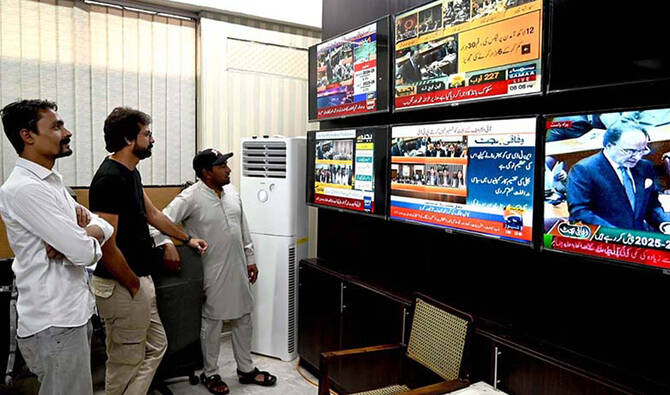
Corporate employees watching television screens as Pakistan Finance Minister Muhammad Aurangzeb presents Pakistan’s $62 billion federal budget for fiscal year 2025–26, in Islamabad on June 10, 2025. (APP)
Short Url
Updated 10 June 2025
Follow

Pakistan announces income tax relief for salaried class in FY2025-26 budget

  • Tax rate for those earning between $2,128–$4,255 annually to be cut from 5% to 2.5%
  • Pakistan’s tax-to-GDP ratio remains below 10%, among the lowest in the region

ISLAMABAD: Pakistan announced significant income tax relief for the salaried class on Tuesday as it announced its federal budget for the fiscal year 2025-26, aiming to ease the burden on working people amid high inflation and economic uncertainty.

Pakistan’s tax-to-GDP ratio remains below 10%, among the lowest in the region. The government has pledged to raise this ratio to 14% through tax reforms, digital enforcement, and expanding the tax base.

“First of all, we are providing relief where it is most needed, relief for the salaried class,” Finance Minister Muhammad Aurangzeb, presenting his first full-year budget in the National Assembly, said.

“In this regard, there is a proposition for a significant reduction in the income tax slabs for the working class.”

Aurangzeb said the income tax rate for individuals earning between Rs600,000 and Rs1.2 million ($2,128–$4,255) annually would be cut from 5% to 2.5%.

“For those earning up to Rs22,000,000 [$7,788], the tax rate has been proposed at 11% instead of 15%. Similarly, those who earn a higher salary, there is a proposition of tax reduction,” the finance minister said.

“For those who are earning between Rs22,000,000 [$7,788] up to Rs32,000,000 [$11,328], the tax rate has been proposed to be reduced from 25% to 23%.”

For high-income earners making over Rs10 million ($35,460) annually, a 1% reduction in the additional surcharge has been recommended to help curb the ongoing brain drain, the minister said.

Aurangzeb described the changes as part of broader efforts to simplify the tax structure and “strike a balance between inflationary pressures and take-home pay.”

The federal budget, with a total outlay of Rs17.57 trillion ($62 billion), comes as Pakistan seeks to stabilize its economy under a $7 billion International Monetary Fund (IMF) bailout program approved last year.

The budget also includes a 20% increase in defense spending, while total government expenditure is expected to be 7% lower year-on-year compared to the last fiscal, reflecting fiscal consolidation goals tied to IMF negotiations.

The proposed budget will be debated in parliament before final approval.


World Bank approves $700 million for Pakistan’s economic stability

Updated 20 December 2025
Follow

World Bank approves $700 million for Pakistan’s economic stability

  • Of this, $600 million will go for federal programs and $100 million will ⁠support a provincial program in Sindh
  • The results-based design ensures that resources are only disbursed once program objectives are achieved

ISLAMABAD: The World Bank has approved $700 million in ​financing for Pakistan under a multi-year initiative aimed at supporting the country’s macroeconomic stability and service delivery, the bank said on Friday.

The funds will be released under the bank’s Public ‌Resources for Inclusive ‌Development — Multiphase ‌Programmatic ⁠Approach (PRID-MPA) that ‌could provide up to $1.35 billion in total financing, according to the lender.

Of this amount, $600 million will go for federal programs and $100 million will ⁠support a provincial program in ‌the southern Sindh province. The results-based design ensures that resources are only disbursed once program objectives are achieved.

“Pakistan’s path to inclusive, sustainable growth requires mobilizing more domestic resources and ensuring they are used efficiently and transparently to deliver results for people,” World Bank country director Bolormaa Amgaabazar said in a statement.

“Through this MPA, we are working with the Federal and Sindh governments to deliver tangible impacts— more predictable funding for schools and clinics, fairer tax systems, and stronger data for decision‑making— while safeguarding priority social and climate investments and strengthening public trust.”

The approval ‍follows a $47.9 ‍million World Bank grant ‍in August to improve primary education in Pakistan’s most populous Punjab province.

In November, an IMF-World Bank ​report, uploaded by Pakistan’s finance ministry, said Pakistan’s fragmented ⁠regulation, opaque budgeting and political capture are curbing investment and weakening revenue.

Regional tensions may surface over international financing for Pakistan. In May, Reuters reported that India would oppose World Bank funding for Pakistan, citing a senior government ‌source in New Delhi.

“Strengthening Pakistan’s fiscal foundations is essential to restoring macroeconomic stability, delivering results and strengthening institutions,” said Tobias Akhtar Haque, Lead Country Economist for the World Bank in Pakistan.

“Through the PRID‑MPA, we are launching a coherent nationwide approach to support reforms that expand fiscal space, bolster investments in human capital and climate resilience, and strengthen revenue administration, budget execution, and statistical systems. These reforms will ensure that resources reach the frontline and deliver better outcomes for people across Pakistan with greater efficiency and accountability.”

In Sindh, the program is expected to increase provincial revenues, enhance the speed and transparency of payments, and broaden the use of data to guide provincial decision making. The program will directly support the increase of public resources for inclusive development, including more equitable and responsive financing for primary health care facilities and more funding for schools.