

Italy arrests Burundi man over 2014 murders of three Catholic nuns

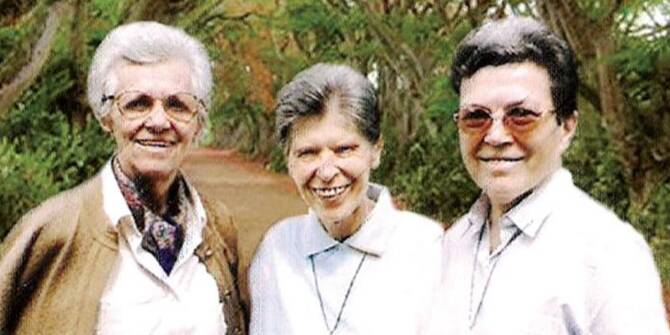
Guillaume Harushimana is suspected of instigating, jointly organizing and logistically supporting the murders of Olga Raschietti, 83, Lucia Pulici, 75, and Bernadetta Boggian, 79, in two separate attacks on September 7-8, 2014. (X/@bbcgahuza)
Short Url
Updated 26 February 2026
Follow

Italy arrests Burundi man over 2014 murders of three Catholic nuns

  • Guillaume Harushimana is suspected of instigating, jointly organizing and logistically supporting the murders
  • The nuns may have ⁠been killed for refusing to provide medical aid to Burundian militias deployed in Congo

ROME: Italy has arrested a 50-year-old Burundian man in connection with the murder of three Italian missionary nuns in the east African country’s commercial capital Bujumbura more than 10 years ago, prosecutors in Parma said on Thursday.
Guillaume Harushimana is suspected of instigating, jointly organizing and logistically supporting the murders of Olga Raschietti, 83, Lucia Pulici, 75, and Bernadetta Boggian, 79, in two separate attacks on September 7-8, 2014.
Monica Moschioni, a lawyer appointed by a court to represent Harushimana, told Reuters she could not say whether he would ⁠plead innocent or ⁠guilty as she had not yet spoken to him. She was due to do so on Friday, she added.

KILLINGS ORDERED BY GENERAL, PROSECUTORS SAY
The killings were ordered by General Adolphe Nshimirimana, then head of the Burundi secret police, who was assassinated in 2015, the prosecutors said. Harushimana was one of the general’s close associates, they added.
According to investigators, the nuns may have ⁠been killed for refusing to provide medical aid to Burundian militias deployed in Congo, disputes over the funding of a youth center in Kamenge, or as part of a sacrificial rite.
Burundi authorities did not respond to a request for comment.
Prosecutors said four people were suspected of carrying out the killings. Two had made radio confessions and one described as the general’s bodyguard was questioned in Parma and had partially admitted the facts, they added. The fourth person has not been identified.
The presumed killers entered the nuns’ compound disguised in clerical robes and left wearing police uniforms, prosecutors said. In 2014, Reuters reported ⁠that two of ⁠the three victims were raped and decapitated.
Italian prosecutors said they reopened investigations into the murders in 2024, thanks to leads from a book by investigative journalist Giusy Baioni, leading them to testimonies from other nuns which had not been heard by Burundian authorities.
Harushimana’s name had already emerged in connection with the murders, Italian prosecutors said, adding that he had obtained a travel visa to Italy in 2018 to attend a training course in the northern city of Parma.
They said he was taken in for questioning at the time in Parma, but denied any involvement, saying he had been outside Burundi at the time of the murders, and providing passport stamps as evidence of his absence from the country.


26 Doctors without Borders workers remain unaccounted for in South Sudan a month after attacks

Updated 4 sec ago
Follow

26 Doctors without Borders workers remain unaccounted for in South Sudan a month after attacks

  • A hospital in the town of Lankien was bombed by government forces, MSF said
  • “We have lost contact with them amid ongoing insecurity”

NAIROBI: More than two dozen Doctors Without Borders workers remain unaccounted for a month after attacks in South Sudan, the medical charity said.
Two facilities belonging to the group, known by French acronym MSF, were attacked on Feb. 3 in Jonglei State, northeast of the capital, Juba, where violence has displaced an estimated 280,000 people since December.
A hospital in the town of Lankien was bombed by government forces, MSF said, while another medical facility in the town of Pieri was raided by “unknown assailants.” Both were located in opposition-held areas.
Staff working at the two facilities fled alongside much of the local population into deeply rural areas where armed clashes and aerial bombardments were ongoing.
MSF said in a statement on Monday that “26 of 291 of our colleagues working in Lankien and Pieri remain unaccounted for.
“We have lost contact with them amid ongoing insecurity,” it said.
The lack of communication with its staff could be linked to the limited network connectivity in much of the state. Staff members who had been contacted described “destruction, violence and extreme hardships.”
Fighting escalated sharply in December, when opposition forces captured a string of government outposts in north central Jonglei. In January, the government responded with a counteroffensive that recaptured most of the area it had lost.
Displaced people in Akobo, an opposition-held town near the Ethiopian border, described horrific violence by government fighters. Many described not being able to find food or water as they walked for days to reach safety.
The attacks on MSF facilities in Lankien and Pieri are part of an uptick in violence on humanitarian staff, supplies and infrastructure, aid groups say. MSF facilities have been attacked 10 times in the last 12 months.
“This violence has taken an unbearable toll not only on health care services, but on the very people who kept them running,” said Yashovardhan, MSF head of mission in South Sudan, who only uses one name.
“Medical workers must never be targets,” he said. “We are deeply concerned about what has happened to our colleagues and the communities we serve.”