ISLAMABAD: Pakistan will increase defense spending by more than 20% in the 2025-26 fiscal year to Rs2.55 trillion ($9.04 billion) as it seeks to bolster military capabilities following the country’s worst confrontation with India in nearly three decades.
The move comes as the government unveiled a Rs17.57 trillion ($62 billion) federal budget on Tuesday, reflecting a 7% decrease in overall spending compared to the current fiscal year. The largest portion of the budget – Rs8.21 trillion ($29 billion), or nearly half of total expenditures – will go toward debt servicing, continuing to strain Pakistan’s fiscal space.
“National defense is the most important priority of the government,” Finance Minister Muhammad Aurangzeb said while presenting his first full-year budget in the National Assembly. “For this national duty, Rs2,550 billion [$9.04 billion] will be allocated.”
Pakistan’s defense budget for the outgoing fiscal year stood at Rs2.12 trillion ($7.44 billion). The increase comes weeks after a four-day military standoff with India in May, which erupted following an attack in Indian-administered Kashmir that left 26 Hindu pilgrims dead. New Delhi blamed Pakistan-backed militants, a charge Islamabad denied.
The two nuclear-armed neighbors exchanged missile, drone, artillery, and air strikes before agreeing to a ceasefire on May 10.
Aurangzeb said the budget was being presented “at a very important and historic moment when the nation in recent days showed extraordinary unity, determination and strength.”
“After the Pak-India war, India has threatened to block the flow of river water into Pakistan. India is trying to use water as a weapon. I want to make it clear that water guarantees Pakistan’s survival and no hindrance will be tolerated in this respect,” the finance minister added.
Fiscal consolidation under IMF watch
Pakistan remains under a $7 billion IMF loan program approved last year, and the budget reflects an attempt to balance security concerns with ongoing fiscal reform efforts.
The government has set a GDP growth target of 4.2% for the next fiscal year, while aiming to reduce the fiscal deficit to 3.9% of GDP. The economy grew just 2.6% in 2024/25, falling short of its 3.6% target due to weak agriculture and industrial output. Inflation is projected at 7.5%.

Security personnel shift boxes with copies of the 2025–26 fiscal budget outside the Parliament House in Islamabad, before the start of the budget session. (APP)
In a May 23 statement, the IMF said Pakistan had pledged to maintain fiscal consolidation while safeguarding “social and priority expenditures,” targeting a primary surplus of 1.6% of GDP in 2025/26.
Aurangzeb said the new budget aimed to “change the DNA of our economy” by boosting exports, building foreign exchange reserves, and promoting productivity to avoid recurring balance of payment crises.
Bridging the gap
The government expects total revenues of Rs11.1 trillion ($39 billion), leaving a Rs6.5 trillion ($23 billion) financing gap to be filled through domestic and external borrowing, as well as privatization proceeds. Privatization is expected to bring in Rs87 billion, while Rs106 billion ($376 million) is projected from foreign sources.
The Federal Board of Revenue (FBR) has been tasked with collecting Rs14.1 trillion of the projected Rs19.3 trillion in gross revenue, marking a 19% year-on-year increase.
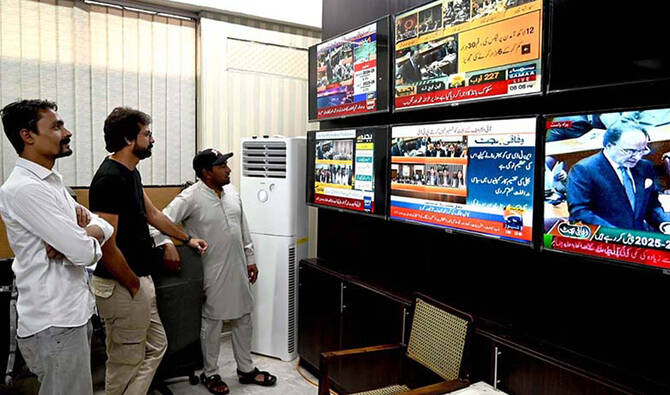
Corporate employees watching television screens during presentation of Pakistan’s $62 billion federal budget for fiscal year 2025–26, in Islamabad. (APP)
Under the Public Sector Development Program (PSDP), Rs1 trillion ($3.5 billion) has been allocated, with Rs328 billion ($1.16 billion) earmarked for transport infrastructure projects. The government also set aside Rs113 billion ($399 million) for education and Rs32 billion ($113 million) for health care.
Aurangzeb also announced plans to grow IT exports to $25 billion over the next five years and forecast a rise in workers’ remittances to $38 billion by the end of the current fiscal year.
Mixed reaction from markets
The budget drew mixed reactions from analysts and market participants.
Muhammad Waqas Ghani, head of research at JS Global Capital Ltd., said the proposals prioritized “tax reduction, energy sector changes, and austerity” in line with the last two budgets.
He noted the construction sector was favored, while the auto industry was the most negatively affected.
“On equities, CGT (capital gains tax) remains at 15%, but income from loans will be taxed at 25% to encourage mutual funds to divert their funds toward the equity asset class,” Ghani said.
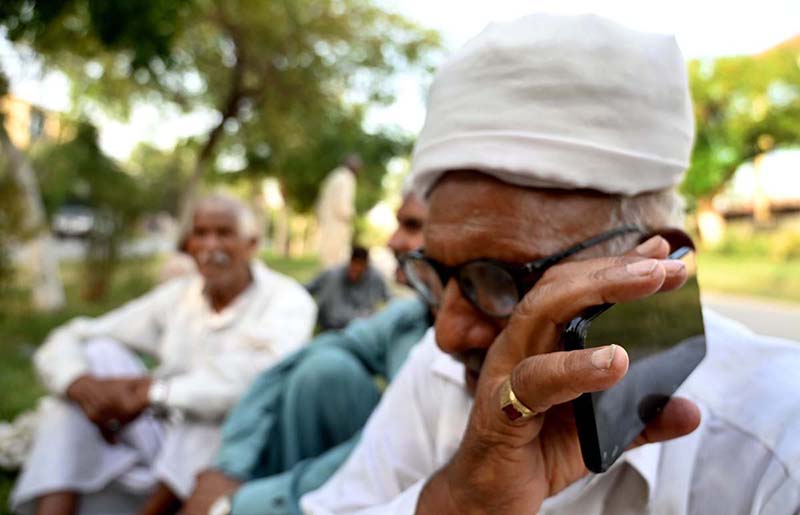
An elder man listening the 2025-26 federal budget speech live on his mobile phone at a roadside in Islamabad. (APP)
Amreen Soorani, head of research at Al Meezan Investment Management, said the budget proposals were largely in line with market expectations.
“While there are some discernible disparities in the taxation of various asset classes, the initial reaction from the listed equity market appears to be one of cautious optimism,” she told Arab News.
However, the Overseas Investors Chamber of Commerce and Industry (OICCI), which represents over 200 multinational companies in Pakistan, expressed disappointment, urging the government to overhaul tax structures to improve competitiveness and attract foreign investment.