South Africa says 2 of its nationals died fighting for Russia in Ukraine after recruitment scheme

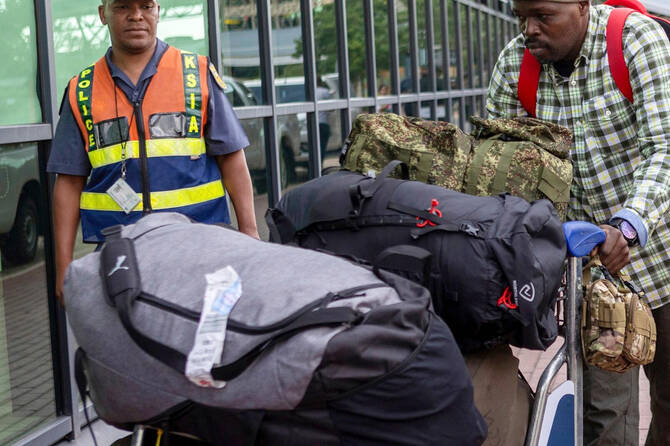
South African men who were allegedly tricked into fighting for Russia in the war in Ukraine arrive at King Shaka International Airport in Durban, Feb. 25, 2026. (AP)
Short Url
Updated 26 February 2026
Follow

South Africa says 2 of its nationals died fighting for Russia in Ukraine after recruitment scheme

  • Foreign Minister Ronald Lamola didn’t name the two people who died or say when or where they had died
  • Duduzile Zuma-Sambudla, ex-President Jacob Zuma’s daughter, is being investigated by police for alleged involvement in luring those 17 men to Russia

CAPE TOWN: At least two South Africans have died fighting for Russia in the war in Ukraine after being tricked into traveling there by a recruitment scheme, South Africa’s foreign minister said Thursday.
It was the first time South African authorities had confirmed any of their citizens who were allegedly lured to Russia with false promises of employment or training opportunities had been killed in the war.
Foreign Minister Ronald Lamola didn’t name the two people who died or say when or where they had died.
His announcement came while he visited the families of 11 South Africans who returned home on Wednesday after they were allegedly recruited last year in a scheme promising them security training in Russia and ended up involved in the conflict in Ukraine. Four men caught up in the same scheme had previously been repatriated, while two remained in Russia with “severe injuries,” Lamola said.
Duduzile Zuma-Sambudla, a daughter of former South African President Jacob Zuma, is being investigated by police for alleged involvement in luring those 17 men to Russia. She denied any wrongdoing but resigned as a lawmaker in November over the allegations.
Lamola said the two people who died were not connected to the group allegedly recruited by Zuma-Sambudla, but they were “part of another recruitment drive or another scheme that took them there.”
“The law must take its course,” Lamola said regarding the cases of the 17 men who were allowed to leave the front lines in Ukraine after diplomatic negotiations between South Africa and Russia. “Everyone who is involved in this scheme must be held accountable and there must be consequences.”
Ukraine has said it believes more than 1,700 Africans have been recruited to fight for Russia and several African nations have said some of their citizens have been tricked into fighting for Russia by offers of lucrative jobs or skills training.
An intelligence report presented to parliament in Kenya last week said that 1,000 Kenyans were recruited to fight for Russia after being misled with false promises of jobs in Russia before being sent to the front lines.
The Kenyan government said that at least 89 Kenyans were still on the front line in Ukraine, 39 were hospitalized, 28 were missing in action, and others had returned home. It has confirmed one death.
A man in Kenya was arrested and charged on Thursday with trafficking 25 Kenyans to Russia last year in an alleged scheme that duped them into fighting for Russia.
Russia’s recruitment network has spread to other continents. An Associated Press investigation in January found that workers in Bangladesh were lured to Russia under the false promise of civilian work, only to be thrust into the chaos of combat in Ukraine. Many were threatened with violence, imprisonment or death.
The Russia-Ukraine war marked its four-year anniversary this week and Russia has been seeking to replenish its forces, partly by recruiting fighters from other countries.


Columbia student detained by ICE is abruptly released after Mamdani meets with Trump

Updated 53 min 40 sec ago
Follow

Columbia student detained by ICE is abruptly released after Mamdani meets with Trump

  • Ellie Aghayeva, an Azerbaijani, hasn’t been publicly linked to any of the pro-Palestinian demonstrations
  • Mamdani asked Trump to drop cases against other students facing deportation for their roles in protests against Israel
NEW YORK: Federal immigration authorities arrested a Columbia University student early Thursday, triggering protests on campus along with allegations that agents had entered the university-owned residence under false pretenses.
Just hours after detaining student Ellie Aghayeva, though, the federal government abruptly reversed course, permitting her to walk free after an apparent intervention by President Donald Trump.
In a social media post Thursday afternoon, Mayor Zohran Mamdani said he expressed concerns about the arrest during an unrelated meeting with Trump, who then agreed to release her immediately.
“I am safe and okay,” Aghayeva wrote on Instagram, minutes after Mamdani’s post, adding she was in “complete shock” from the experience.
The head-spinning series of events marked the latest development to emerge from the Republican president’s unlikely relationship with a democratic socialist mayor he once threatened to have deported.
On Thursday, while pitching Trump on a massive housing project, Mamdani also called on the president to drop cases against several other current and former students facing deportation for their roles in protests against Israel.
Aghayeva, a senior from Azerbaijan studying neuroscience and politics, hasn’t been publicly linked to any of the pro-Palestinian demonstrations that roiled Columbia’s campus. A self-described content creator, she has amassed a large social media following by sharing day-in-the-life videos and tips for navigating college as an immigrant.
Early Thursday, federal agents gained entry to her apartment by claiming they were searching for a missing person, according to a petition from her lawyers and a statement released by Columbia. She quickly dashed off a message to her more than 100,000 followers on Instagram: “DHS illegally arrested me. Please help.” A photo accompanying the post appeared to show her legs in the backseat of a vehicle.
A Department of Homeland Security spokesperson said Aghayeva’s student visa had been terminated in 2016 for failing to attend classes. Inquiries to Columbia about her visa status and how long she had been enrolled in the university were not returned.
In their petition, attorneys for Aghayeva said she had entered the country on a visa in or around 2016. They declined to provide additional comment, including details about her immigration status.
A spokesperson for DHS, Tricia McLaughlin, denied allegations levied by some state officials that agents had gained entry to her apartment by posing as New York City police officers. She didn’t respond to questions about whether they had claimed to be seeking a missing person.
The use of disguises or other misrepresentations by immigration authorities has drawn attention in recent months, after federal agents were seen posing as utility workers and other service employees in Minneapolis and elsewhere.
The practice is legal, in most cases. But immigration attorneys say such ruses are becoming increasingly common, adding to concerns about the Trump administration’s dramatic reshaping of immigration enforcement tactics nationwide.
In recent weeks, Trump has once again intensified his attacks on several universities, including Harvard and UCLA. The arrest would seem to mark the first federal enforcement action against at Columbia since the university agreed to pay more than $220 million to the administration over the summer.
“It’s a horrifying sign that the roving eye of the administration is turning back to Columbia,” said Michael Thaddeus, a mathematics professor at Columbia and vice president of the university’s chapter of the American Association of University Professors, which has sued Trump. “The idea that secret police would abduct and imprison students in our midst is something we’d expect from an authoritarian regime.”
Many students and faculty called on Columbia to increase protections for international students following the arrest last March of Mahmoud Khalil, a former graduate student and pro-Palestinian activist, whose deportation case remains ongoing.
In an email to the Columbia community Thursday, acting president Claire Shipman said that residential staff had been reminded not to allow federal law enforcement into university buildings without a subpoena or warrant.
“If you encounter or observe DHS/ICE agents conducting enforcement activities on or near campus, immediately contact Public Safety,” Shipman wrote. “Do not allow them to enter non-public areas or accept service of a warrant or subpoena.”