

Pakistan announces income tax relief for salaried class in FY2025-26 budget

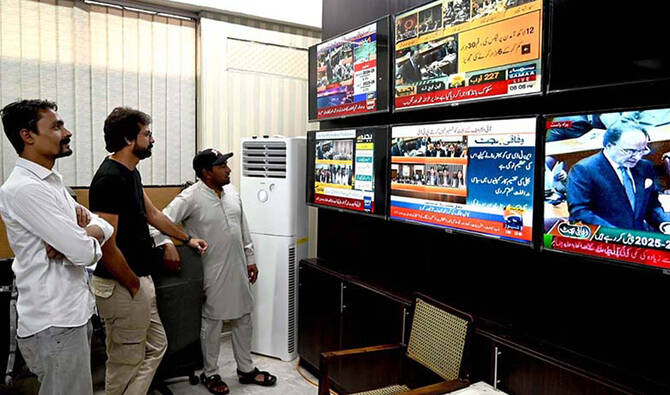
Corporate employees watching television screens as Pakistan Finance Minister Muhammad Aurangzeb presents Pakistan’s $62 billion federal budget for fiscal year 2025–26, in Islamabad on June 10, 2025. (APP)
Short Url
Updated 10 June 2025
Follow

Pakistan announces income tax relief for salaried class in FY2025-26 budget

  • Tax rate for those earning between $2,128–$4,255 annually to be cut from 5% to 2.5%
  • Pakistan’s tax-to-GDP ratio remains below 10%, among the lowest in the region

ISLAMABAD: Pakistan announced significant income tax relief for the salaried class on Tuesday as it announced its federal budget for the fiscal year 2025-26, aiming to ease the burden on working people amid high inflation and economic uncertainty.

Pakistan’s tax-to-GDP ratio remains below 10%, among the lowest in the region. The government has pledged to raise this ratio to 14% through tax reforms, digital enforcement, and expanding the tax base.

“First of all, we are providing relief where it is most needed, relief for the salaried class,” Finance Minister Muhammad Aurangzeb, presenting his first full-year budget in the National Assembly, said.

“In this regard, there is a proposition for a significant reduction in the income tax slabs for the working class.”

Aurangzeb said the income tax rate for individuals earning between Rs600,000 and Rs1.2 million ($2,128–$4,255) annually would be cut from 5% to 2.5%.

“For those earning up to Rs22,000,000 [$7,788], the tax rate has been proposed at 11% instead of 15%. Similarly, those who earn a higher salary, there is a proposition of tax reduction,” the finance minister said.

“For those who are earning between Rs22,000,000 [$7,788] up to Rs32,000,000 [$11,328], the tax rate has been proposed to be reduced from 25% to 23%.”

For high-income earners making over Rs10 million ($35,460) annually, a 1% reduction in the additional surcharge has been recommended to help curb the ongoing brain drain, the minister said.

Aurangzeb described the changes as part of broader efforts to simplify the tax structure and “strike a balance between inflationary pressures and take-home pay.”

The federal budget, with a total outlay of Rs17.57 trillion ($62 billion), comes as Pakistan seeks to stabilize its economy under a $7 billion International Monetary Fund (IMF) bailout program approved last year.

The budget also includes a 20% increase in defense spending, while total government expenditure is expected to be 7% lower year-on-year compared to the last fiscal, reflecting fiscal consolidation goals tied to IMF negotiations.

The proposed budget will be debated in parliament before final approval.


Pakistan says $50 million meat export deal with Tajikistan nearing finalization

Updated 09 December 2025
Follow

Pakistan says $50 million meat export deal with Tajikistan nearing finalization

  • Islamabad expects to finalize agreement soon after Dushanbe signals demand for 100,000 tons
  • Pakistan is seeking to expand agricultural trade beyond rice, citrus and mango exports

ISLAMABAD: Tajikistan has expressed interest in importing 100,000 tons of Pakistani meat worth more than $50 million, with both governments expected to finalize a supply agreement soon, Pakistan’s food security ministry said on Tuesday.

Pakistan is trying to grow agriculture-based exports as it seeks regional markets for livestock and food commodities, while Tajikistan, a landlocked Central Asian state, has been expanding food imports to support domestic demand. Pakistan currently exports rice, citrus and mangoes to Dushanbe, though volumes remain small compared to national production, according to official figures.

The development came during a meeting in Islamabad between Pakistan’s Federal Minister for National Food Security and Research Rana Tanveer Hussain and Ambassador of Tajikistan Yusuf Sharifzoda, where agricultural trade, livestock supply and food-security cooperation were discussed.

“Tajikistan intends to purchase 100,000 tons of meat from Pakistan, an import valued at over USD 50 million,” the ambassador said, according to the ministry’s statement, assuring full facilitation and that Islamabad was prepared to meet the demand.

The statement said the two sides agreed to expand cooperation in meat and livestock, fresh fruit, vegetables, staple crops, agricultural research, pest management and standards compliance. Pakistan also proposed strengthening coordination on phytosanitary rules and establishing pest-free production zones to support long-term exports.

Pakistan and Tajikistan have long maintained political ties but bilateral food trade remains below potential: Pakistan produces 1.8 million tons of mangoes annually but exported just 0.7 metric tons to Tajikistan in 2024, while rice exports amounted to only 240 metric tons in 2022 out of national output of 9.3 million tons. Pakistan imports mainly ginned cotton from Tajikistan.