

Pakistan partially rolls back solar policy, keeps old net-metering terms for pending applicants

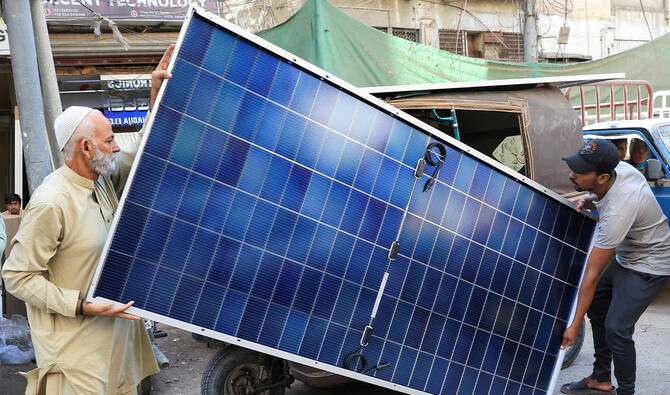
Men load solar panels on a rickshaw at a market in Karachi, Pakistan, on March 26, 2025. (REUTERS/File)
Short Url
Updated 19 February 2026
Follow

Pakistan partially rolls back solar policy, keeps old net-metering terms for pending applicants

  • Decision applies to applications submitted before Feb. 8, which will be processed under previous net-metering regulations
  • Move follows public backlash after Pakistan cut buyback rates for rooftop solar power under new billing framework

ISLAMABAD: Pakistan’s power minister has ordered electricity distribution companies to process all rooftop solar net-metering applications submitted before Feb. 8 under the previous, more favorable rules, according to a government statement released Thursday.

The decision comes after days of public criticism over new regulations that lowered the rate paid to solar users for surplus electricity, part of broader reforms aimed at easing financial pressure on loss-making power utilities.

The directive by Power Minister Sardar Awais Leghari applies nationwide, including the private utility K-Electric, and affects thousands of households and businesses awaiting approval to connect solar systems to the national grid.

“All electricity distribution companies, including K-Electric, will provide the net-metering facility for applications submitted up to February 8,” the ministry said in the statement, adding immediate implementation orders had been issued.

Authorities said 5,165 pending applications fall under the decision, adding about 250.822 megawatts of capacity to the national grid. The ministry said the move would remove uncertainty for consumers and directed companies to maintain transparency in processing requests.

Pakistan introduced grid-connected rooftop solar and net-metering in 2015 during a worsening power shortage, allowing consumers to sell excess electricity to the grid at the same tariff they paid utilities, a policy designed to encourage renewable adoption and reduce outages.

Over the past three years, soaring electricity prices and frequent blackouts triggered a rapid solar boom, with households and businesses installing panels to cut costs. Solar’s share of the energy mix rose sharply and tens of thousands of new connections were added annually.

Earlier this month, however, regulators replaced the net-metering regime with a net-billing framework separating purchase and sale prices, meaning consumers would receive a lower, market-linked rate for exported electricity while paying full tariffs for grid power.

Officials argued the change was necessary because widespread rooftop generation was reducing utility revenues and worsening the country’s circular debt crisis. Consumers and industry groups criticized the move, saying it undermined investment certainty.

The government has since moved to protect existing users and now pending applicants from the revised pricing mechanism, while new connections after the cutoff date will fall under the updated billing system.


IMF team expected in Islamabad today for loan reviews amid reform scrutiny

Updated 8 sec ago
Follow

IMF team expected in Islamabad today for loan reviews amid reform scrutiny

  • Talks to cover third review of $7 billion bailout and second climate resilience assessment
  • Analysts flag revenue shortfall and energy reforms as potential sticking points in negotiations

KARACHI: An International Monetary Fund (IMF) staff mission is expected to arrive in Islamabad today, Wednesday, to begin discussions on key program reviews that will determine Pakistan’s continued access to funding under its $7 billion bailout and a parallel climate resilience facility.

The visit, confirmed last week by IMF communications director Julie Kozack, will cover the third review under the Extended Fund Facility (EFF) and the second review under the Resilience and Sustainability Facility (RSF), which supports climate-vulnerable countries.

“We do have a staff team that is expected to visit Pakistan starting February 25th for discussions on the third review under the EFF and the second review under the RSF,” Kozack said at a regular press briefing last week.

The talks come at a sensitive moment for Islamabad, which has spent the past year implementing tax increases, subsidy rationalization and tight monetary policy to stabilize an economy that teetered on the brink of default in 2023.

IMF officials have credited those measures with producing measurable gains. Kozack said Pakistan’s policy efforts under the EFF had helped stabilize the economy and rebuild confidence, pointing to a primary fiscal surplus of 1.3 percent of GDP in the last fiscal year, contained inflation and the country’s first current account surplus in 14 years.

The review is expected to probe fiscal discipline and energy sector reforms, two areas that have historically complicated negotiations between Islamabad and the Fund.

Analysts told Arab News last week that while approval of the next tranche is likely, discussions might not be straightforward.

“This is expected to be a smooth sailing. However, questions might arise,” Shankar Talreja, head of research at Karachi-based Topline Securities Limited, said earlier.

He pointed to a revenue shortfall of Rs336 billion ($1.2 billion) against IMF targets and raised the possibility that the Fund may seek clarification over the government’s recent reduction in electricity tariffs for export-oriented industries, a move designed to support manufacturing but with fiscal implications.

A positive outcome of the review is vital for continued disbursements under the EFF and RSF programs. It will also be important to sustain investor confidence as the country seeks to consolidate its fragile economic recovery.

A successful staff-level review leads to a provisional agreement between the two sides, which then requires approval by the Fund’s Executive Board before the disbursement of the next tranche.