

More than 520 pilgrims with disabilities perform rituals under national initiative

1 / 2
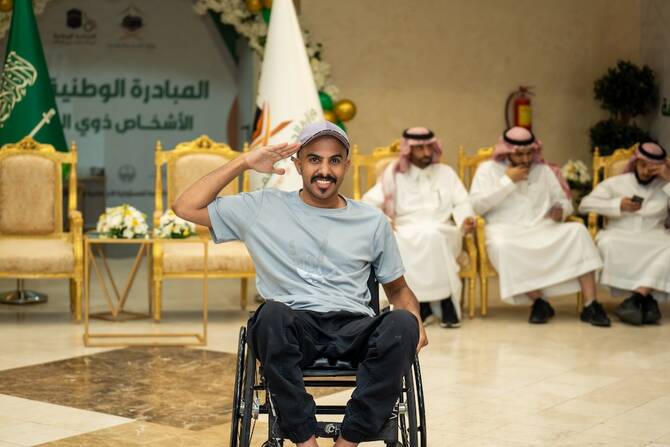
Abdulaziz Al-Enezi, a pilgrim with a mobility disability. (AN photo/Abdulrahman bin Shalhoub)
2 / 2
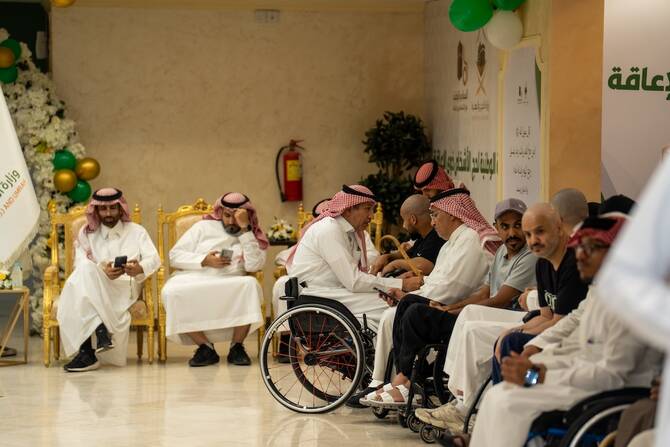
The National Hajj Initiative for Persons with Disabilities was designed to ensure that pilgrims with disabilities can perform Hajj with dignity and ease. (AN photo/Abdulrahman bin Shalhoub)
Short Url
Updated 07 June 2025
Follow

More than 520 pilgrims with disabilities perform rituals under national initiative

  • The National Hajj Initiative for Persons with Disabilities was designed to ensure that pilgrims with disabilities can perform Hajj with dignity and ease

MINA: Some 524 pilgrims with disabilities arrived earlier at the holy sites, embarking on their spiritual journey as part of a pioneering national initiative led by the Ministry of Hajj and Umrah, now in its fifth consecutive year.

The National Hajj Initiative for Persons with Disabilities was designed to ensure that pilgrims with disabilities can perform Hajj with dignity and ease. It provides a suite of tailored services, including accessible transportation, specialized accommodation and 24-hour escort support for those in need.

The initiative aligns with the Kingdom’s Vision 2030 reform plan, which prioritizes inclusivity and a higher quality of life for all citizens and residents. By expanding access and strengthening support for pilgrims with disabilities, the Kingdom is reaffirming its commitment to equitable participation in all aspects of life.

According to the General Authority for Statistics’ Disability Statistics Publication 2023, released in May 2024 and carried by the Saudi Press Agency, an estimated 1.8 percent of Saudi Arabia’s population lives with some form of disability. These include a range of physical, sensory and communication impairments of varying levels of severity.

Speaking to Arab News, Abdullah Abdulmohsin Al-Harbi, head of the social responsibility and volunteering department at the Ministry of Hajj and Umrah, said that the initiative now encompassed all 13 regions of the Kingdom.

“The initiative was originally conceived to empower persons with disabilities to visit all the holy sites and perform the Hajj pilgrimage with ease and dignity,” he said.

He said that the program welcomed men and women with disabilities from across the Kingdom, selected on defined criteria and classifications.

“We are proud to host pilgrims with various types of disabilities, including those who are visually impaired, have physical disabilities, or amputations. We have mobilized all necessary resources to support them, including a streamlined travel itinerary developed in collaboration with key entities such as Public Security, the Ministry of Health, and the Ministry of Human Resources and Social Development,” he added.

Al-Harbi said that the initiative had matured over the past five years, identifying the full spectrum of needs among persons with disabilities and developing appropriate support mechanisms, including comprehensive access solutions.

He added that the ministry hoped that the program could serve as a model for all services offered to pilgrims with disabilities.

Al-Harbi also emphasized the initiative’s profound impact on pilgrims, particularly the opportunity it gave them to fulfill the fifth pillar of Islam.

“The spiritual and emotional impact of performing Hajj has been deeply meaningful for them,” he said.

“With the support of the Kingdom’s wise leadership, all necessary resources and facilities have been mobilized to serve the Guests of Allah, regardless of their background. This valued segment of society has been provided with comprehensive services and supports to enable them to perform Hajj.”

Since its inception, the initiative has served nearly 2,000 beneficiaries of both genders, Al-Harbi added.

Among this year’s participants is Abdullah Saif Al-Qahtani, a pilgrim with a mobility disability, who said that his Hajj journey was smoother than he could have imagined.

“I registered and was admitted to the program. I have performed Hajj before, but this year’s organization was exceptionally excellent, and the stoning ritual was so easy,” he said, adding that every person he encountered was willing to help.

Abdulaziz Al-Enezi, another pilgrim with a similar disability, said that he learned about the initiative through a local disability society in Hafr Al-Batin, of which he is a member.

“I applied for the initiative, and they responded promptly. Their support was outstanding. I left Hafr Al-Batin on my own and didn’t need help from anyone. The initiative’s officials provided everything I needed, including medical and food support,” he said.

He said that he did not pay a single riyal for the Hajj. “I left my city with only my clothes and my wheelchair. So far, the services have been excellent. I would like to extend my sincere thanks to King Salman and Crown Prince Mohammed bin Salman,” he added.


Threat to Kingdom’s security is ‘red line’ that will be ‘addressed and neutralized,’ Saudi envoy says

Updated 14 January 2026
Follow

Threat to Kingdom’s security is ‘red line’ that will be ‘addressed and neutralized,’ Saudi envoy says

  • Abdulaziz Alwasil tells UN Security Council the situation in southern Yemen is ‘a just cause with social and historic dimensions’ that can only be resolved through dialogue
  • Recent military activity in the south was unilateral, resulting in an escalation that harms the interests of Yemeni people and undermines efforts to address issues in the south, he said

NEW YORK CITY: Any attempt to threaten Saudi Arabia’s national security is a “red line” and will be met with decisive action, the Kingdom’s ambassador to the UN told the Security Council on Wednesday.

Speaking during a meeting of the council to discuss Yemen, Abdulaziz Alwasil said the situation in the south of the country is “a just cause with social and historic dimensions” that can only be resolved through dialogue.

“We stress that any attempt to threaten our national security is a red line, and we will not hesitate to take the necessary actions and steps to address it and neutralize it,” he added.

Alwasil reaffirmed Saudi Arabia’s support for Yemeni President Rashad Al-Alimi, the Presidential Leadership Council, and the Yemeni government in their efforts to achieve security, stability, development and peace while preserving national unity.

He said military activity by Southern Transitional Council forces in Hadramout and Al-Mahra on Dec. 2, 2025, was unilateral, did not have the approval of the Presidential Leadership Council, and was not carried out in coordination with the Coalition to Restore Legitimacy in Yemen.

It had resulted in an unjustified escalation that harmed the interests of the Yemeni people, undermined efforts to address the issues in the south, and ran counter to the coalition’s objectives, Alwasil added.

The Kingdom, working with its coalition partners, the Presidential Leadership Council and the Yemeni government, had moved to contain the situation by dispatching a military force to coordinate arrangements with the Southern Transitional Council in Aden, he said.

The aim was to ensure the return of the southern council’s forces to their previous positions outside of Hadramout and Al-Mahra, and the handover of camps to legitimate government forces and local authorities in line with agreed procedures, Alwasil added.

He expressed regret over the military operations that took place in Hadramout and Al-Mahra, close to Saudi Arabia’s southern border, which he said posed a direct threat to the Kingdom’s national security, as well as the security of Yemen and regional stability. Such steps were extremely dangerous, he added, and contradicted the principles on which the Coalition to Restore Legitimacy in Yemen had been founded.

Alwasil welcomed a prisoner and detainee exchange agreement signed in Muscat on Dec. 23, which he described as an important humanitarian measure to alleviate suffering and build confidence.

He praised Oman for hosting and sponsoring the consultations and supporting negotiations, and commended the efforts of UN’s special envoy for Yemen, Hans Grundberg, the International Committee of the Red Cross and all others that has played a part.

Regarding the political efforts to resolve the crisis, Alwasil said Saudi Arabia welcomed President Al-Alimi’s call for an inclusive conference in Riyadh to bring together all stakeholders to discuss just solutions to the situation in southern Yemen.

Preparations for the conference have begun, he added, in cooperation with the Yemeni government and southern representatives, reflecting the close ties between the two countries and their shared interests in stabilizing Yemen.

He urged all southern stakeholders to participate actively and constructively in the talks, to help find comprehensive and just solutions that meet the legitimate aspirations of the people of southern Yemen.

Alwasil called on all Yemeni forces and stakeholders to cooperate and intensify their efforts to reach a lasting political settlement that would ensure security and stability.

He described the southern issue as “a just cause with social and historic dimensions,” adding that “the only way to address it is through dialogue that leads to a comprehensive political solution” based on nationally and internationally agreed terms of reference.