

Trump says Greenland will ‘work out’ after Denmark fails to bridge gap

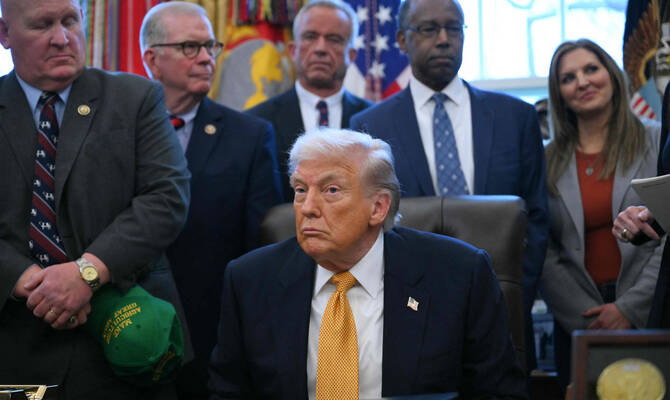
US President Donald Trump looks on before signing a bill in the Oval Office of the White House in Washington, DC, on January 14, 2026. (AFP)
Short Url
Updated 15 January 2026
Follow

Trump says Greenland will ‘work out’ after Denmark fails to bridge gap

  • Trump has appeared emboldened on Greenland — which he views as in the US backyard — since ordering a deadly January 3 attack in Venezuela that removed president Nicolas Maduro

WASHINGTON, United States: US President Donald Trump held open the possibility Wednesday for a resolution on his designs over Greenland after Denmark’s top diplomat said he failed to change the administration’s mind on wanting to conquer the island.
The foreign ministers of Denmark and Greenland, an autonomous territory under Copenhagen’s sovereignty, met at the White House with Vice President JD Vance and Secretary of State Marco Rubio in a meeting the visitors had requested to clear up “misunderstandings” after Trump’s bellicose language toward the fellow NATO member.
Trump, speaking after the meeting which he did not attend, for the first time sounded conciliatory on Greenland, acknowledging Denmark’s interests even if he again said he was not ruling out any options.
“I have a very good relationship with Denmark, and we’ll see how it all works out. I think something will work out,” Trump said without explaining further.
He again said Denmark was powerless if Russia or China wanted to occupy Greenland, but added: “There’s everything we can do.”
Danish Foreign Minister Lars Lokke Rasmussen, speaking after leaving the White House, said a US takeover of Greenland was “absolutely not necessary.”
“We didn’t manage to change the American position. It’s clear that the president has this wish of conquering over Greenland,” Lokke told reporters.
“We therefore still have a fundamental disagreement, but we also agree to disagree.”
He said the issue was “very emotional” for the people of Greenland and Denmark, a steadfast US ally whose troops died alongside Americans in Afghanistan and, controversially, Iraq.
“Ideas that would not respect territorial integrity of the Kingdom of Denmark and the right of self-determination of the Greenlandic people are, of course, totally unacceptable,” Lokke said.
He nonetheless said the tone was “constructive” and said the sides would form a committee that would meet within weeks to see if there was possible headway.
Referring to the British prime minister who trumpeted his diplomacy with Hitler, Lokke said, “I am not a Chamberlain to say “Peace for our time,” but we must seize the opportunities that present themselves.”

Mocking tone

While the talks were underway, the White House posted on X: “Which way, Greenland man?“
The post included a drawing of two dogsleds — one heading toward the White House and a huge US flag, and the other toward Chinese and Russian flags over a lightning-bathed Kremlin and Great Wall of China.
Neither country has claimed Greenland, and Lokke said no Chinese ship had been spotted there in a decade and that there were no major Chinese investments.
Denmark promised ahead of the meeting to ramp up its military presence further in the vast, sparsely populated and strategically located island.
Trump has derided recent Danish efforts to increase security for Greenland as amounting to “two dogsleds.” Denmark says it has invested almost $14 billion in Arctic security.
Denmark also announced immediate military exercises that will include aircraft, vessels and soldiers, with Sweden also participating.
In another show of solidarity with Denmark following Trump’s threats, Germany and France both said Wednesday they will send troops to Greenland. German’s defense ministry said it would send a 13-person team.

Signs of relief

On the quiet streets of the capital Nuuk, red and white Greenlandic flags flew in shop windows, on apartment balconies, and on cars and buses, in a show of national unity during the talks.
Ivaana Egede Larsen, 43, said she felt relief that the meeting appeared to be cordial.
“I am more calm now, and I feel more safe. I had felt very much unsafe lately,” she said.
In Copenhagen, Thomas Fallesen, 56, voiced similar sentiments.
“They are now at least talking together instead of talking through the press. I think it’s a very positive thing,” he said.
Vance, who slammed Denmark as a “bad ally” during an uninvited visit to Greenland last year, is known for a hard edge, which was on display when he publicly berated Ukrainian President Volodymyr Zelensky in the Oval Office last February.
Wednesday’s meeting, however, was closed to the press, meaning there was no on-camera confrontation.
Trump has appeared emboldened on Greenland — which he views as in the US backyard — since ordering a deadly January 3 attack in Venezuela that removed president Nicolas Maduro.


Bangladesh votes in world’s first Gen Z-inspired election

Updated 51 min 24 sec ago
Follow

Bangladesh votes in world’s first Gen Z-inspired election

  • Ousted PM Hasina’s Awami League party banned
  • BNP, Jamaat in close race with big economic, geopolitical stakes

DHAKA: For years under former Prime Minister Sheikh Hasina, Bangladesh’s opposition had little presence on the streets during elections, either boycotting polls or being sidelined by mass arrests of senior leaders. ​Now, ahead of Thursday’s vote, the roles have reversed.
Hasina’s Awami League is banned, but many young people who helped oust her government in a 2024 uprising say the upcoming vote will be the Muslim-majority nation’s first competitive election since 2009, when she began a 15-year-rule.
The Bangladesh Nationalist Party (BNP) is widely expected to win, although a coalition led by the Islamist Jamaat-e-Islami is putting up a strong challenge. A new party driven by Gen-Z activists under the age of 30 has aligned with Jamaat after failing to translate its anti-Hasina street mobilization into an electoral base.
BNP chief Tarique Rahman told Reuters his party, which is contesting 292 of the 300 parliamentary seats at stake, was confident of winning “enough to form a government.”

Bangladesh Nationalist Party (BNP) chairman Tarique Rahman speaks during an election campaign rally, ahead of the national election at Pallabi, in Dhaka, Bangladesh, on February 8, 2026. (Reuters)

Analysts say a decisive result in the February 12 vote, instead of a fractured outcome, is vital for restoring ‌stability in the nation of ‌175 million after Hasina’s ouster triggered months of unrest and disrupted major industries, including ‌the garments ⁠sector ​in the ‌world’s second-largest exporter.
The verdict will also affect the roles of rival regional heavyweights China and India in the South Asian nation.
“Opinion polls suggest the BNP has an edge, but we must remember that a significant portion of voters are still undecided,” said Parvez Karim Abbasi, executive director at Dhaka’s Center for Governance Studies.
“Several factors will shape the outcome, including how Generation Z — which makes up about a quarter of the electorate — votes, as their choices will carry considerable weight.”
Across Bangladesh, black-and-white posters and banners bearing the BNP’s “sheaf of paddy” symbol and Jamaat’s “scales” hang from poles and trees and are pasted on roadside walls, alongside those of several independent candidates. Party shacks on street corners, draped in their emblems, blare campaign songs.
It marks a sharp ⁠contrast with past elections, when the Awami League’s “boat” symbol dominated the landscape.
Opinion polls expect the once-banned Jamaat, which had opposed Bangladesh’s India-backed 1971 independence from Pakistan, to have its best electoral ‌performance even if it does not win.

China’s influence increases as India’s wanes
The election verdict ‍will also influence the roles of China and India in Bangladesh ‍in coming years, analysts have said. Beijing has increased its standing in Bangladesh since Hasina was seen as pro-India and fled to ‍New Delhi after her ouster, where she remains.
While New Delhi’s influence is on the wane, the BNP is seen by some analysts as being relatively more in tune with India than the Jamaat.
A Jamaat-led government might tilt closer to Pakistan, a fellow Muslim-majority nation and a long-standing rival of Hindu-majority India, analysts say. Also, Jamaat’s Gen-Z ally has said “New Delhi’s hegemony” in Bangladesh is one of its main concerns and its leaders met Chinese diplomats recently.
Jamaat, which calls ​for a society governed by Islamic principles, has said the party is not inclined toward any country.
BNP’s Rahman has said if his party formed the government it would have friendly relations with any nation that “offers what is suitable for ⁠my people and my country.”
Bangladesh, one of the world’s most densely populated countries with high rates of extreme poverty, has been hit by high inflation, weakening reserves and slowing investment, which has pushed it to seek large-scale external financing since 2022, including billions of dollars from the International Monetary Fund and the World Bank.

Bangladesh Nationalist Party (BNP) chairman Tarique Rahman attends an election campaign rally, ahead of the national election at Pallabi, in Dhaka 

Corruption is the biggest concern among the 128 million voters, followed by inflation, according to a survey by Dhaka-based think tanks Communication & Research Foundation and Bangladesh Election and Public Opinion Studies.
Analysts say Jamaat’s clean image is a factor in its favor, much more than its Islamic leanings.
“Voters report high intention to participate, prioritize corruption and economic concerns over religious or symbolic issues, and express clear expectations for leaders who demonstrate care, competence and accountability,” said the survey.
Nevertheless, BNP’s Rahman, son of former Prime Minister Khaleda Zia, is seen as the frontrunner to lead the next government. But if the Jamaat-led coalition emerges ahead, its chair, Shafiqur Rahman, could be in line for the top job.
Mohammad Rakib, 21, who is set to vote for the first time, said he hoped the next government would allow people to express their views and exercise their franchise freely.
“Everyone ‌was tired of (Hasina’s) Awami League. People couldn’t even vote during national elections. People had no voice,” he said. “I hope the next government, whoever comes into power, will ensure this freedom of expression.”